

- expertise:
- CFD Trading, Forex, Derivatives, Risk Management
- credentials:
- Chartered ACII (2018) · Trading since 2012
- tested:
- 40+ forex & CFD platforms with live accounts

- expertise:
- Platform Testing, Cryptocurrency, Retail Investing
- credentials:
- Active investor since 2013 · 11+ years experience
- tested:
- 50+ platforms · 200+ guides authored
How We Test
Real accounts. Real money. Real trades. No demo accounts or press releases.
What we measure:
- Spreads vs advertised rates
- Execution speed and slippage
- Hidden fees (overnight, withdrawal, conversion)
- Actual withdrawal times
Scoring:
Fees (25%) · Platform (20%) · Assets (15%) · Mobile (15%) · Tools (10%) · Support (10%) · Regulation (5%)
Regulatory checks:
FCA Register verification · FSCS protection
Testing team:
Adam Woodhead (investing since 2013), Thomas Drury (Chartered ACII, 2018), Dom Farnell (investing since 2013) — 50+ platforms with funded accounts
Quarterly reviews · Corrections: in**@*******************co.uk
Disclaimer
Not financial advice. Educational content only. We're not FCA authorised. Consult a qualified advisor before investing.
Capital at risk. Investments can fall. Past performance doesn't guarantee future results.
CFD warning. 67-84% of retail accounts lose money trading CFDs. High risk due to leverage.
Contact: in**@*******************co.uk
Quick Answer: Should You Choose Pepperstone or Trading 212?
Pepperstone (FCA FRN 684312) and Trading 212 (FCA FRN 609146) serve fundamentally different purposes. This is not a case of picking the “better” broker — it is about matching the right tool to what you actually want to do with your money.
Choose Pepperstone if: You want to actively trade using spread betting (tax-free in the UK), CFDs, and professional-grade platforms like MT4, MT5, cTrader, or TradingView.
Choose Trading 212 if: You want to invest for the long term using a free Stocks and Shares ISA, buy fractional shares from as little as £1, and build a portfolio without paying commissions.
| Feature | Pepperstone (FCA 684312) | Trading 212 (FCA 609146) |
|---|---|---|
| Primary purpose | Active trading (spread betting + CFDs) | Passive investing (ISA + fractional shares) |
| Spread betting | Yes | No (discontinued November 2020) |
| Stocks and Shares ISA | No | Yes (free) |
| EUR/USD spread | From 0.1 pips (Razor) / 1.1 pips (Standard) | 1.1–1.5 pips (CFD) |
| Trading platforms | MT4, MT5, cTrader, TradingView, proprietary app | Proprietary platform only |
| Total markets | 2,700+ (all leveraged) | 12,000+ (Invest/ISA); fewer for CFDs |
| FSCS protection | Up to £85,000 | Up to £85,000 |
| Algo trading / API | Yes (via MT4/MT5/cTrader) | No |
I’d point most readers toward Pepperstone for active trading and spread betting, and toward Trading 212 for passive investing and ISA-based portfolios. They barely overlap.
Pepperstone vs Trading 212 — At a Glance

Pepperstone
- TIC Score
- 4.7/5
- EUR/USD Spread
- From 0.1 pips
- Spread Betting
- Yes (tax-free)
- Best For
- Active Trading
73.6% of retail CFD accounts lose money.

Trading 212
- TIC Score
- 4.5/5
- EUR/USD Spread
- 1.1–1.5 pips
- Stocks & Shares ISA
- Yes (free)
- Best For
- Passive Investing
Sponsored link. Terms apply.
Which Broker Should You Choose Based on Your Needs?
| If You Want… | Choose | Why |
|---|---|---|
| UK spread betting (tax-free profits) | Pepperstone | Trading 212 discontinued spread betting in November 2020. Pepperstone is the only UK broker offering MT5, cTrader, and TradingView for spread betting. |
| A free Stocks and Shares ISA | Trading 212 | Pepperstone does not offer ISAs or real share ownership. Trading 212’s ISA has zero platform fees and zero commissions. |
| Fractional share investing from £1 | Trading 212 | Not available on Pepperstone. Trading 212 offers 12,000+ stocks and ETFs with fractional access. |
| Tight forex spreads for active trading | Pepperstone | Pepperstone’s Razor account delivers EUR/USD from 0.1 pips. Trading 212’s CFD spreads start around 1.1 pips. |
| MetaTrader 4 or MetaTrader 5 | Pepperstone | Trading 212 does not support MT4 or MT5. |
| cTrader | Pepperstone | Not available on Trading 212. |
| TradingView integration (native) | Pepperstone | Trading 212 uses TradingView-powered charts but not the full TradingView platform with broker connectivity. |
| Algorithmic / automated trading | Pepperstone | Trading 212 has no API, no EAs, no cBots, no algo capability. |
| Passive, hands-off portfolio building | Trading 212 | AutoInvest pies, fractional shares, and zero fees make Trading 212 purpose-built for this. |
| Low-cost commodity CFDs | Pepperstone | Gold from 0.15 points on Razor vs 0.25+ on Trading 212. 40+ commodities vs 28–45 on Trading 212. |
How Do Pepperstone and Trading 212 Compare on Regulation and Safety?
Both brokers are authorised and regulated by the Financial Conduct Authority (FCA), which means they must comply with client money segregation rules, provide negative balance protection for retail clients, and contribute to the Financial Services Compensation Scheme (FSCS).
Pepperstone (FCA FRN 684312) — Pepperstone Limited is the UK entity, registered at 70 Gracechurch Street, London EC3V 0HR. The parent company was founded in Melbourne in 2010 and holds licences across multiple jurisdictions including ASIC, CySEC, BaFin, CMA, and DFSA. Client funds are held in segregated accounts at tier-one UK banks. Read our full Pepperstone review for a broader assessment.
Trading 212 (FCA FRN 609146) — Trading 212 UK Ltd is authorised and regulated by the FCA with its head office in London. The parent group was founded in 2004. Invest/ISA shares are held in nominee accounts in the client’s name.
Both brokers meet the same FCA regulatory standard. I would not have material safety concerns with either. For a UK client, the practical protections — FSCS cover up to £85,000, segregated accounts, negative balance protection — are identical.
How Do Pepperstone and Trading 212 Compare on Fees?
This is where the comparison becomes interesting, because these brokers charge for entirely different things.
What Does Pepperstone Cost?
| Cost Element | Standard Account | Razor Account | Spread Betting Account |
|---|---|---|---|
| EUR/USD spread | From 1.1 pips | From 0.1 pips | Competitive (spread-only) |
| GBP/USD spread | From 1.2 pips | From 0.2 pips | Competitive (spread-only) |
| Gold spread | From 0.15 points | From 0.15 points | From 0.15 points |
| Commission | None | From £2.25/lot/side | None |
| Overnight financing | Yes (variable) | Yes (variable) | Yes on spot; No on forwards |
| Inactivity fee | None | None | None |
When I tested EUR/USD on Pepperstone’s Razor account during a London session, I consistently saw spreads between 0.1 and 0.3 pips, which is genuinely competitive. The spread betting account is the standout for UK residents — spreads on major forex pairs typically ran 0.6–1.4 pips with no separate commission, and any profits are free from capital gains tax and stamp duty under current UK tax law.
What Does Trading 212 Cost?
| Cost Element | Invest Account | Stocks and Shares ISA | CFD Account |
|---|---|---|---|
| Trading commission | Zero | Zero | Zero |
| Platform fee | Zero | Zero | Zero |
| FX conversion fee | 0.15% | 0.15% | 0.50% (on P&L) |
| EUR/USD spread (CFD) | N/A | N/A | 1.1–1.5 pips |
| Stamp duty (UK shares) | 0.5% | 0.5% | N/A |
| Deposit fee (card above £2,000) | 0.7% | 0.7% | 0.7% |
| Inactivity fee | None | None | None |
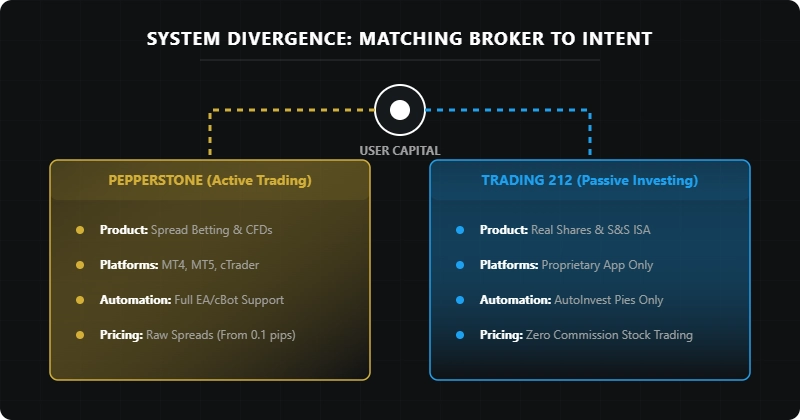
The zero-commission structure is genuinely free for investing. There is no hidden platform fee, no custody charge, and no annual account fee. However, I would not recommend Trading 212 for active CFD trading — the spreads are wider than specialist brokers, and the 0.50% FX fee on CFD profit/loss is an additional drag. For those considering other low-cost investment apps in the UK, Trading 212 remains highly competitive.
Fee comparison verdict: For trading, Pepperstone wins decisively with institutional-grade Razor pricing and tax-efficient spread betting. For investing, Trading 212 wins equally decisively with zero commissions and a 0.15% FX fee.
How Do the Platforms and Tools Compare?
What Platforms Does Pepperstone Offer?
Pepperstone offers more platform choice than almost any other UK broker. This includes MetaTrader 4 (the industry-standard for forex with Expert Advisors), MetaTrader 5 (upgraded with depth of market and improved backtesting — see our best MT5 broker for spread betting guide), cTrader (a modern alternative with native cAlgo for algorithmic trading), TradingView (full native integration for order execution directly from charts), and a proprietary mobile app.
What sets Pepperstone apart is that all these platforms are available for spread betting, not just CFDs. Most UK brokers offering spread betting lock traders into a proprietary platform. When I tested Pepperstone’s TradingView integration, I placed a spread bet on GBP/USD directly from a TradingView chart with my analysis tools already applied. The execution was immediate.
What Platforms Does Trading 212 Offer?
Trading 212 offers a single proprietary platform with a clean, intuitive interface featuring TradingView-powered charts (but not the full TradingView platform). Features include AutoInvest Pies for percentage-based portfolio allocations with automatic recurring investments, fractional shares from £1, and community/social features.
What Trading 212 does not offer: MT4, MT5, cTrader, API access, algorithmic trading, Expert Advisors, cBots, advanced order types, or programmable indicators. There is no depth of market, no VWAP orders, no bracket orders. If you’re considering Trading 212 alternatives for active trading, Pepperstone is at the top of the list.
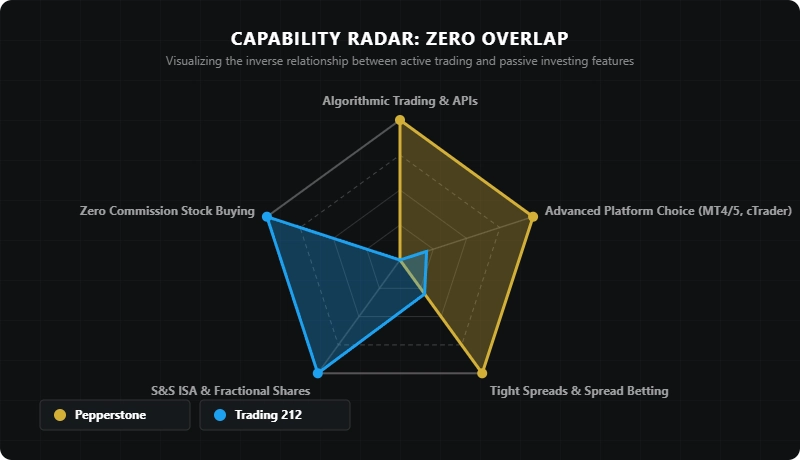
Platform verdict: These are not comparable. Pepperstone is for traders who need professional tools. Trading 212 is for investors who need simplicity. If platform capability matters, Pepperstone is in a different league.
How Do the Markets and Asset Ranges Compare?
Pepperstone offers 2,700+ markets, all accessible via leveraged products (spread bets and CFDs): 60+ forex pairs, 20+ global indices, 40+ commodities, 1,000+ global share CFDs, select ETF CFDs, and 30+ crypto CFDs. All markets are tradeable via spread betting for UK clients. There is no ability to buy and own the underlying asset. For the best forex broker UK options beyond this comparison, see our dedicated guide.
Trading 212 offers 12,000+ instruments across its accounts. The Invest and ISA accounts provide real ownership of 10,000+ shares from 15+ exchanges, 2,000+ ETFs, and fractional shares from £1. The CFD account offers 150+ forex pairs, major indices, 28–45 commodities, 3,000+ share CFDs, and select crypto CFDs.
Markets verdict: For real share ownership and passive investing, Trading 212 offers far more instruments (12,000+ vs zero — Pepperstone has no investing capability). For leveraged trading, Pepperstone offers tighter spreads and better execution on a focused selection of 2,700+ markets. If you want to own shares, only Trading 212 can do that. If you want to spread bet, only Pepperstone can do that.
What Account Types Does Each Broker Offer?
Pepperstone Account Types
| Account | Description | Key Features |
|---|---|---|
| Standard | CFD trading with spreads built in | No commission; EUR/USD from 1.1 pips; all platforms |
| Razor | CFD trading with raw spreads + commission | EUR/USD from 0.1 pips; £2.25/lot/side; best for high-volume |
| Spread Betting | UK-exclusive tax-free trading | No commission; competitive spreads; profits exempt from CGT |
| Demo | Practice account | £50,000 virtual funds; available on all platforms |
Trading 212 Account Types
| Account | Description | Key Features |
|---|---|---|
| Invest | Real share ownership | Zero commission; fractional shares from £1; 12,000+ instruments |
| Stocks and Shares ISA | Tax-free investing wrapper | Same as Invest; £20,000 annual ISA allowance; tax-free gains |
| Cash ISA | Tax-free cash savings | Competitive AER; flexible withdrawals |
| CFD | Leveraged trading | Zero commission; wider spreads; 150+ forex pairs; £10 minimum |
| Demo | Practice account | Virtual funds; available for all account types |
Account type verdict: Pepperstone’s three accounts are variations on the same theme: leveraged trading with different cost structures. Trading 212’s accounts serve genuinely different purposes. For anyone who wants both trading and investing, Trading 212 offers more account flexibility — though its CFD offering is weaker than Pepperstone’s.
Which Has the Better Mobile Experience?
Pepperstone’s proprietary mobile app provides account management, one-tap trading, price alerts, and basic charting. In addition, traders can use the MT4, MT5, and cTrader mobile apps connected to their Pepperstone accounts — giving mobile traders access to EAs, advanced orders, and deeper charting. The real mobile power comes from the third-party apps.
Trading 212’s mobile app is widely considered one of the best trading platforms in the UK for investing. Clean interface, portfolio performance tracking, AutoInvest pie management, fractional share purchasing, and community features. It consistently receives 4.5+ star ratings on iOS and Android.
When I tested both apps side by side, Trading 212 felt more polished for portfolio management, while Pepperstone (via cTrader mobile) felt more capable for active trading. Each excels at what it was designed for.
How Does Customer Support Compare?
Pepperstone offers live chat available 24/5 (Monday–Friday), email support typically responding within a few hours, UK toll-free phone support, and a UK office at 70 Gracechurch Street, London. When I tested their live chat with a question about overnight financing on a spread bet, I received a detailed, accurate response within three minutes.
Trading 212 takes a digital-first approach with live chat via the app and website, email through the help centre, and an extensive self-service knowledge base. Phone support is not prominently offered. When I contacted them about FX fees on a US ETF purchase, I received a helpful reply in approximately 10 minutes.
Support verdict: Pepperstone offers broader support channels and faster response times, particularly for complex trading queries. Trading 212’s support is adequate for straightforward investing questions but lacks the phone accessibility and 24/5 availability that active traders may need.
Who Should Use Pepperstone?
Good for: UK spread bettors who want tax-free trading on a wide range of markets with professional platforms. Active forex and CFD traders seeking raw spreads from 0.1 pips on the Razor account. Algorithmic traders who need MT4 EAs, MT5 advisors, or cTrader cBots. TradingView users who want to execute trades directly from their charts, including spread bets. Scalpers and day traders who need tight spreads and fast execution.
Not for: Investors who want to buy and own real shares. Anyone looking for a Stocks and Shares ISA or Cash ISA. Beginners who want to start investing with £1. Passive investors looking for automatic portfolio rebalancing. Anyone who does not want leveraged products.
73.6% of retail investor accounts lose money when trading CFDs with this provider. You should consider whether you can afford to take the high risk of losing your money.
Who Should Use Trading 212?
Good for: ISA investors who want a zero-fee Stocks and Shares ISA with 12,000+ instruments. Beginner investors who want a simple, clean app to start investing from £1. Passive investors who want AutoInvest pies and automatic recurring investments. Fractional share buyers who want to build a diversified portfolio without large capital. Cost-conscious investors who want zero commissions and only a 0.15% FX fee on non-GBP assets.
Not for: Active forex or CFD traders who need tight spreads and professional tools. Spread bettors (Trading 212 no longer offers spread betting). Algorithmic or automated traders (no API, no EAs, no cBots). Traders who want MT4, MT5, cTrader, or full TradingView integration. Anyone who needs advanced order types, depth of market, or multi-chart layouts.
Trading and investing involve risk. The value of your investments can go up or down, and you may lose all or part of your capital. These products may not be suitable for all investors. Please ensure you fully understand the risks involved. Sponsored link. To get free fractional shares worth up to 100 EUR/GBP, you can open an account with Trading 212 through this link . Terms apply
Final Verdict
After testing both platforms extensively, my view is straightforward: Pepperstone and Trading 212 are not really competitors. They serve different financial needs, and the right choice depends entirely on what you want to do.
For active trading: Pepperstone is the clear winner. It offers spread betting (tax-free for UK residents), raw spreads from 0.1 pips, and the widest platform choice in the UK market — including being the only broker where you can spread bet from MT5, cTrader, and TradingView. If you are a trader, Pepperstone is the stronger platform by a significant margin.
For investing: Trading 212 is the clear winner. A genuinely free ISA, fractional shares from £1, zero commissions, and a well-designed app make it one of the best low-cost investing platforms in the UK.
Can you use both? Absolutely, and many people do. There is nothing stopping you from using Pepperstone for active spread betting while using Trading 212 for your ISA and long-term investments. In fact, that combination covers almost every UK financial need.
I would not choose one over the other without first being clear about what you need. A trader using Trading 212’s CFD account is overpaying for an inferior platform. An investor trying to build a share portfolio on Pepperstone cannot do so at all. Match the broker to the task. For related comparisons, see our eToro vs Trading 212 guide. For beginners wanting to practise first, see our best trading demo accounts guide.
Discuss Pepperstone vs Trading 212
Used Pepperstone, Trading 212, or both? Share which broker worked for you, ask questions, or help others pick the right platform. Our community earns Equity for quality contributions.
Discussion 0 comments
Be the first to start discussing this topic! Log in or create an account to share your thoughts.
Log In Create AccountFAQs
References
- FCA Register — Pepperstone Limited (FRN 684312)
- Pepperstone UK — About Us
- FSCS — Check your money is protected
- FCA Register — Trading 212 UK Ltd (FRN 609146)
- Trading 212 — How is my money protected?
- HMRC — Spread betting and CFDs (BIM22015)
- Pepperstone UK — Trading Platforms
- Trading 212 — Invest and ISA Fees
- Pepperstone UK — Pricing
- Trading 212 — CFD Fees
73.6% of retail investor accounts lose money when trading spread bets and CFDs with this provider.
No comments yet. Be the first to start discussing this topic!