

- expertise:
- CFD Trading, Forex, Derivatives, Risk Management
- credentials:
- Chartered ACII (2018) · Trading since 2012
- tested:
- 40+ forex & CFD platforms with live accounts

- expertise:
- Broker Comparison, ISA Strategy, Portfolio Management
- credentials:
- Active investor since 2013 · 11+ years experience
- tested:
- 40+ brokers with funded accounts
How We Test
Real accounts. Real money. Real trades. No demo accounts or press releases.
What we measure:
- Spreads vs advertised rates
- Execution speed and slippage
- Hidden fees (overnight, withdrawal, conversion)
- Actual withdrawal times
Scoring:
Fees (25%) · Platform (20%) · Assets (15%) · Mobile (15%) · Tools (10%) · Support (10%) · Regulation (5%)
Regulatory checks:
FCA Register verification · FSCS protection
Testing team:
Adam Woodhead (investing since 2013), Thomas Drury (Chartered ACII, 2018), Dom Farnell (investing since 2013) — 50+ platforms with funded accounts
Quarterly reviews · Corrections: info@theinvestorscentre.co.uk
Disclaimer
Not financial advice. Educational content only. We're not FCA authorised. Consult a qualified advisor before investing.
Capital at risk. Investments can fall. Past performance doesn't guarantee future results.
CFD warning. 67-84% of retail accounts lose money trading CFDs. High risk due to leverage.
Contact: info@theinvestorscentre.co.uk
Picking a trading platform when you've never traded before feels like choosing a bank in a foreign country. The logos all look professional, the marketing all says "zero commission," and every comparison guide recommends roughly the same handful of names. The reality is more complicated than that.
The Best Trading Platforms for Beginners at a Glance
I've deposited real money into each of the platforms covered here, placed real trades, timed the onboarding from start to first execution, and measured the actual costs — not just the advertised ones. Some platforms that market themselves to beginners are genuinely excellent. A few are so complicated or so poorly regulated that they'll cost you money before you've placed a single trade. This guide covers both: who I'd recommend, and who I'd actively steer you away from.
If you're past the beginner stage and want the full ranked platform comparison, that's here.
| Platform | Best For | Min Deposit | Cost: £250 UK Share | Cost: £250 US Share | ISA | Demo | Trustpilot |
|---|---|---|---|---|---|---|---|
| Capital.com | Learning CFD trading | £20 | CFDs only (spread) | CFDs only (no FX fee) | No — CFD only | Yes (unlimited) | 4.6 / 5 (13,841) |
| IG | All-round market leader | £0 | £3 (share dealing) | $0 (spread bet) / £3 (share) | Yes | Yes (£10k virtual) | 3.9 |
| Spreadex | Spread betting specialist | £0 | Spread only | Spread only | No — spread betting | Yes | 4.3 |
| eToro | Copy trading & multi-asset | $50 (~£40) | £0 (spread applies) | £0 (1.5–3.0% FX fee) | Yes (eToro Money) | Yes ($100k virtual) | 4.2 / 5 (30,459) |
FCA FRNs — Capital.com: 793714 · IG: 195355 · Spreadex: 190941 · eToro: 583263. All fees verified February 2026.
What the Numbers Really Mean
The table tells a clear story. Capital.com leads our beginner rankings for its intuitive risk management tools and clean mobile interface, though it is CFD-only — you cannot buy and own real shares on this platform. Every position is a contract for difference, which means you are speculating on price movements rather than building a portfolio. That is not inherently wrong, but a beginner needs to understand the distinction before depositing. IG offers the broadest market access of any UK broker, with share dealing, spread betting, and CFDs all under one roof, and its educational resources are among the strongest available.
Spreadex is a specialist spread betting platform with tight spreads and a straightforward interface that suits beginners who want exposure to markets without the complexity of share ownership. eToro's CopyTrader feature remains genuinely useful for beginners who want to learn by observing experienced investors, though the FX conversion fee ranges from 1.5% to 3.0% depending on the currency pair — not the flat 0.5% you will see quoted in most comparison articles. All four platforms are FCA-regulated and offer meaningful protections for UK traders.

62% of Retail CFD Accounts Lose Money

68% of retail CFD accounts lose money.
65% of retail CFD accounts lose money.

50% of retail CFD accounts lose money when trading CFDs with this provider.
Why Did These Four Make the Cut?
Capital.com — Best Mobile App for Learning to Trade CFDs
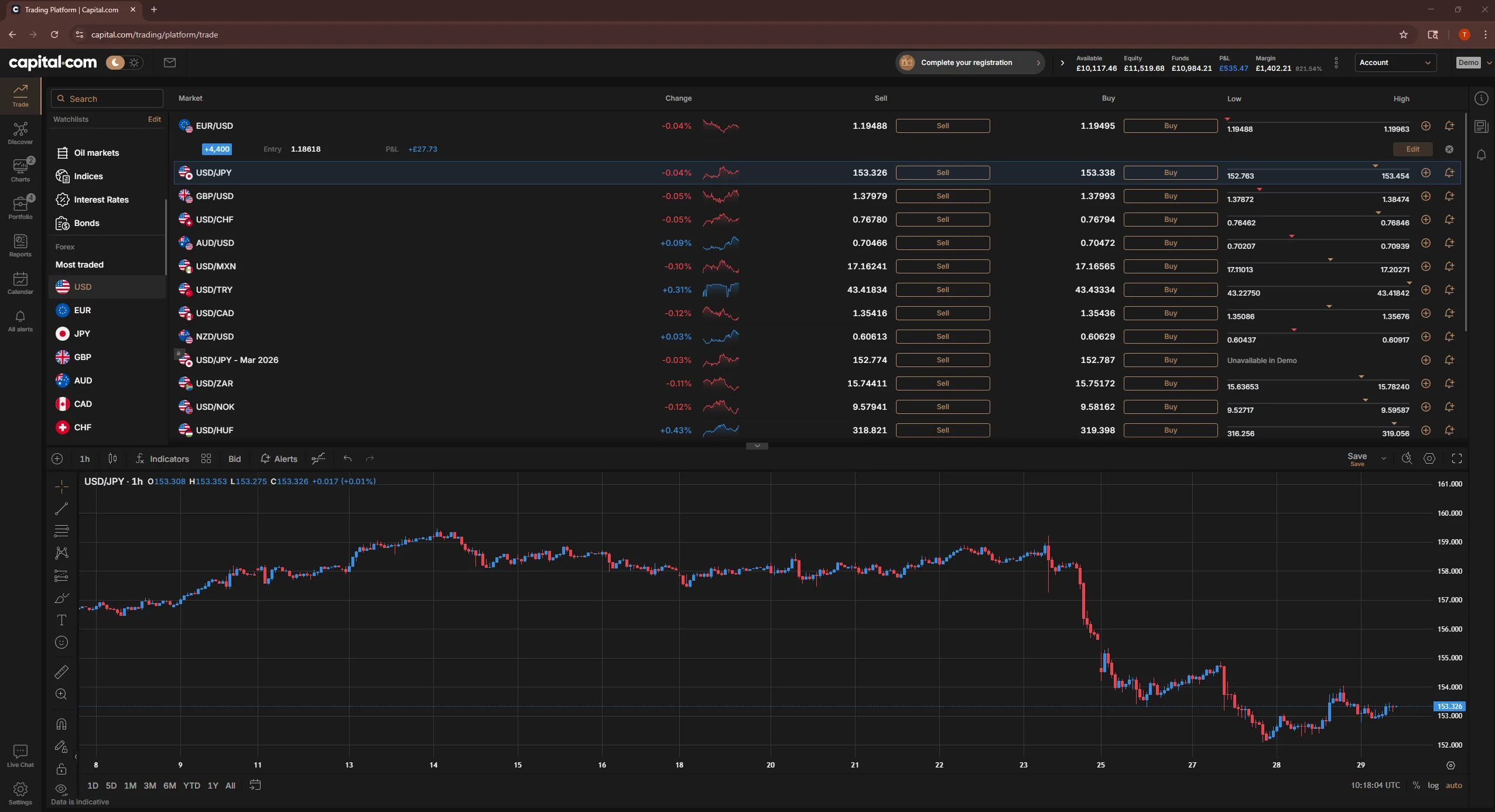
Capital.com's mobile app is the best trading interface I've tested for someone learning how CFDs work. The design is clean without being patronising — it surfaces helpful insights about your trading behaviour and flags when you're about to take on unusual risk.
Pros
- Best mobile interface for learning CFD trading
- Built-in insights flag risky behaviour
- No FX conversion fee
- First demo trade in under 90 seconds
Cons
- CFD and spread betting only — no real share ownership
- 62% of retail accounts lose money
- No ISA available
- Not suitable for long-term portfolio building
The critical caveat
This is a CFD and spread betting platform only. You cannot buy and own real shares. Every position is leveraged by default (though you can set leverage to 1x on certain instruments), and 62% of retail investor accounts lose money when trading CFDs with Capital.com. That's their own figure, prominently displayed. If you're interested in learning to trade — as in actively speculating on price movements — rather than investing for the long term, Capital.com offers the best mobile experience. But it's the wrong choice entirely if you want to build a portfolio.
| Metric | Value |
|---|---|
| Best for | Learning CFD and forex trading |
| Minimum deposit | £20 |
| UK share cost | CFDs only (spread) |
| US share cost | CFDs only (no FX fee) |
| FCA FRN | 793714 |
| Trustpilot | 4.6/5 (13,841 reviews) |
IG — The All-Round Market Leader
IG is the UK's largest trading platform and one of the most established brokers in the world. For a beginner, the breadth of offering is the standout feature — share dealing, spread betting, CFDs, and options all under one roof, with educational content integrated throughout the platform.
Pros
- UK's largest broker — established and deeply trusted
- Share dealing, spread betting, CFDs, and options in one account
- IG Academy provides structured beginner education
- Demo account with £10,000 virtual funds
Cons
- Share dealing charges £3 per trade (not zero commission)
- Platform can feel dense for complete beginners
- 68% of retail accounts lose money on spread bets and CFDs
Why IG works for beginners
IG Academy is one of the best structured educational programmes available on any UK broker. It walks you through the fundamentals of trading, risk management, and market analysis in a logical sequence rather than a scattered collection of articles. The demo account gives you £10,000 of virtual funds to practise with before risking real money. Share dealing is available at £3 per trade, which is competitive though not zero-commission — but you get access to the full London Stock Exchange and international markets in return.
What are the downsides?
The platform can feel dense for a complete beginner — there are a lot of options and the interface reflects IG's heritage as a professional-grade tool. Share dealing carries a £3 per trade charge, which is more than Trading 212 or eToro's zero-commission model for shares. And 68% of retail investor accounts lose money when trading spread bets and CFDs with IG, which is above the industry average. For beginners who want comprehensive market access and strong education, though, IG remains a top choice.
| Metric | Value |
|---|---|
| Best for | All-round market access with strong education |
| Minimum deposit | £0 |
| UK share cost | £3 per trade |
| US share cost | $0 (spread bet) / £3 (share dealing) |
| FCA FRN | 195355 |
| Trustpilot | 3.9 |
Spreadex — Specialist Spread Betting Made Simple
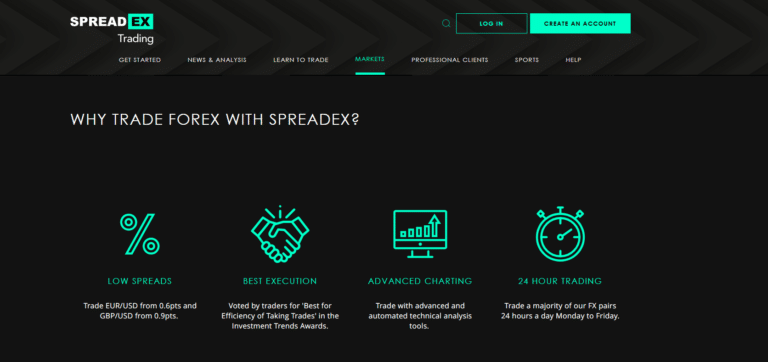
Spreadex is a specialist spread betting platform that combines tight spreads with a straightforward interface. For a beginner interested in spread betting rather than share ownership, it offers one of the simplest entry points in the UK market, backed by full FCA regulation.
Pros
- Tight spreads on forex and indices
- Simple, user-friendly platform interface
- FCA regulated with strong client protections
- Tax-free spread betting profits for UK traders
Cons
- Spread betting only — no real share ownership
- No ISA available
- Smaller range of markets than IG
- 68% of retail accounts lose money
Why Spreadex for beginners
Spreadex keeps things simple. The platform focuses on spread betting, which means profits are tax-free for UK traders — a genuine advantage for beginners who want to keep things straightforward. The spreads are competitive, particularly on forex and major indices, and the interface avoids the clutter that makes some professional platforms intimidating for new users. FCA regulation (FRN 190941) provides the same client fund protections you would expect from any established UK broker.
| Metric | Value |
|---|---|
| Best for | Spread betting with tight spreads |
| Minimum deposit | £0 |
| Trading cost | Spread only |
| Tax on profits | Tax-free (spread betting) |
| FCA FRN | 190941 |
| Trustpilot | 4.3 |
eToro — The One That Lets You Learn by Watching
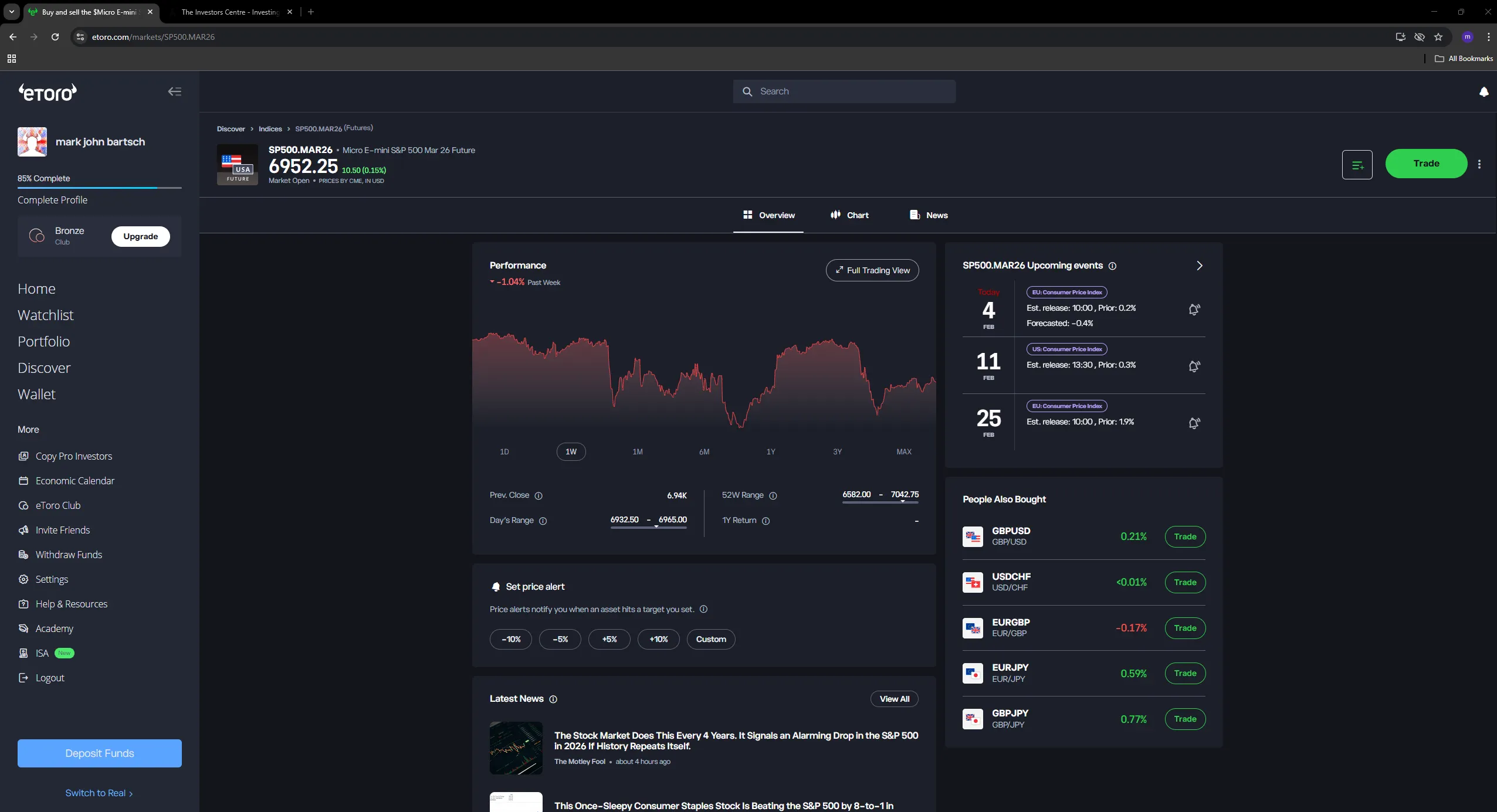
eToro's CopyTrader feature is the single most useful tool I've found for a complete beginner who wants to invest but doesn't know where to start. You pick a trader whose strategy and risk profile you like, allocate a portion of your capital, and your account automatically mirrors their trades in real time.
Pros
- CopyTrader lets you learn by watching experienced investors
- Social feed shows what the community is trading and why
- Near-instant verification — first trade in ~14 minutes
- $100k virtual demo account included
Cons
- FX conversion fee 1.5–3.0% (not flat 0.5% as often quoted)
- $5 withdrawal fee on every withdrawal
- $10/month inactivity fee after 12 months
- ISA requires separate eToro Money sign-up
Why eToro works for beginners
It's not a gimmick — it's a structured way to learn by observing what experienced investors actually do with real money, rather than reading theory. The social feed adds context: you can see what the community is trading, why, and whether sentiment is shifting before you commit. I went from downloading the app to copying my first trader in about 14 minutes — verification was near-instant using photo ID, though eToro warns it can take up to 24 hours during busy periods.
What are the downsides?
The downsides are real and worth flagging. eToro's FX conversion fee is not the flat 0.5% you'll see quoted in most comparison articles — it varies from 1.5% to 3.0% depending on the currency pair, which adds up quickly on US trades. There's a $5 fee on every withdrawal, which I confirmed when I moved funds back to my bank. The ISA is offered through eToro Money, which is a separate FCA-regulated entity (FRN 900923), not through the main trading platform — it requires a separate sign-up process. And if you stop using the account, a $10/month inactivity fee kicks in after 12 months. Despite those caveats, for a beginner who wants multi-asset access and a built-in way to learn, it remains a strong starting point.
| Metric | Value |
|---|---|
| Best for | Learning by copying experienced traders |
| Minimum deposit | $50 (~£40) |
| UK share cost | £0 (spread applies) |
| US share cost | £0 (1.5–3.0% FX fee) |
| FCA FRN | 583263 |
| Trustpilot | 4.2/5 (30,459 reviews) |
Which Platforms Should Beginners Avoid?
Not every platform that appears in Google ads or gets recommended on Reddit is suitable for a first-time trader. Some are built for professionals and will overwhelm you. Others operate in regulatory grey areas that put your money at genuine risk. I've tested all three of the platforms below, and while each has a legitimate audience, none of them should be your first.
Interactive Brokers — Avoid for beginners
I rate Interactive Brokers highly in my main platform rankings — for experienced traders, it's exceptional. For beginners, it's a different story entirely. The Trader Workstation interface looks and feels like a Bloomberg terminal: powerful, dense, and completely unintuitive if you don't already know what you're looking for. When I logged into Trader Workstation for this review, I counted 63 menu items on the main dashboard before giving up trying to find a simple "buy shares" button. The fee structure offers both "fixed" and "tiered" pricing models, and even after years of testing brokers, I had to read the documentation twice to work out which model would cost me less on a £250 UK share purchase.
The ISA carries a £3/month minimum commission charge — which means if you're a buy-and-hold beginner who trades infrequently, you're paying £36/year just for the privilege of having an account that Trading 212 and eToro offer for free. The Broker account requires a $10,000 upfront deposit (applied against commissions over 8 months). And the support data speaks for itself: a Trustpilot rating of 3.6/5 — the lowest of any platform in this article — with only 55% of negative reviews receiving a reply, typically taking over a month. If you don't know the difference between a limit order and a market order yet, this platform will punish you for it.
Admiral Markets — Avoid for beginners
Admiral Markets (now branded as Admirals) has a similar problem to Interactive Brokers — complexity — but without the depth of markets to justify it. The platform is built around MetaTrader 4 and MetaTrader 5, which are powerful professional tools but present a steep learning curve for someone placing their first trade. When I went through the onboarding, the first decision I was asked to make was choosing between two account types — Trade (commission-free, wider spreads) and Zero ($3/lot, tighter spreads). That's a decision no beginner should need to make on day one, and the platform gives you almost no guidance on which to pick.
The FCA register entry for Admiral Markets UK (FRN 595450) includes an unusual note: "Some activities by this firm may not be protected." That's a flag worth paying attention to. App engagement in the UK is vanishingly low — the iOS App Store shows between 2 and 79 ratings depending on the app version, compared to 336,000 for Trading 212. The minimum deposit ranges from £100 to £250 depending on your account type. For a new trader, there is simply no reason to choose Admiral Markets over Capital.com or Trading 212 — you get access to the same asset classes with a fraction of the friction.
MEXC — Avoid entirely (not FCA regulated)
MEXC is not authorised or regulated by the FCA. The FCA added MEXC to its Warning List on 22 March 2024 as an unauthorised firm targeting UK consumers. That means no FSCS protection (your first £85,000 of eligible deposits is not covered), no access to the Financial Ombudsman Service, and no regulatory recourse if something goes wrong with your funds.
There is no direct GBP fiat deposit option — you cannot deposit pounds into your account, which forces you through additional conversion steps and fees before you've even placed a trade. When I tested the sign-up flow from a UK IP address in February 2026, the platform accepted my registration without any warning that it lacks FCA authorisation — no disclaimer, no pop-up, no redirect. It markets aggressively to UK users despite having no UK regulatory standing. The Trustpilot rating tells the real story: 1.6/5, rated "Bad" from 1,269 reviews. The contrast with the iOS App Store rating (4.7/5 globally) is itself instructive — app store ratings capture ease of download and first impressions, not what happens when you try to withdraw money or resolve a dispute. For a beginner interested in crypto, Bitpanda offers FCA-registered access to the same major cryptocurrencies without the regulatory risk.
How Do Beginner Fees Actually Compare?
| Platform | Our View | UK Shares | US Shares | FX Fee | Inactivity | Withdrawal |
|---|---|---|---|---|---|---|
| Capital.com | Recommended | CFDs only | CFDs only | Free | None listed | Free |
| IG | Recommended | £3 | $0 (spread bet) / £3 (share) | 0.5% | None | Free |
| Spreadex | Recommended | Spread only | Spread only | N/A | None | Free |
| eToro | Recommended | £0 | £0 | 1.5–3.0% | $10/mo (12mo) | $5 |
| Interactive Brokers | Avoid for beginners | £3 (fixed) / tiered | $0.005/share (tiered) | Variable | None | 1 free/mo, then $10 |
| Admiral Markets | Avoid for beginners | £0 (Trade) / $3/lot (Zero) | £0 (Trade) / $3/lot (Zero) | 0.3% | Verify | 1 free/mo |
| MEXC | Avoid entirely | N/A | N/A | No GBP fiat | None | Network fees |
All fees verified against platform fee pages, February 2026. Admiral Markets inactivity fee not listed publicly — requires direct verification.
The pattern is clear. The beginner-friendly platforms have simpler, more predictable fee structures. Capital.com and Spreadex are both transparent — I can calculate the cost of any trade in seconds. IG charges £3 per share deal, which is straightforward even if it's not zero. eToro's FX conversion adds a layer of complexity that catches many new users off guard, and the real rate is significantly higher than what most comparison sites report. Interactive Brokers' dual pricing model (fixed vs. tiered) genuinely requires a spreadsheet to compare properly — I've been doing this for years and I still have to check.
At the other end of the spectrum, MEXC doesn't even support direct GBP deposits, which means you're paying conversion costs before you've entered the platform — and doing so without any FCA regulatory protection. A new trader shouldn't need to study a fee schedule to work out what a trade costs. If the pricing isn't immediately obvious, that's a signal the platform wasn't designed with you in mind.
What Actually Makes a Platform "Beginner-Friendly"?
There's an important difference between a platform that's simple and one that's been dumbed down. Capital.com simplifies the CFD trading interface without removing the tools you'll eventually need — it guides you without limiting you. Trading 212 gives you access to real shares and ETFs through a clean interface that doesn't assume you know what a stop-loss order is. eToro gamifies the experience, which is a double-edged sword: the social feed and copy trading are powerful learning tools, but the app's design can encourage over-trading in beginners who find it hard to distinguish between investing and entertainment.
Demo accounts are worth using, but with realistic expectations. The psychological difference between trading £10,000 of virtual money and £200 of real money is enormous. In a demo, you'll take risks you'd never take with your own capital, and you'll feel nothing when a position goes against you. I've watched my own behaviour change between demo and live — the strategies that feel bold and clever on paper become genuinely stressful with real money on the line. Use a demo to learn the interface and mechanics, not to develop a strategy you'll then deploy at the same sizing with real capital.
Educational resources vary wildly. Capital.com integrates learning into the trading workflow. Trading 212 has a community-driven knowledge base. eToro's Academy covers the basics well. What matters more than volume of content is structure — a beginner needs a clear path from "what is a share" to "how do I build a portfolio," not 300 scattered blog posts. And regulation is non-negotiable. If a platform isn't authorised by the FCA, you have no protection under the FSCS (up to £85,000 for eligible deposits) and no access to the Financial Ombudsman. That's not a nice-to-have — it's the minimum baseline.
What Are the Mistakes New Traders Make in Their First 90 Days?
The most common mistake is using leverage before understanding it. If you're depositing your first £200 into a CFD account with 30:1 leverage because someone on TikTok told you to trade forex, you are going to lose that money. Leverage amplifies losses exactly as much as it amplifies gains, and the FCA's data consistently shows that the majority of retail CFD accounts are unprofitable. Start with 1:1 exposure until you genuinely understand what you're risking. If CFDs are the route you want to take, our guide to the best CFD trading platforms for beginners ranks the safest options for new traders.
Not using a Stocks & Shares ISA when one is available is the second most expensive error. If you're buying real shares on Trading 212 or eToro and not doing it inside an ISA, you're volunteering to pay capital gains tax on profits above the £3,000 annual allowance. The ISA is free on Trading 212 and available through eToro Money. There is no reason not to use one.
By the time you see a stock being discussed on Reddit or TikTok, the early move has already happened. You're not getting in early — you're providing exit liquidity for someone who did.
Treating a demo account the same as real money is a fantasy that every beginner indulges and every experienced trader has abandoned. The emotions are completely different. Your demo strategy will not survive contact with real losses. Depositing more than you can afford because the app makes it frictionless is closely related — when adding £500 is as easy as tapping a button, the psychological weight of that money evaporates. Set a budget before you open the account, not after.
And finally, chasing volatile meme stocks or crypto tokens because they're trending on social media is the fastest way to learn a very expensive lesson. By the time a ticker is being shared on Reddit or TikTok, the early move has already happened. You're not getting in early — you're providing exit liquidity for someone who did.
Our Verdict — Where Should a Beginner Actually Start?
If your interest is specifically in learning to trade CFDs or forex and you want the best mobile experience, Capital.com offers the most intuitive interface — just understand that you'll never own the underlying asset. If you want the broadest market access with strong education and a trusted name, IG is the all-round market leader. If spread betting appeals and you want tight spreads with a simple platform, Spreadex is a strong specialist choice with tax-free profits. And if you want to learn by watching experienced traders with multi-asset access from a single account, eToro's CopyTrader feature is genuinely valuable, though be mindful of the FX conversion costs.
Whatever you do, don't start with a platform built for professionals or one that isn't regulated in the UK. The learning curve will cost you money, or the lack of protection will cost you sleep. Neither is a good outcome for someone placing their first trade.
For the full scored rankings across all experience levels, see my main best trading platforms guide.
FAQs
References
- FCA Register — eToro (UK) Ltd, FRN 583263 – FCA Register
- FCA Register — eToro Money UK Ltd, FRN 900923 – FCA Register
- FCA Register — Trading 212 UK Limited, FRN 609146 – FCA Register
- FCA Register — Capital Com (UK) Limited, FRN 793714 – FCA Register
- FCA Register — Bitpanda Broker UK Ltd, FRN 925234 – FCA Register
- FCA Register — Interactive Brokers (U.K.) Limited, FRN 208159 – FCA Register
- FCA Register — Admiral Markets UK Ltd, FRN 595450 – FCA Register
- FCA Warning List — MEXC, added 22 March 2024 – FCA Unauthorised Firms
- Financial Services Compensation Scheme — Protection Limits – FSCS
- eToro Fees & Charges – eToro
- Trading 212 Trading Terms – Trading 212
- Capital.com Fees & Charges – Capital.com
- Bitpanda Fees – Bitpanda
- Interactive Brokers Pricing – IBKR