

- expertise:
- Platform Testing, Cryptocurrency, Retail Investing
- credentials:
- Active investor since 2013 · 11+ years experience
- tested:
- 50+ platforms · 200+ guides authored

- expertise:
- CFD Trading, Forex, Derivatives, Risk Management
- credentials:
- Chartered ACII (2018) · Trading since 2012
- tested:
- 40+ forex & CFD platforms with live accounts
How We Test
Real accounts. Real money. Real trades. No demo accounts or press releases.
What we measure:
- Spreads vs advertised rates
- Execution speed and slippage
- Hidden fees (overnight, withdrawal, conversion)
- Actual withdrawal times
Scoring:
Fees (25%) · Platform (20%) · Assets (15%) · Mobile (15%) · Tools (10%) · Support (10%) · Regulation (5%)
Regulatory checks:
FCA Register verification · FSCS protection
Testing team:
Adam Woodhead (investing since 2013), Thomas Drury (Chartered ACII, 2018), Dom Farnell (investing since 2013) — 50+ platforms with funded accounts
Quarterly reviews · Corrections: in**@*******************co.uk
Disclaimer
Not financial advice. Educational content only. We're not FCA authorised. Consult a qualified advisor before investing.
Capital at risk. Investments can fall. Past performance doesn't guarantee future results.
CFD warning. 67-84% of retail accounts lose money trading CFDs. High risk due to leverage.
Contact: in**@*******************co.uk
How to Buy SpaceX Shares
UK investors have two routes. Apply through a participating broker like eToro before the 21:00 BST deadline on 10 June 2026 for a chance of an allocation at the $135 offer price, or wait and buy SPCX on the open market once it starts trading on the Nasdaq on 12 June. Open-market access is the simpler route.
Key Findings
- Ticker: SPCX, listing on the Nasdaq from 12 June 2026.
- Fixed offer price: $135 per share, targeting a ~$1.75 trillion valuation.
- UK retail route: FCA-regulated brokers including eToro, Hargreaves Lansdown and IG, via Marex Financial.
- Minimum IPO order on eToro: $750, which showed as £588.33 in our own account.
- Index inclusion: Nasdaq-100 likely within weeks, S&P 500 not until profitability (earliest mid-2027).
When can you buy SpaceX shares, and what is the ticker?
SpaceX trades on the Nasdaq from Friday 12 June 2026 under the ticker SPCX. The IPO is priced the evening before, after the US market closes on 11 June, at a fixed price of $135 per share.
Until now, access has been limited to staff, early backers and institutional investors. From 12 June, anyone with a UK broker that offers US shares can buy SPCX the same way they would buy Apple or Tesla.
SpaceX IPO at a glance
| Detail | Confirmed information |
|---|---|
| Company | Space Exploration Technologies Corp. (SpaceX) |
| Ticker | SPCX |
| Exchange | Nasdaq |
| Offer price | $135 per share (fixed) |
| Target valuation | Around $1.75 trillion |
| Amount raised | Around $75 billion |
| Shares offered | 555.55 million Class A shares, roughly 3% of the company |
| Pricing date | 11 June 2026, after the US close |
| First day of trading | 12 June 2026 |
These figures come from SpaceX’s pricing filing. They are firm but can still change right up to the moment the shares are priced.
Two ways UK investors can buy SpaceX
There are two separate routes, and they are not the same thing. The first is applying for shares in the IPO itself, before the company lists. The second is buying the shares on the open market once trading begins.
Which one suits you comes down to timing, and to how much certainty you want over the price you pay.
Applying for shares in the IPO (the UK Retail Offer)
A small group of UK brokers were given access to a UK Retail Offer. This let everyday investors apply for SpaceX shares at the offer price before the stock lists, arranged through Marex Financial as the offer platform and reaching UK investors through FCA-authorised brokers including eToro, Hargreaves Lansdown and IG.
The catch is timing. Application windows close at 21:00 BST on Wednesday 10 June 2026, so depending on when you read this the IPO application route may already be shut.
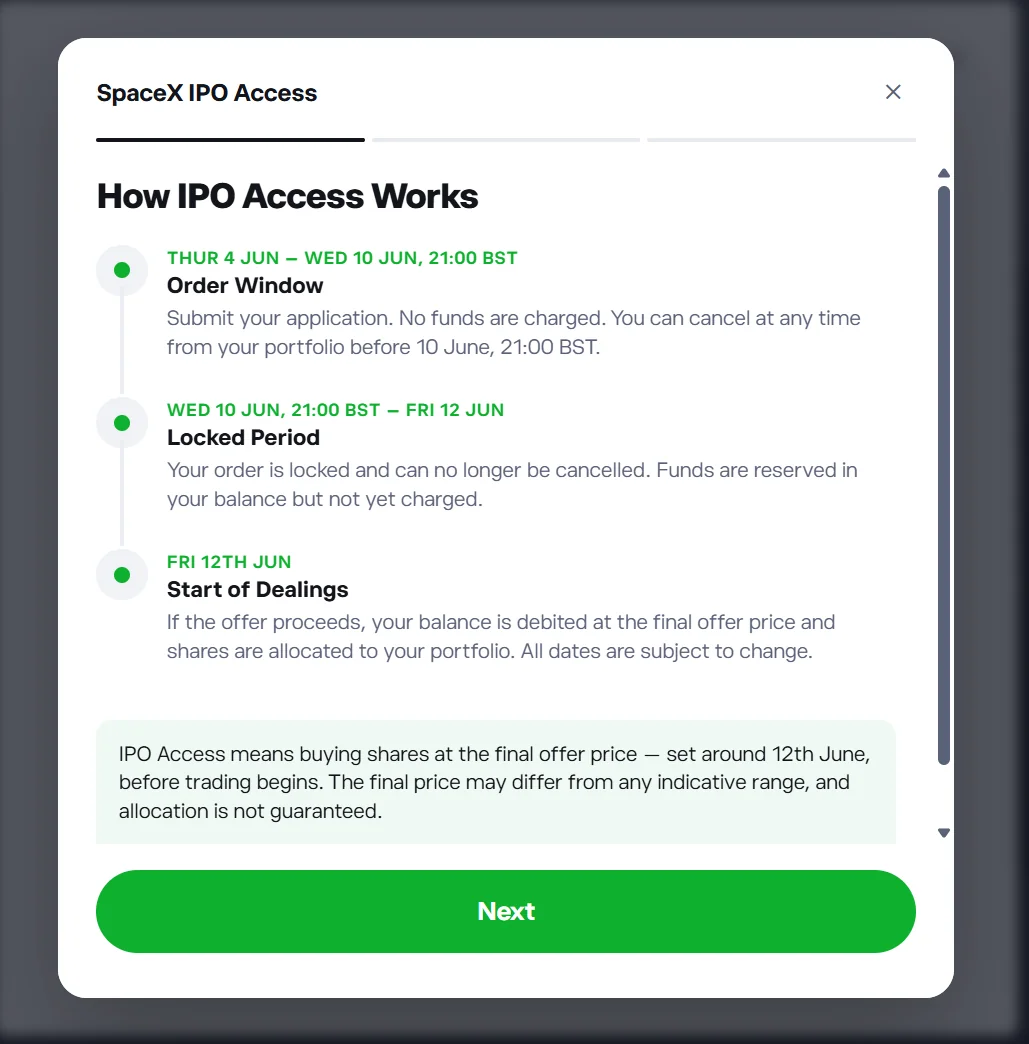
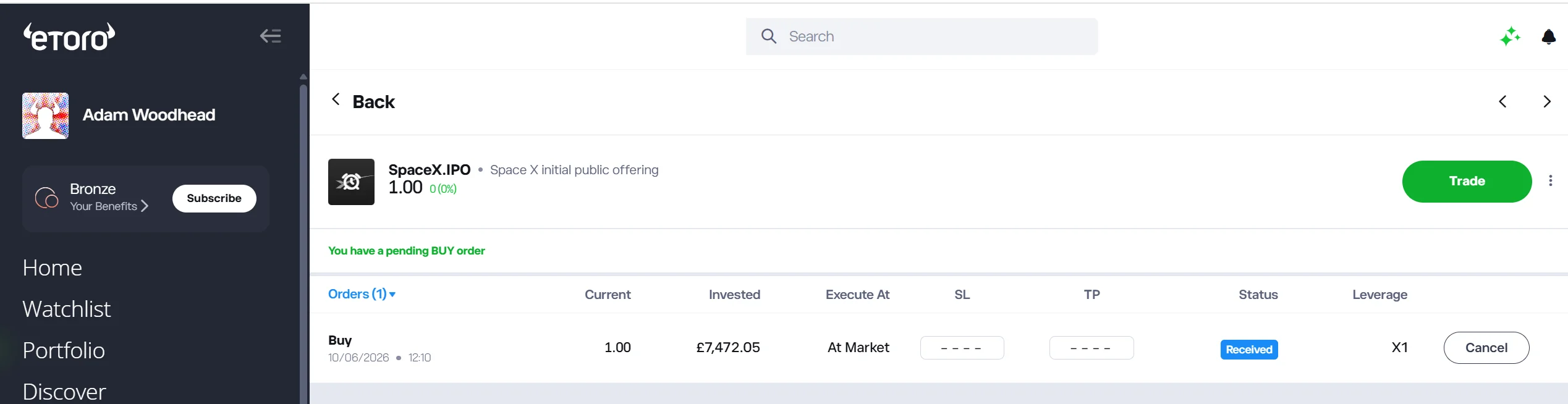
The route works in three stages. You submit an application during the order window with no money charged, your order then locks and your funds are reserved, and if the offer proceeds your balance is debited at the final price on 12 June.
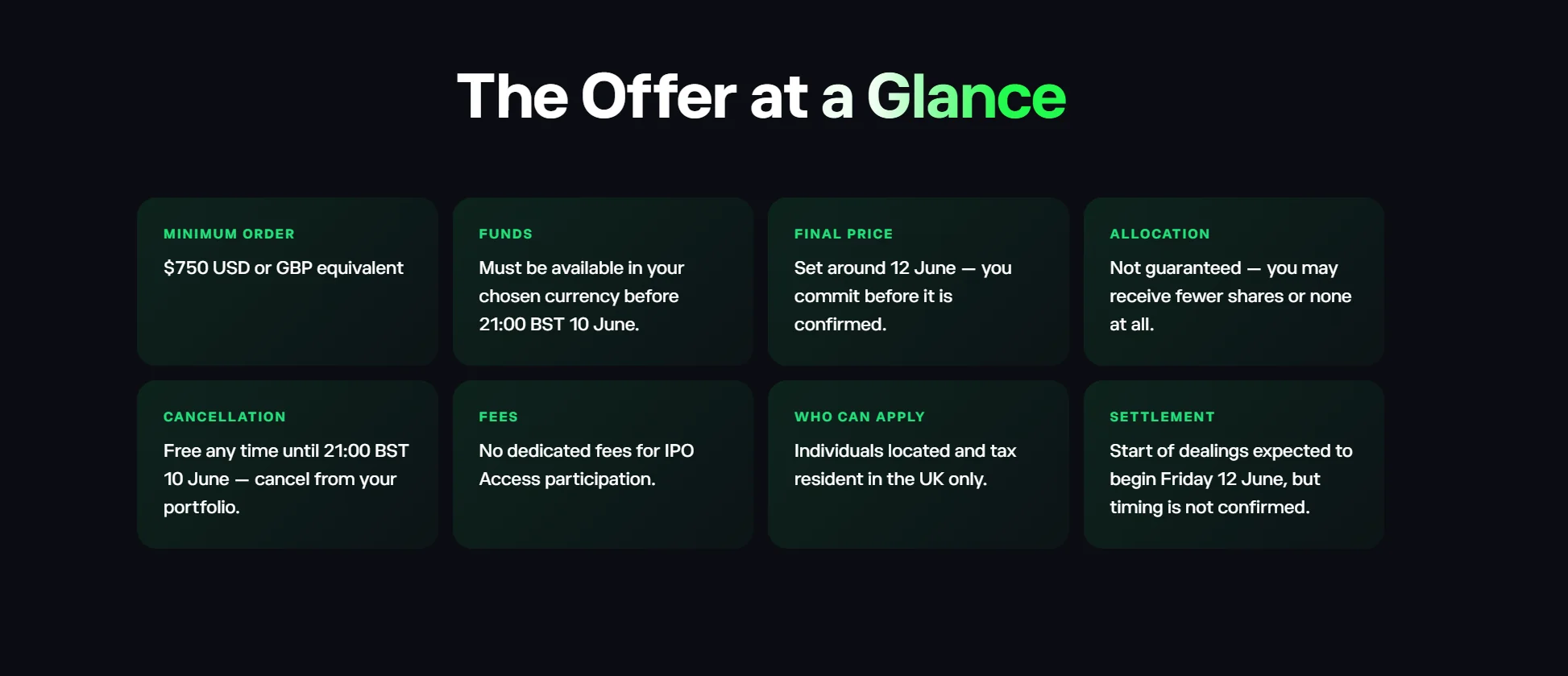
A few things are worth knowing before you apply. The minimum order is $750, or the pound equivalent, the final price is only confirmed around 12 June so you commit before you know it, and allocation is never guaranteed.
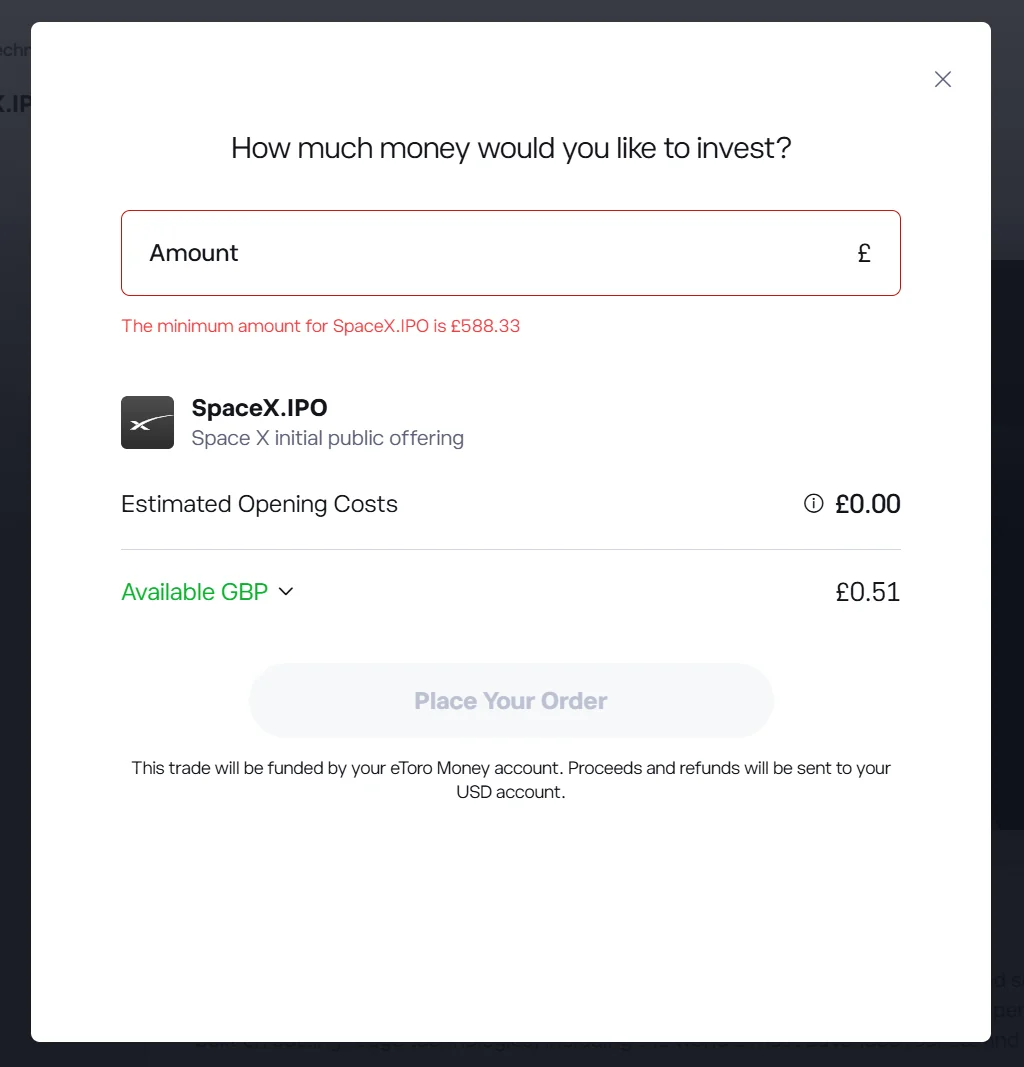
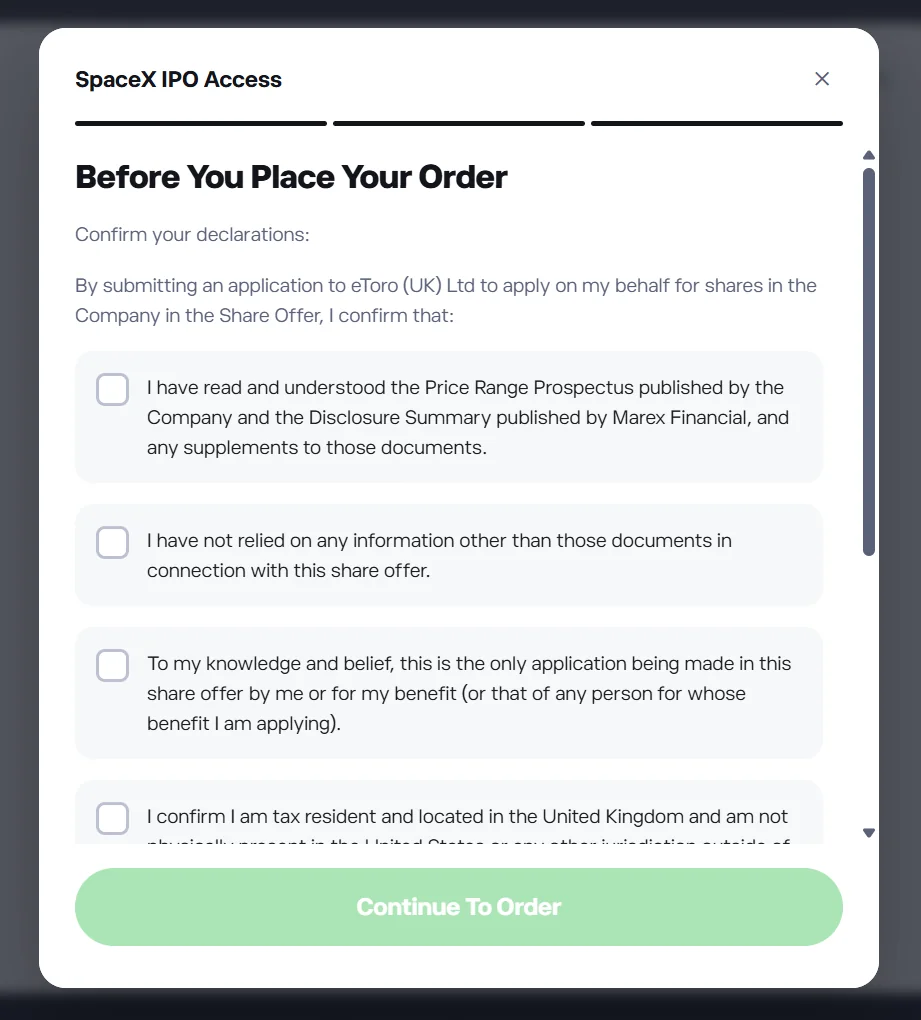
When we ran through the application in our own eToro account, the minimum showed as £588.33, the pound equivalent of the $750 figure, with estimated opening costs of £0.00. That confirms there is no separate fee just to take part.
Buying SPCX on the open market from 12 June
This is the route most people will use, and it is the one we would point you to now. From 12 June you buy SPCX at the live market price through any UK broker that offers US shares, exactly like any other Nasdaq stock.
The trade you are making is on price. You will not pay the $135 offer price on the open market, you pay whatever the price is when your order goes through. A listing this big can open well above its offer price before it settles, so the first day is rarely the calm option.
If you want to be ready for that opening bell, the practical move is to get an account open and funded in advance. Open an eToro account so your money has cleared and your identity is verified before SPCX starts trading.
How to buy SpaceX shares on eToro, step by step
We are pointing readers to eToro because it offers SPCX as a real share with no eToro dealing commission, it is regulated by the FCA, and it lets you hold the stock for the long term rather than only trade it. Here is the full process from a standing start.
Step 1: Open and verify your eToro account
Head to eToro and open an account with your email and a few basic details. You will need to verify your identity with photo ID before you can deposit or trade, which is an FCA requirement and usually takes a few minutes. Getting this done early means you are ready to buy the moment SPCX opens, rather than scrambling on the day.
Step 2: Deposit funds
Fund your account by bank transfer, debit card or one of the other supported methods. eToro accounts are held in US dollars, so when you deposit in pounds a currency conversion fee applies, currently around 0.75%. Deposit a little ahead of time so the money has fully cleared before listing day.
Step 3: Find SpaceX (SPCX)
Type SPCX or “SpaceX” into the eToro search bar. From 12 June the live price, chart and company page will appear, and before then you can set an alert so you know the moment it goes live.
Step 4: Place your order
Decide how much you want to invest. eToro lets you buy fractional shares, so you can set a cash amount rather than a whole number of shares, which is useful when a single share could open at a high price. You can use a market order to buy at the current price, or a limit order to set the maximum price you are willing to pay.
Step 5: Manage your investment
Once your order fills, SPCX sits in your portfolio where you can track it, add to it later, or set price alerts. If you are holding for the long term, the honest answer is that you can mostly leave it alone and check in now and then.
One important point on what you are buying. A normal SPCX purchase on eToro is a real share, which means you own the underlying stock. That is different from a CFD, a leveraged product built for short-term trading that carries a much higher risk of losing money quickly, and we cover that difference in full further down.
Where else can you buy SpaceX in the UK?
eToro is our pick for a commission-free, long-term holding, but it is not the only FCA-regulated option. Here is how the main UK platforms line up.
| Platform | Routes offered | Min for IPO application | FX fee (indicative) | ISA / SIPP | FCA FRN |
|---|---|---|---|---|---|
| eToro | IPO offer and open market | Around $750 | Around 0.75% | General account only, no SIPP | 583263 |
| Hargreaves Lansdown | IPO offer and open market | Around £1,000 | Up to around 0.99% | ISA, SIPP, LISA, Junior ISA | 115248 |
| Trading 212 | Pre-order and open market | Fractional | Around 0.15% | ISA and SIPP | 609146 |
| IG | IPO offer and open market | Around £500 | Varies | ISA | 195355 |
| XTB | Open market | Not applicable | Around 0.50% | ISA | 522157 |
Figures are indicative and change often, so check the live fees and minimums on each platform before you commit. FX fees matter more than they first appear, because every SPCX trade involves converting pounds into dollars and back again.
A quick read on the table. eToro stands out for commission-free real shares and ease of use, Trading 212 has the lowest FX fee of the group, and Hargreaves Lansdown is the only one here that offers the full set of tax wrappers, including a SIPP and a Junior ISA.
Are you investing in SpaceX or trading it?
These are two different activities with very different risk profiles, and it is worth being honest with yourself about which one you are doing. Investing means buying the real shares to hold for the long term, ideally inside a tax wrapper, and sitting through the ups and downs. Trading means trying to profit from short-term price moves, often over days or even hours.
On eToro, a standard SpaceX purchase is a real share, so you own the underlying stock and can hold it for as long as you like. That is the route we would point most readers towards for a company like this.
Trading is a different game. Some platforms let you trade SpaceX using CFDs, which are leveraged products that magnify both gains and losses and are built for short holding periods. They carry a high risk of losing money quickly, and they are not the right tool for a buy-and-hold investor.
How is the SpaceX IPO price set?
The headline offer price is $135 per share, set by SpaceX and its underwriters in the run-up to the listing. In a typical IPO the bank running the deal gauges demand during the roadshow, publishes a price range in the prospectus, then confirms the final price once the order book closes.
That is why the eToro application asks you to confirm you have read the Price Range Prospectus. You are committing before the final price and your allocation are confirmed, which happens around 12 June.
The number most people will actually pay is different again. Once SPCX starts trading, the open-market price is set by live supply and demand at the opening auction, and for a deal this hyped it can open well above the $135 offer price before it settles.
Can you hold SpaceX in an ISA or SIPP?
In most cases yes, because the Nasdaq is an HMRC-recognised stock exchange, so Nasdaq-listed shares like SPCX are generally eligible for a Stocks and Shares ISA or a SIPP. The catch is that eligibility also depends on your platform, and not every broker offers every wrapper.
Hargreaves Lansdown is the most flexible here, offering SpaceX across an ISA, SIPP, Lifetime ISA and Junior ISA. Trading 212 offers both an ISA and a SIPP.
eToro has recently launched its own ISA, but it is a separate product and there is no confirmation that a day-one SpaceX allocation can sit inside it, so in practice you would hold SPCX in your general account. eToro does not offer a SIPP.
What will it cost? Fees, FX and commission
There are no dedicated fees to apply through eToro’s IPO Access, and the order screen showed estimated opening costs of £0.00. For buying SPCX as a normal share, eToro markets zero commission, though a small flat charge can apply on some exchanges, so check the live figure before you trade.
The cost that catches people out is foreign exchange. SpaceX trades in US dollars, so every time you move between pounds and dollars there is a conversion fee, currently around 0.75% on eToro.
For comparison, Trading 212 charges around 0.15% on FX, XTB around 0.50%, and Hargreaves Lansdown up to around 0.99% on smaller US trades. On a long-term holding the FX fee usually matters more than the headline commission, because it applies on the way in and on the way out.
SpaceX vs Starlink, what are you actually buying?
This trips a lot of people up, so it is worth being clear. SpaceX and Starlink are not two separate listings. Starlink is a business unit inside SpaceX, it does not have its own ticker, and there is no separate Starlink share to buy here.
When you buy SPCX, you are buying the whole company. That includes Starlink, the Falcon and Starship launch business, the Starshield defence work, and the xAI and Grok operations that were folded in during early 2026.
Starlink is the part actually making money, with around $11 billion of revenue in 2025 and more than 12 million customers. The rest is a mix of profitable launch services and big, expensive bets on the future.
When will SpaceX join the S&P 500 or Nasdaq-100?
SpaceX is likely to join the Nasdaq-100 quickly, but the S&P 500 is a longer wait. Nasdaq changed its rules so a top-40 company by size can enter the index after just 15 trading days, which points to late June or early July for SPCX.
The S&P 500 is a different story. Its index committee rejected a fast-track on 4 June and kept its existing rules, which require a company to be profitable over its most recent quarter and the prior four quarters combined. SpaceX is still loss-making, so the earliest realistic window is mid-2027, and only if it turns a profit.
This matters more than it sounds. When a stock joins a major index, the funds that track that index are forced to buy it, which can support the price regardless of valuation.
What are analysts saying about the valuation?
Opinion is split, and not by a little. The bears think SpaceX is worth roughly half its IPO price, while the bulls think it could double or more from here over the next few years.
Morningstar is the loudest sceptic. Its analyst put a fair value on the business of around $780 billion, close to $63 a share, which is well under half the $135 offer price. The argument is that the price already builds in Starship and AI projects that have not yet proven they can make money, and that investors may get a better entry once the hype fades.
Some analysts have been blunter still, with one calling the filing borderline dishonest over a valuation it felt was detached from the current numbers.
The bulls see it differently. ARK Invest has floated a base case of a $2.5 trillion valuation by 2030, rising to $3.1 trillion in its most optimistic scenario, on the view that SpaceX becomes critical global infrastructure rather than just a rocket company. For that to hold, analysts at Goldman Sachs have suggested revenue would need to climb above $100 billion a year, which is a steep ask from under $19 billion in 2025.
Our reading is simple. There is a credible long-term bull case, and a credible warning that you are paying up front for things that may take years to arrive.
What price swings should you expect after listing?
Expect volatility, and plenty of it. Everything about the structure of this deal points to a sharp move at the open, in either direction.
The setup is unusual. Only around 3% of the company is being floated, retail demand is heavy, and a Nasdaq-100 entry within weeks would force index funds to buy the stock. Limited supply meeting strong, partly forced demand is the classic recipe for a price spike.
The flip side is the comedown. Big, hyped listings often open well above their offer price, then give a chunk of it back over the following days and weeks as the early excitement cools. One scenario model put the range anywhere from up 40 to 60% to down 30 to 50% over the first 90 days, which tells you how wide the spread of outcomes really is.
There is also a later pressure point to keep on your radar. When the lock-up period ends, insiders and early backers can start selling, and that wave of supply can weigh on the price. For SpaceX that window falls later in 2026.
These are possibilities, not predictions. Nobody knows where the price lands, and anyone who tells you otherwise is guessing.
The risks every UK investor should weigh first
A company this exciting can make it easy to skip the boring part. Here are the risks that matter most for a UK investor.
- You are not buying at $135. That is the offer price, not the open-market price. On day one you pay whatever the market sets, which could be a lot higher.
- The S-1 is not a UK prospectus. It was filed with the US regulator and has not been approved by the FCA, so it does not carry the same protections you might expect from a UK listing.
- It is loss-making. SpaceX lost around $4.9 billion in 2025, and only the Starlink side of the business currently turns a profit.
- You get almost no say. A dual-class structure leaves Elon Musk with around 82% of the voting power, so ordinary shareholders have very little control.
- The valuation is rich. At $1.75 trillion you are paying a high multiple of current sales, which leaves little room for disappointment.
- Currency risk. SPCX trades in dollars, so your returns in pounds will move with the exchange rate as well as the share price.
- Lock-up selling. When the lock-up ends later in 2026, early holders can sell, which can add downward pressure.
None of this means you should stay away. It means you should size your position so that a bad first few months would be uncomfortable rather than damaging.
Should you buy SpaceX shares? Our take
I will be honest with you, because that is more useful than a confident forecast. In the short term, this IPO scares me.
If you asked me where the price will be 48 hours after listing, I would be flipping a coin. I do not trust where big institutional money pushes a stock in the first days of trading, and I have been burned before backing the way the crowd was leaning. So I will not be trading the open.
My co-founder Tom sits on the other side of this. He is genuinely bullish on the IPO and the long-term story, and would happily back it from day one. I cannot quite get there, because the fact that almost everyone expects it to moon, pun intended, is exactly what keeps me on the fence.
The long term is where I change my mind completely. What this company is building is genuinely remarkable, and Elon has a way of pulling the bull out of almost all of us. Across launch, Starlink and the AI side, the ten-year story is as exciting as anything on the market.
So here is what I am actually doing. I want a measured, sensible allocation in my long-term portfolio, bought in a way I am comfortable holding through the noise, and I am leaving the first-week fireworks well alone.
That is my personal view, not advice, and not a nudge for you to do the same. Your job is to decide what fits your own goals, your own timeline and the amount you can afford to lose.
If you do decide SpaceX has a place in your portfolio, you can open an eToro account and be ready to buy when you are. Take your time, and never invest money you cannot afford to lose.
SpaceX IPO FAQ
When is the SpaceX IPO?
SpaceX prices on the evening of 11 June 2026 and starts trading on the Nasdaq on 12 June 2026.
What is SpaceX’s ticker symbol?
SpaceX lists under the ticker SPCX on the Nasdaq.
How much is one SpaceX share?
The fixed offer price is $135. The open-market price from 12 June will be set by supply and demand, and is likely to differ.
Can I buy SpaceX on eToro?
Yes. eToro offers SpaceX as a real share to UK investors, and you can buy it once trading opens on 12 June.
Can I hold SpaceX in an ISA?
Generally yes, because the Nasdaq is HMRC-recognised. Availability depends on your platform, and on eToro it would sit in your general account rather than its ISA.
Is Starlink the same as SpaceX?
Starlink is part of SpaceX, not a separate company or share. Buying SPCX gives you exposure to Starlink along with the rest of the business.
Will SpaceX join the S&P 500?
Not soon. It needs to be profitable first, so the earliest realistic window is around mid-2027.
Is SpaceX profitable?
No. It lost around $4.9 billion in 2025, although the Starlink division does make money.

52% of retail CFD accounts lose money when trading CFDs with this provider.