


Quick Answer: Which Indices Are Actually Worth Trading?
Four, in my view, and for different jobs. The US 500 is the workhorse: the deepest market on the board and the tightest to trade, from 0.4 points on IG. The FTSE 100 is the home fixture, from 1 point, ideal for learning because it moves at a walking pace. Germany 40 is the volatility play for the European session, from 1.2 points. And Wall Street earns its place not despite its 2.4-point spread but because its huge point count makes small stakes go a long way, provided you size it properly. Everything else on the list, and there are dozens, is mostly a way to pay wider spreads for markets you know less well. The underrated details are the clocks, not the markets: the US indices deal 24 hours on IG, and separate weekend markets let you trade or hedge when everything else is shut.

Spread bets and CFDs are complex instruments and come with a high risk of losing money rapidly due to leverage. 70% of retail investor accounts lose money when trading spread bets and CFDs with this provider. You should consider whether you understand how spread bets and CFDs work, and whether you can afford to take the high risk of losing your money.
Why Do Indices Suit UK Traders So Well?
An index gives you the whole market in one instrument, and for a retail trader that solves half a dozen problems at once. No earnings landmines from a single company blowing up your position overnight. No stock borrow to arrange when you want to short; you just sell. Liquidity deep enough that your size never moves the price. And spreads that are a fraction of what individual shares cost to trade, with no commission on top, because index spread bets and CFDs on IG are priced through the spread alone.
For a spread bettor there is an extra advantage: index bets are priced in pounds per point, so the risk arithmetic stays simple whatever the underlying currency does. A £2-a-point FTSE bet and a £2-a-point Wall Street bet both cost £2 for every point of movement, dollar index or not. Most UK traders I know do the bulk of their trading on three or four indices, and I think that is exactly right: the edge comes from knowing your market's personality, and collecting flags adds nothing.
The Four I Keep Coming Back To
Each earns its place for a specific reason, and the costs below are IG's published from-spreads, so you can check them against the live ticket any day.
US 500: the default, and the cheapest
From 0.4 points, the US 500 is the tightest major index on IG's board and tracks the most liquid equity market in the world. It trends better than most, it has endless free analysis written about it, and it deals 24 hours during the week, so a UK evening is prime US trading time rather than a compromise. It is also the index where the spread matters least relative to the daily range, and cost measured against range is the definition of cheap that counts. If I could only trade one index, this is the one.
FTSE 100: the teacher
From 1 point, with a standard minimum bet of 50p per point, and IG runs reduced minimums from as little as 1p per point on selected major markets, which makes genuinely small-stakes practice on live prices possible. The FTSE is slower and more range-bound than the US indices, and that makes it a good classroom: you learn execution, sizing and stops without the market sprinting away from you. The evening news actually talks about it too, which makes connecting its behaviour to events easier, and its heavyweight miners and banks give it a personality worth learning: dollar-sensitive, dividend-heavy, rarely hysterical.
Germany 40: the European session's engine
From 1.2 points, the Germany 40 is where the action lives between the London open and lunchtime. It moves harder and faster than the FTSE, reacts sharply to euro area data and ECB days, and rewards traders who like momentum. It is my pick for anyone whose free trading hours are UK mornings, and its weekend market (more below) makes it one of the few European exposures you can manage seven days a week.
Wall Street: respect the point value
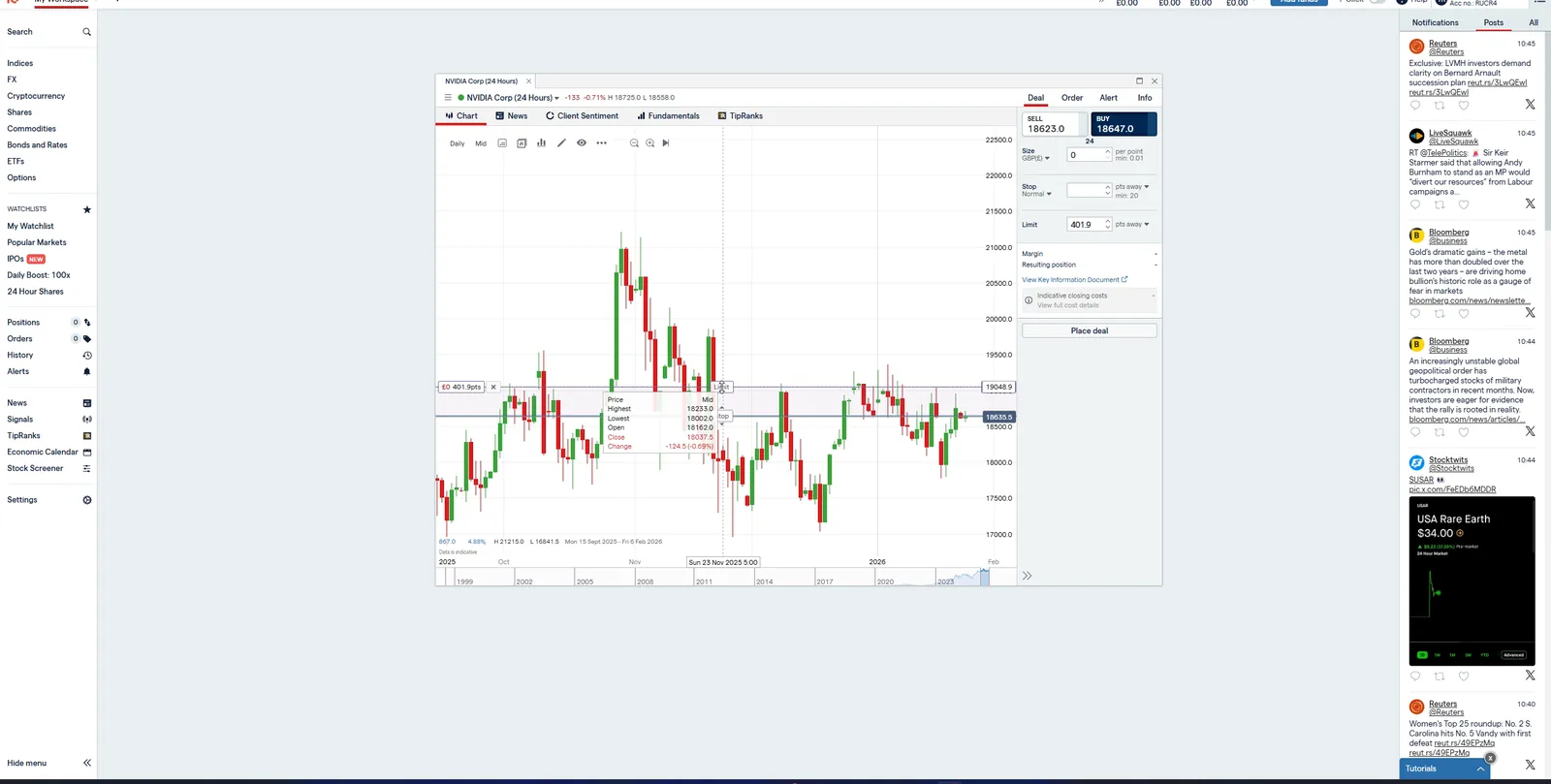
From 2.4 points, the Dow looks expensive next to the US 500, and per point it is. The reason it stays on my list is arithmetic: it trades in the tens of thousands and moves hundreds of points in a normal session, so the same risk budget needs a much smaller stake per point than on the FTSE. Price a trade as a fraction of the daily range rather than in raw points and Wall Street's spread is fair; treat every index stake the same and it will bleed you. The stake calculator is part of the trade here.
What Do Most Index Traders Miss? The Clocks
The most useful things about IG's index offering are not on the spread table at all.
They are about when you can trade, and they are the reason I keep more of my index trading at IG than the spreads alone would justify.
24-hour dealing on the US indices
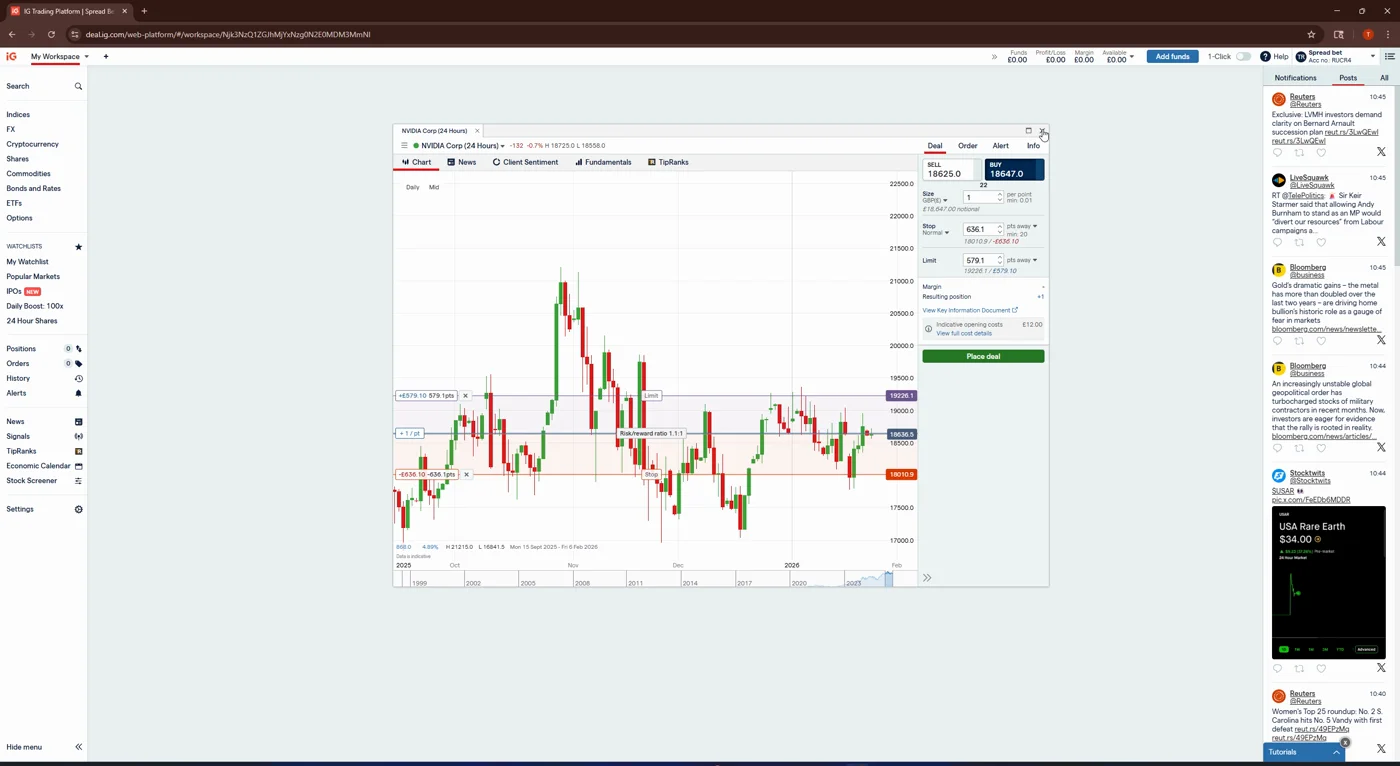
Wall Street and the US Tech 100 deal around the clock on IG from 11pm London time on Sunday, which changes what a UK trader can actually do with them. You can react to an Asian-session move at breakfast, position before the US open at lunchtime, and manage the trade through the evening while the cash market is live. The 24-hour price is IG's own market outside exchange hours, so spreads are wider overnight than during the US session, but having the door open at all is the point: the alternative is a stop order and hope.
Weekend markets, and the hedge most people never think of
IG runs separate weekend markets on the UK 100, Wall Street, US Tech 100, Germany 40 and the HS50 from 8am Saturday to 10.40pm Sunday. Because they are priced as distinct markets, a weekend position does not touch your weekday one, which creates a genuinely useful trick: if news breaks on a Saturday and you are exposed from Friday's close, you can take the opposite position in the weekend market and neutralise the risk until Monday, instead of sweating through the gap. Even if you never trade a Saturday in your life, the hedge is a useful thing to have in your back pocket.
Overnight funding: the cost that builds night after night
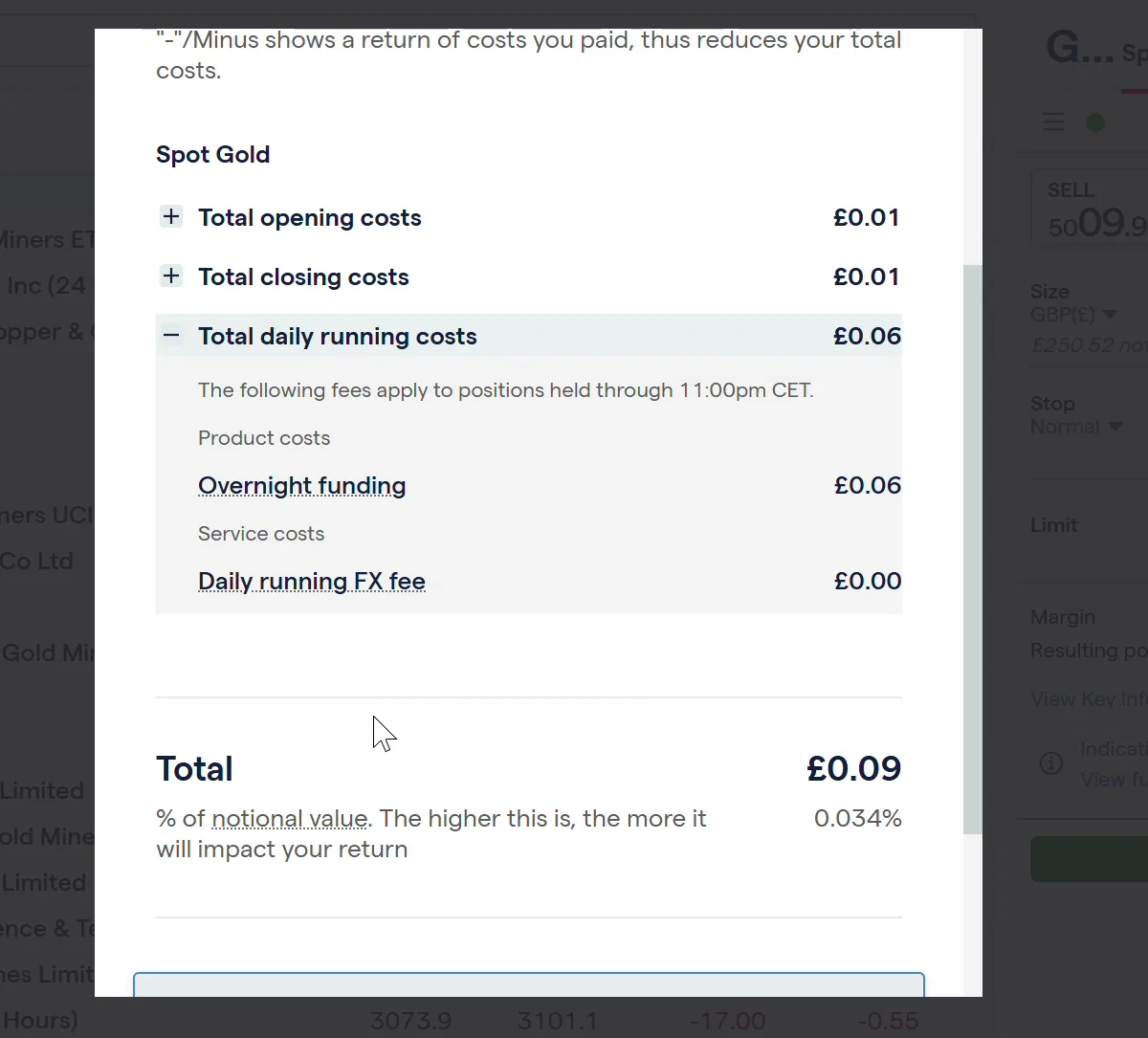
Hold a daily-funded index position past 10pm and IG charges funding calculated as the closing level, times your size, times a 2.5% admin fee plus or minus the relevant benchmark rate, divided across the year.
The worked example worth doing once
A £2-a-point FTSE position at 8200 is £16,400 of exposure. At the 2.5% admin fee plus a benchmark in the mid-4s, overnight funding runs in the region of £3 a night, roughly £90 a month. That is trivial on a two-day swing and devastating on a position you hold for a quarter, so the arithmetic deserves five minutes before any long hold.
When the futures beat the daily market
For genuinely longer-term index views, IG's futures pricing rolls the holding cost into a wider spread with no daily funding line at all. Past a few weeks of intended holding, that trade-off usually wins, and switching wrapper is a one-click decision that most people never realise they are allowed to make.
Which Indices Do I Skip?
Almost everything else, honestly. Exotic country indices trade on wider spreads, thinner books and time zones that fight a UK schedule, and unless you follow that economy closely you are paying extra to trade a market you know less about. The one exception worth a look is Japan, which gives you a clean Asian-session market if your hours suit it; the HS50's weekend market is the other niche with a genuine use. The deeper point is that index selection is risk management wearing a different hat. Every market you add is a personality you have to learn, a calendar you have to follow and a session you have to be awake for. Nobody ever went broke sticking to the four above; plenty of accounts have died of variety. Trade fewer markets, know them better.
If you want the mechanics of shorting an index rather than choosing one, my guide to shorting the FTSE covers that side, and IG publishes its full index spread list if you want to check today's live numbers against the figures here.