

- expertise:
- CFD Trading, Forex, Derivatives, Risk Management
- credentials:
- Chartered ACII (2018) · Trading since 2012
- tested:
- 40+ forex & CFD platforms with live accounts

- expertise:
- Broker Comparison, ISA Strategy, Portfolio Management
- credentials:
- Active investor since 2013 · 11+ years experience
- tested:
- 40+ brokers with funded accounts
How We Test
Real accounts. Real money. Real trades. No demo accounts or press releases.
What we measure:
- Spreads vs advertised rates
- Execution speed and slippage
- Hidden fees (overnight, withdrawal, conversion)
- Actual withdrawal times
Scoring:
Fees (25%) · Platform (20%) · Assets (15%) · Mobile (15%) · Tools (10%) · Support (10%) · Regulation (5%)
Regulatory checks:
FCA Register verification · FSCS protection
Testing team:
Adam Woodhead (investing since 2013), Thomas Drury (Chartered ACII, 2018), Dom Farnell (investing since 2013) — 50+ platforms with funded accounts
Quarterly reviews · Corrections: in**@*******************co.uk
Disclaimer
Not financial advice. Educational content only. We're not FCA authorised. Consult a qualified advisor before investing.
Capital at risk. Investments can fall. Past performance doesn't guarantee future results.
CFD warning. 67-84% of retail accounts lose money trading CFDs. High risk due to leverage.
Contact: in**@*******************co.uk
Where does Razor actually rank on forex spreads?
At or near the front, once you compare like with like. Pepperstone's own dated table, built from every trading session between 1 and 31 May 2026, puts Razor's average raw spread at 0.1 pips on EUR/USD and AUD/USD, 0.2 on GBP/USD and 0.3 on USD/JPY, before commission. Most rivals publish a "from" figure instead, which is a floor rather than an average, so their headline numbers are not the same kind of number at all. On my funded GBP account the all-in EUR/USD round trip works out at about £5.30 per standard lot on MetaTrader. IC Markets matches Pepperstone almost line for line, CMC and OANDA bundle everything into a wider spread, and the full pair-by-pair working is below, every figure sourced and dated.

73.6% of retail investor accounts lose money when trading spread bets and CFDs with this provider.
How did I measure this?
Everything on this page comes from one of two sources, kept strictly apart. The first is my own funded Razor account, which has been logging real fills since the start of 2026: the per-trade record lives in my EUR/USD trading cost log, which also carries the monthly re-measurement, and the news-day behaviour has its own write-up in my scalping through the news piece. The second is what each broker publishes on its own website, checked on 1 September 2026, with the date recorded next to every figure.
Averages and floors are different animals
Pepperstone is unusual in publishing dated averages: its pairs-and-spreads table states the exact data window, 1 to 31 May 2026, covering all sessions including rollover. Most competitors publish minimums instead. A "from 0.5" figure tells you the best the spread ever gets, not what you pay at 3pm on a Tuesday, and comparing someone's floor with someone else's average flatters the floor every time. Where a broker publishes only a floor, this page says so.
One conflict on Pepperstone's own site
Their accounts page still advertises the Standard spread "starting from" 0.4 points on majors while the pricing page lists 1-point minimums and the dated table shows averages of 1.1 to 1.3. When a broker's own pages disagree, the dated table wins, so this page ignores the 0.4 claim entirely.
What do the published numbers say, pair by pair?
Start with Pepperstone against itself, because the Razor and Standard gap is the cleanest comparison available: same broker, same data window, same four majors.
| Pair | Razor average | Standard average |
|---|---|---|
| EUR/USD | 0.1 | 1.1 |
| GBP/USD | 0.2 | 1.2 |
| USD/JPY | 0.3 | 1.3 |
| AUD/USD | 0.1 | 1.1 |
Adding the commission back in
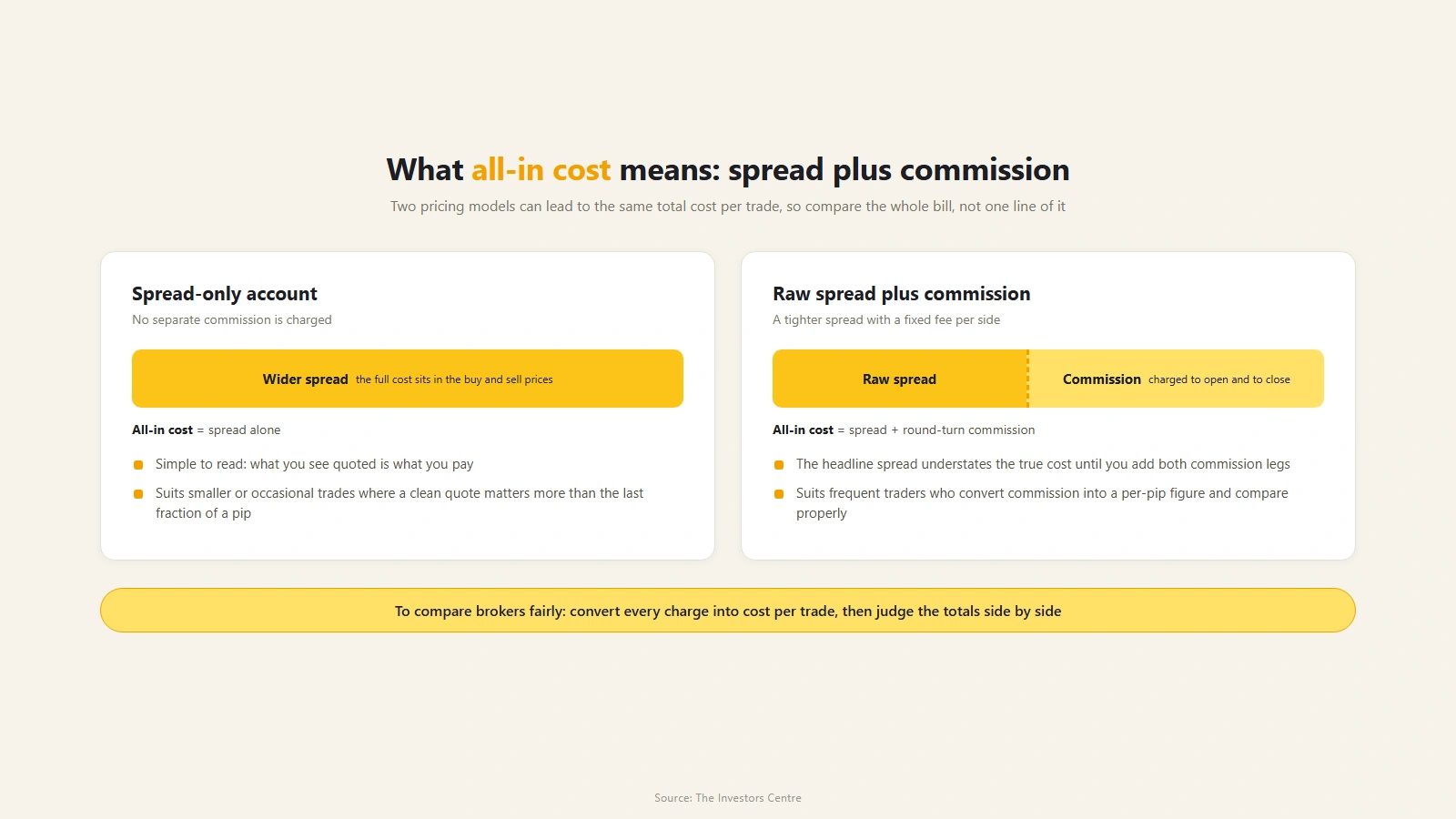
Razor's raw spread is only half its price. On a GBP MetaTrader account the commission is £2.25 per lot per side, £4.50 round turn. On cTrader it is $6 round turn per FX lot, on TradingView $7, and on Pepperstone's own platform $3.50 per side. So the true all-in EUR/USD cost on my account is roughly 80p of spread plus £4.50 of commission, about £5.30 per standard lot, against roughly £8.80 for Standard's commission-free 1.1 pips. Your platform choice changes your dealing rate, which still surprises people.
The rivals, on their own published figures
These are the brokers I hold live head-to-head pages on, each figure from their own site.
| Broker | EUR/USD as published | Commission | Checked |
|---|---|---|---|
| Pepperstone Razor | 0.1 pips average (dated, May 2026) | £4.50 round turn, GBP MT4/MT5 | 1 Sep 2026 |
| IC Markets Raw | from 0.0 pips (floor) | $6 RT cTrader, $7 RT MT4/MT5 | Jun 2026 |
| CMC Markets | from 0.5 pips (floor) | None on FX | Aug 2026 |
| OANDA | from 0.6 pips (floor) | None on standard pricing | Jun 2026 |
Where does Razor win, and where does it not?
IC Markets is the one rival this page cannot separate from Razor on price. On cTrader the two brokers charge an identical $6 round turn on a raw spread from zero, and my Pepperstone vs IC Markets page calls that a cost draw, because it is. The gap between them is regulatory, not financial: the IC Markets entity serving UK clients is not FCA-regulated, Pepperstone Limited is, FRN 684312.
Against the spread-only brokers the sums favour Razor at every realistic size. CMC's floor of 0.5 pips would cost about £4 per lot if you always got it, marginally under Razor's £5.30 all-in, but a floor is precisely the price you cannot rely on paying, and CMC publishes no average to check it against. My Pepperstone vs CMC Markets comparison gives CMC honest wins elsewhere, market range above all. OANDA's from 0.6 works out wider still, and its case, argued in my Pepperstone vs OANDA page, rests on its API and data pedigree rather than headline cost.
Where Razor genuinely does not win: simplicity. A spread-only account gives you one number on one ticket. Razor gives you a raw quote plus a commission that changes with your platform, and if reconciling that annoys you, Standard exists for a reason.
Which costs do the spread tables not show?
The biggest one is the swap. Hold a standard lot of EUR/USD long past rollover and my log showed about £7.10 a night, more than the entire dealing cost of opening the trade, with a triple charge on Wednesdays. News widening is the other one. The same EUR/USD market that averages 0.1 pips printed 0.9 through US payrolls in my log, and every broker's spread does something similar whatever their marketing says. Either can dwarf the spread when it bites. The per-night swap figures live in the EUR/USD cost log, and the release-by-release widening record is in the news scalping log.
Both of those logs are re-measured monthly, and the next section covers how this page keeps step with them.
Does this page stay current?
Yes, on the same cycle as the cost log. The EUR/USD page re-measures the same funded account every month, and when its figures move, the all-in workings here get rechecked against whatever the brokers are publishing that week. Pepperstone's dated table carries a May 2026 window at the time of writing; when they refresh the window, this page updates with it. If the numbers you are reading ever disagree with the log page, trust the log and tell me.
FAQs
References
- FCA Register: Pepperstone Ltd. FRN: 684312
- Pepperstone: forex pairs and spreads, dated averages (checked 1 September 2026)
- Pepperstone: per-platform commission schedule (checked 1 September 2026)
- CMC Markets: published forex pricing (checked August 2026)
- OANDA: published spreads and pricing (checked June 2026)
- IC Markets: Raw account pricing (checked June 2026)
- The Investors Centre: how we test brokers