

- expertise:
- CFD Trading, Forex, Derivatives, Risk Management
- credentials:
- Chartered ACII (2018) · Trading since 2012
- tested:
- 40+ forex & CFD platforms with live accounts

- expertise:
- Broker Comparison, ISA Strategy, Portfolio Management
- credentials:
- Active investor since 2013 · 11+ years experience
- tested:
- 40+ brokers with funded accounts
How We Test
Real accounts. Real money. Real trades. No demo accounts or press releases.
What we measure:
- Spreads vs advertised rates
- Execution speed and slippage
- Hidden fees (overnight, withdrawal, conversion)
- Actual withdrawal times
Scoring:
Fees (25%) · Platform (20%) · Assets (15%) · Mobile (15%) · Tools (10%) · Support (10%) · Regulation (5%)
Regulatory checks:
FCA Register verification · FSCS protection
Testing team:
Adam Woodhead (investing since 2013), Thomas Drury (Chartered ACII, 2018), Dom Farnell (investing since 2013) — 50+ platforms with funded accounts
Quarterly reviews · Corrections: in**@*******************co.uk
Disclaimer
Not financial advice. Educational content only. We're not FCA authorised. Consult a qualified advisor before investing.
Capital at risk. Investments can fall. Past performance doesn't guarantee future results.
CFD warning. 67-84% of retail accounts lose money trading CFDs. High risk due to leverage.
Contact: in**@*******************co.uk
What leverage do you actually get on Pepperstone in the UK?
Up to 30:1 on major FX CFDs as a retail client, stepping down by asset class to 20:1 on gold and major indices and 2:1 on crypto, with the same caps applying whether you trade CFDs or spread bets. Those ceilings are FCA rules, not Pepperstone generosity, and every FCA broker sits under them. What differs broker to broker is the mechanics underneath: Pepperstone triggers a margin call on MT4 and MT5 when equity drops below 90% of required margin, closes positions automatically at 50% starting with the largest loser, and on cTrader adds three configurable warning tiers before its own 50% Smart Stop-Out. Retail accounts also carry negative balance protection, a retail-only safeguard. The caps only settle what you can do; what you should do is a sizing decision, covered further down.

73.6% of retail investor accounts lose money when trading spread bets and CFDs with this provider.
What are the UK retail caps, asset class by asset class?
Leverage on Pepperstone is not one number. Each asset class carries its own regulatory ceiling, scaled roughly to how violently the underlying market moves, which is why crypto sits at a fraction of what major FX pairs get. Pepperstone presents the headline as up to 30:1 leverage on major FX CFDs, and is unusually direct in the same breath about it magnifying losses as well as gains.
| Asset class | Maximum retail leverage | Margin per £1,000 of exposure |
|---|---|---|
| Major FX pairs | Up to 30:1 | £33.33 |
| Gold | 20:1 | £50 |
| Major indices | Up to 20:1 | £50 |
| Crypto CFDs | Up to 2:1 | £500 |
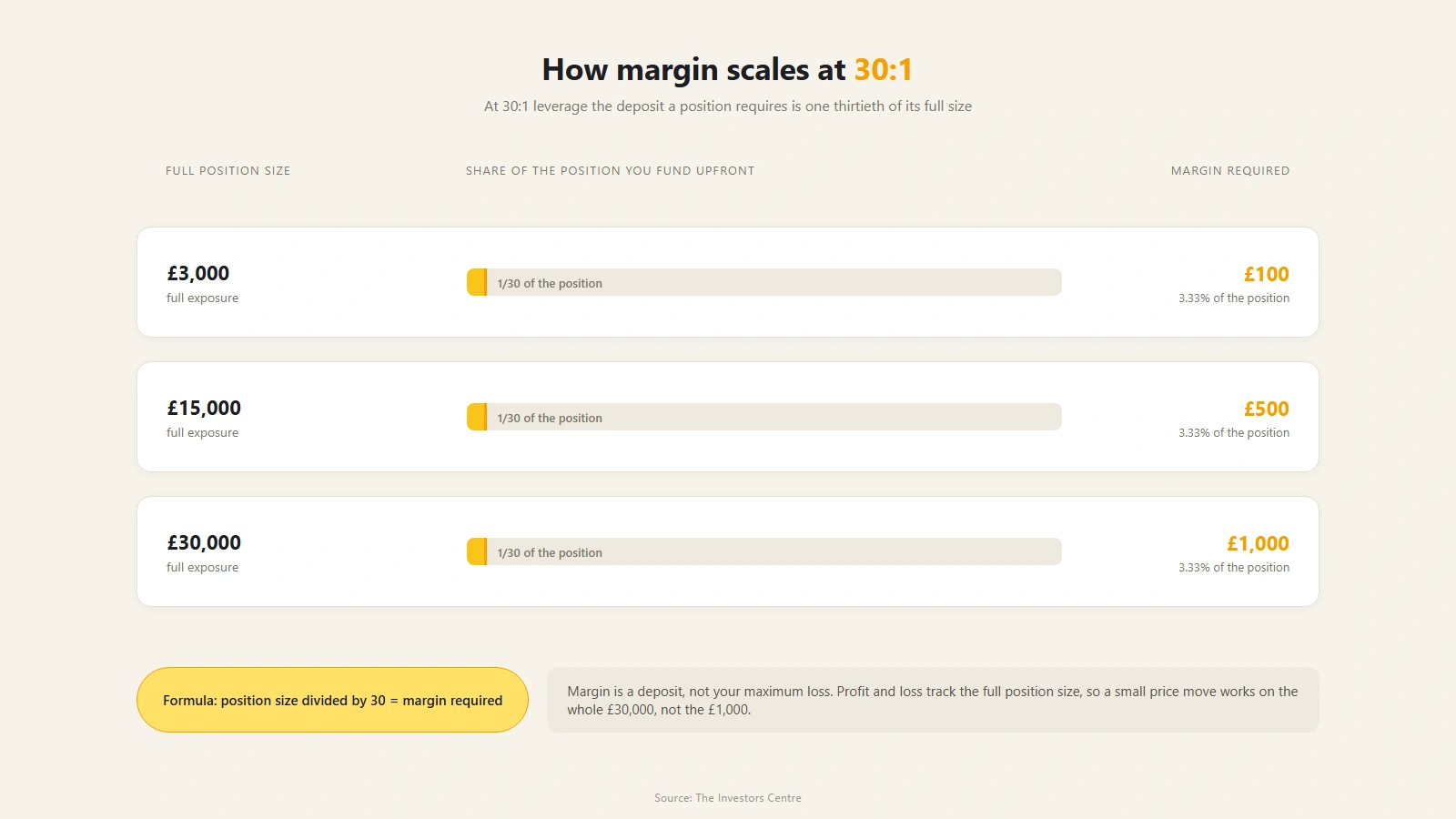
Other markets, including individual shares and softer commodities, step down further; check the margin figure on each instrument's market page rather than assuming. The caps exist because the pre-2018 era of 200:1 retail FX accounts ended badly often enough that the regulator standardised the ceilings, and I think the rules landed about right. A 30:1 cap still lets a £1,000 account control £30,000 of EUR/USD. Nobody needs more than that to have a serious problem or a serious result.
How do margin calls and close-outs work in practice?
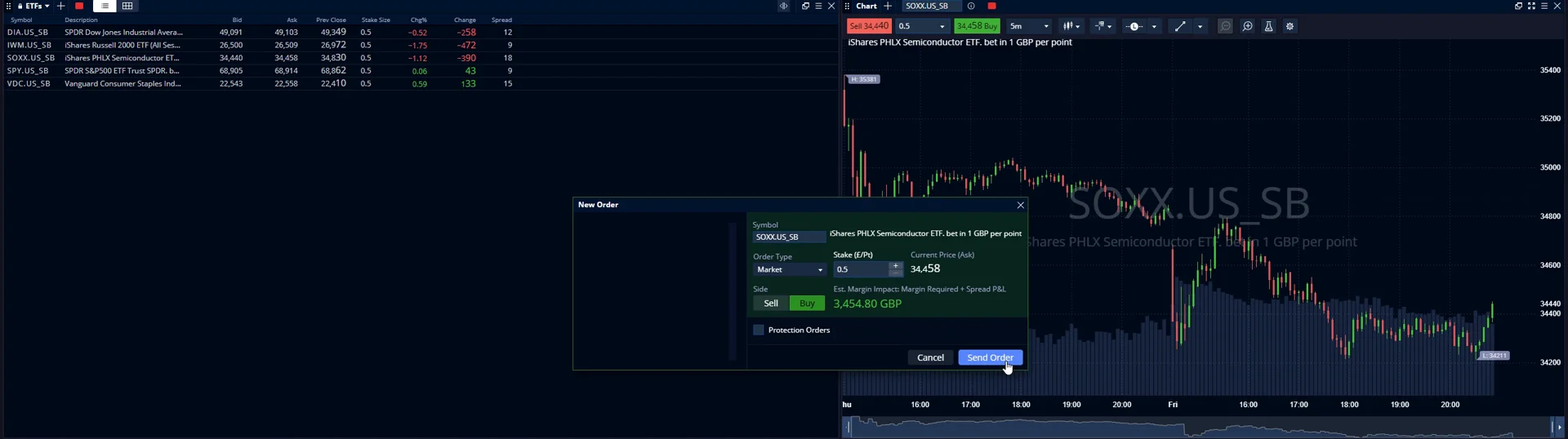
A worked example beats definitions here. Say you hold £10,000 in your account and open one standard lot of GBP/USD, which is £100,000 of notional exposure. At 30:1 that reserves about £3,333 as required margin, leaving the rest as free equity. So far, comfortable. Now the trade moves against you, and each stage below has a specific published trigger.
On MT4 and MT5
Pepperstone's margin call fires when your equity falls below 90% of required margin, in this example around £3,000, and the platform flags the account while Pepperstone sends notification emails, which you can manage in your account settings. Fall further, to 50% of required margin, roughly £1,667 here, and the stop-out mechanism closes positions automatically, starting with the largest losing trade and repeating until equity is back above the line. Notice what that journey means: the £10,000 account swallowed about £7,000 of paper loss before the margin call even fired, and roughly £8,300 before the automatic close-out stepped in. The safety net is real, and it sits much lower than most people assume before they check.
On cTrader
Same destination, more signposts. cTrader shows margin-call warnings at three tiers as your equity-to-margin ratio falls, 150%, 100% and 80% by default, and you can customise those levels in the platform settings. Below 50% the Smart Stop-Out engages, shedding exposure to bring the account back above the threshold. The extra warnings are the reason I would point anyone nervous about leverage toward cTrader or toward trading smaller, ideally both; the platform trade-offs beyond margin are covered in my comparison of Pepperstone's five platforms.
What no close-out mechanism does
It does not protect your money in any meaningful sense. By the time a 50% stop-out triggers, most of the equity backing that position is gone; the mechanism exists to stop the account going through zero in an orderly market, not to save your trade. Treat the margin call as an alarm you should never hear, not a feature you plan around.
What does negative balance protection actually cover?
It covers precisely one thing: as a retail client, you cannot lose more than the money in your account. If a market gaps so hard that the automatic close-out executes beyond your remaining equity, a weekend gap, a flash move, a news spike of the sort my six-month funded forex review logged around NFP, Pepperstone restores the balance to zero rather than pursuing you for the shortfall. It is a retail-only protection; professional clients give it up, as covered below.
What it does not cover is everything else. It does not stop you losing the entire account, it does not make a stop order fill at its level through a gap, and it does not apply to any losses in the professional category. Think of it as a floor under the account at zero; the work of keeping you well above that floor belongs to the sizing habits in the next section.
How should you actually use the leverage you are given?
Mostly by declining it. The cap is a ceiling, not a target, and the working habit that has kept my funded account out of the margin-call emails for six months is deciding position size from the stop distance, never from the available margin. The method fits in a sentence: choose the most you are willing to lose on the trade, divide by the stop distance in pips, and that is your size, regardless of what 30:1 would permit. On a £10,000 account risking 1%, a 50-pip stop on GBP/USD gives you £100 divided by 50, £2 a pip, roughly a quarter of a standard lot at current exchange rates. Effective leverage: under 3:1. The 30:1 headroom just means the margin reserved for that position is small, which is what keeps the close-out machinery a stranger.
The same arithmetic gets more urgent on faster markets. Index CFDs at 20:1 move in bigger daily ranges than the major FX pairs, and the worked sizing for those sits in my guide to trading US indices from a UK account. And leverage magnifies costs as well as moves: every extra lot of size is an extra round of spread and commission, which is exactly what my logged EUR/USD round-trip costs put numbers on. Size small enough that a margin call is implausible, and every percentage in the section above becomes trivia.
What changes with professional status?
The ceilings rise and the protections fall away. Pepperstone offers elective professional status to clients meeting two of three FCA tests, an average of 10 significantly sized trades per quarter over the last year, a financial instrument portfolio including cash deposits exceeding EUR 500,000, or at least a year's professional work in the financial sector in a role requiring derivatives knowledge. Professional leverage rises to 1:500 on FX and gold, 1:400 on indices, 1:100 on soft commodities, 1:20 on stocks, ETFs and energies, 1:10 on crypto and other metals, varying by instrument. In exchange, professionals lose negative balance protection entirely, and Pepperstone will not close their positions at the 50% retail threshold; the professional close-out sits at 20% per Pepperstone's FAQ. Losses beyond the account balance become possible. Whether those trade-offs suit anyone is a judgement I am not making for you here.
FAQs
References
- FCA Register: Pepperstone Ltd, FRN 684312 (checked 1 September 2026)
- Pepperstone: CFD trading, leverage and negative balance protection (checked 1 September 2026)
- Pepperstone: when a margin call and stop-out occur (checked 1 September 2026)
- Pepperstone: professional client eligibility and leverage (checked 1 September 2026)
- The Investors Centre: how we test brokers