

- expertise:
- CFD Trading, Forex, Derivatives, Risk Management
- credentials:
- Chartered ACII (2018) · Trading since 2012
- tested:
- 40+ forex & CFD platforms with live accounts

- expertise:
- Broker Comparison, ISA Strategy, Portfolio Management
- credentials:
- Active investor since 2013 · 11+ years experience
- tested:
- 40+ brokers with funded accounts
How We Test
Real accounts. Real money. Real trades. No demo accounts or press releases.
What we measure:
- Spreads vs advertised rates
- Execution speed and slippage
- Hidden fees (overnight, withdrawal, conversion)
- Actual withdrawal times
Scoring:
Fees (25%) · Platform (20%) · Assets (15%) · Mobile (15%) · Tools (10%) · Support (10%) · Regulation (5%)
Regulatory checks:
FCA Register verification · FSCS protection
Testing team:
Adam Woodhead (investing since 2013), Thomas Drury (Chartered ACII, 2018), Dom Farnell (investing since 2013) — 50+ platforms with funded accounts
Quarterly reviews · Corrections: in**@*******************co.uk
Disclaimer
Not financial advice. Educational content only. We're not FCA authorised. Consult a qualified advisor before investing.
Capital at risk. Investments can fall. Past performance doesn't guarantee future results.
CFD warning. 67-84% of retail accounts lose money trading CFDs. High risk due to leverage.
Contact: in**@*******************co.uk
Pepperstone or Plus500: which model fits how you trade?
These are two different species of broker, so match the model to how you trade. Pepperstone prices trades the raw way: spreads from 0 plus an itemised commission, published in dated tables, across five platforms and more than 2,700 spread bets and CFDs. Plus500 folds everything into one spread-only price on its single in-house platform, publishes no per-instrument spreads on its website at all, and in the UK offers CFDs only, no spread betting. Plus500 genuinely wins on guaranteed stops and its 2,800+ instrument count. Pepperstone wins on cost transparency, platform choice and the tax-relevant spread betting wrapper. Frequent traders should lean Pepperstone. Occasional position-takers who value a guaranteed exit price on individual trades have a real case for Plus500.
76% of retail investor accounts lose money when trading CFDs with this provider. You should consider whether you can afford to take the high risk of losing your money.

73.6% of retail investor accounts lose money when trading spread bets and CFDs with this provider.
How do the two pricing models actually differ?
Every CFD broker has to get paid somehow, and these two have picked opposite answers. Pepperstone's Razor account separates the ingredients: you trade at close-to-underlying spreads (EUR/USD averaged 0.1 on Razor across all sessions in May 2026, per Pepperstone's own dated table) and pay a visible commission per lot, £2.25 per side on a GBP MT4/MT5 account, $6 round-trip on cTrader. Its Standard account rolls the cost into the spread instead, 1.1 on EUR/USD across the same May 2026 window. Either way, the numbers sit on a public pricing page with a data window printed underneath.
Plus500's model is the compressed version. No commission line at all: the firm states plainly that it is compensated mainly through the buy/sell spread, with two mechanisms it calls dynamic spreads, which adjust continuously with the market, and fixed-behaviour spreads on certain instruments. One number, everything included.
Here is the detail that shapes this whole comparison: Plus500 does not publish per-instrument spreads anywhere on its website. To see what EUR/USD costs you, you open the platform and check the instrument's Details view. That is not a hidden fee, the number is right there before you trade, but it does mean nobody can truthfully put a Plus500 EUR/USD spread in a comparison table, and you should distrust any page that does.
What does a real trade cost at each?
On the Pepperstone side I can answer from published figures and my own account. One standard lot of EUR/USD on Razor via cTrader: roughly 0.1 of average spread plus $6 of round-trip commission, which at $10 a pip works out near $7 all-in on an average day. My funded account's logged version of that maths, month by month, lives in my EUR/USD trading cost log, and the fills behind it in my six-month forex review. For an index example, the same exercise on Wall Street exposure is worked through in my page on trading US indices from the UK.
On the Plus500 side, the honest answer is: open the platform and look. I am not going to invent a spread the broker itself declines to print. What can be said from Plus500's own material is structural. A spread-only price has to cover the firm's costs and margin on every trade, and you pay it in full on every entry and exit, whereas Pepperstone's raw model lets a high-frequency trader keep the underlying spread tight and treat commission as a known, fixed line item. The more often you trade, the more that visibility compounds. Trade twice a month and it barely matters.

What does the fee small print add?
Spreads and commission are never the whole bill at any broker. Both firms charge overnight funding on positions held past their daily cut-off, Plus500 as a daily percentage adjustment after each instrument's overnight funding time, Pepperstone as swap rates that my forex review logs in practice. Past that shared line, the small print diverges usefully.
| Fee | Pepperstone | Plus500 |
|---|---|---|
| Inactivity | None | Up to $10 per month after 3 months without a login |
| Currency conversion | Not charged as a separate published line on the fee page | Up to 0.7% of a trade's realised net profit and loss |
| Deposits | Free; most methods fund from £10 | No deposit fee headlined; method minimums shown on the Funds Management screen |
| Withdrawals | Free except international wire at £15 | No fee headlined on the fees page |
| Guaranteed stop cost | Not offered as a paid guaranteed-stop product | Available on some instruments via a wider spread, shown before you place the order, non-refundable once activated |
Read the inactivity row twice if you are the kind of trader who opens an account, tries it, and drifts. Pepperstone charges nothing for going quiet. Plus500's fee only bites after three months without so much as a login, which is avoidable, but only if you remember it exists. The mechanics of getting money in and out of Pepperstone are tested with real transfers in my deposit methods test.
One platform or five, and who gets guaranteed stops?
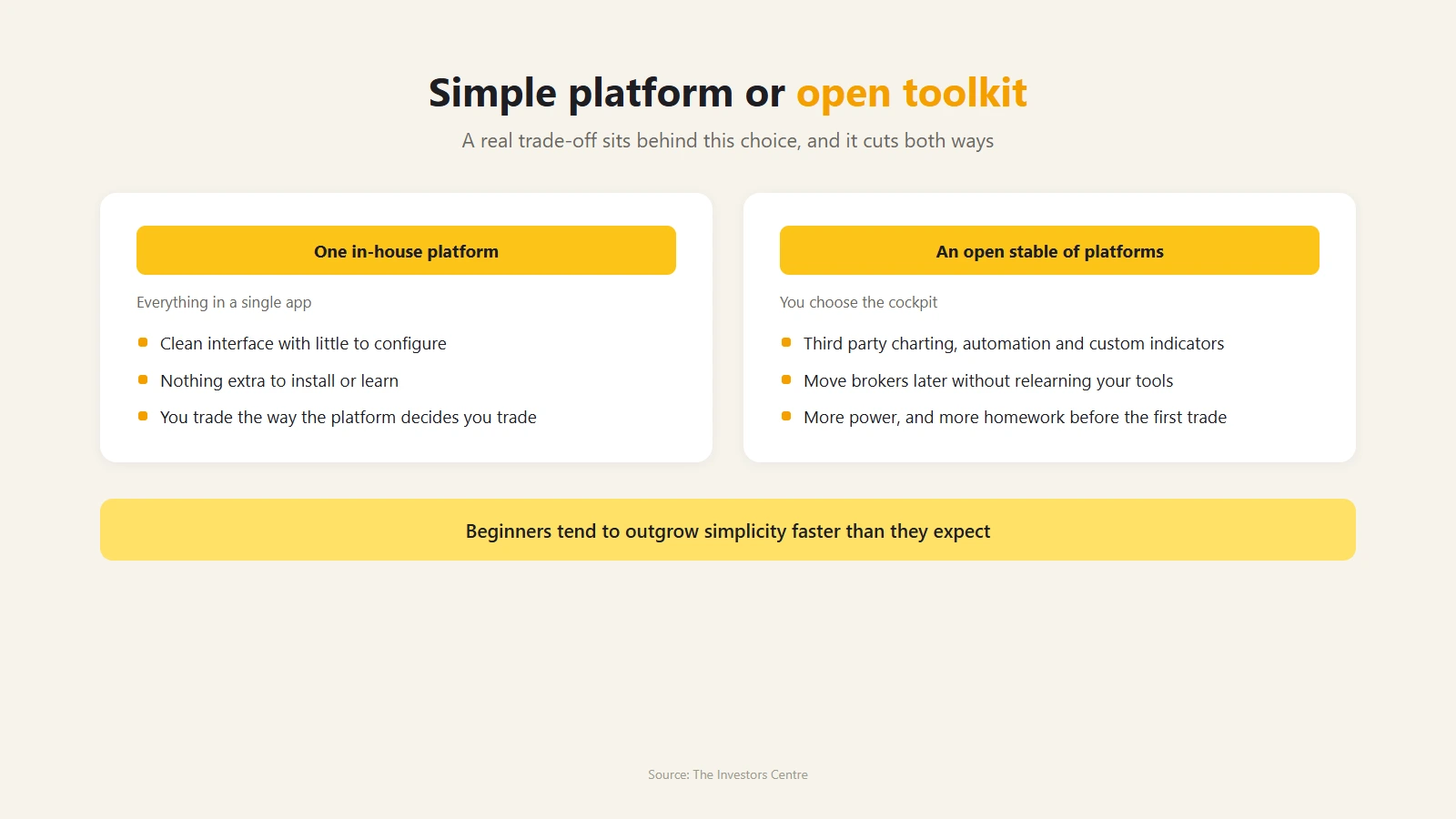
Plus500 is its platform. The proprietary WebTrader and its mobile app are the only way in: no MT4, no MT5, no third-party charting hookups, and a free unlimited demo to learn it on. Pepperstone hands you a menu instead: MT4, MT5, cTrader, TradingView and its own web and app platform, with your commission rate varying by door, which I have compared at length in my rundown of every Pepperstone platform. If you run EAs, want depth-of-market, or already live in TradingView, this row is over before it starts.
But turn the platform question around and Plus500's design has an advantage that broker comparisons routinely undersell: guaranteed stops. On supported instruments, Plus500 lets you pay for a stop that closes at your chosen price no matter what the market gaps through, priced as a visibly wider spread before you commit, non-refundable once it activates. Pepperstone does not sell an equivalent product; a standard stop there can slip in a fast market. Pepperstone's retail accounts do carry negative balance protection, for retail clients only, so the account itself cannot go below zero, and Plus500's UK retail clients have the same regulatory floor. A guaranteed stop protects something different: the specific exit price of a specific trade. For a small account holding positions through news, that is worth real money, and here Plus500 simply wins.
One structural gap remains. Plus500 in the UK is CFD-only, its user agreement is a CFD agreement and no spread betting product exists on its site, while Pepperstone offers both wrappers. UK traders who want spread betting's tax treatment cannot get it at Plus500 at all.
Who does each broker actually suit?
Frequency and size split this cleanly. If you trade often, in standard-lot sizes, with any interest in EAs or serious charting, Pepperstone's published raw pricing, platform choice and spread betting wrapper are built for you, and you can prove the costs to yourself from its dated tables before depositing a pound. That transparency is the reason I could run a six-month funded test on it at all.
If you take a handful of positions a month, want one app, one price, a hard guaranteed exit when you pay for it, and a broker whose parent is listed on the London Stock Exchange, Plus500UK Ltd (FCA FRN 509909, part of LSE-listed, FTSE 250 constituent Plus500 Ltd) is a coherent choice rather than a compromise, with a bigger headline instrument count than Pepperstone to boot. Just accept its trade-off with open eyes: you price every trade inside the platform, because the website will not tell you.
76% of retail investor accounts lose money when trading CFDs with this provider. You should consider whether you can afford to take the high risk of losing your money.
Pick the broker whose habitat matches yours; and if what you actually want is Pepperstone measured against a closer relative, my Pepperstone vs XTB comparison runs that fork.
FAQs
References
- FCA Register: Pepperstone Ltd, FRN 684312 (checked 1 September 2026)
- Pepperstone: pricing, commissions and fees (checked 1 September 2026)
- Pepperstone: forex spreads, May 2026 data window (checked 1 September 2026)
- Plus500: fees and charges (checked 1 September 2026)
- Plus500: how Plus500 spreads work (checked 1 September 2026)
- Plus500: about Plus500 Ltd, listing and instrument count (checked 1 September 2026)
- The Investors Centre: how we test brokers