

- expertise:
- CFD Trading, Forex, Derivatives, Risk Management
- credentials:
- Chartered ACII (2018) · Trading since 2012
- tested:
- 40+ forex & CFD platforms with live accounts

- expertise:
- Broker Comparison, ISA Strategy, Portfolio Management
- credentials:
- Active investor since 2013 · 11+ years experience
- tested:
- 40+ brokers with funded accounts
How We Test
Real accounts. Real money. Real trades. No demo accounts or press releases.
What we measure:
- Spreads vs advertised rates
- Execution speed and slippage
- Hidden fees (overnight, withdrawal, conversion)
- Actual withdrawal times
Scoring:
Fees (25%) · Platform (20%) · Assets (15%) · Mobile (15%) · Tools (10%) · Support (10%) · Regulation (5%)
Regulatory checks:
FCA Register verification · FSCS protection
Testing team:
Adam Woodhead (investing since 2013), Thomas Drury (Chartered ACII, 2018), Dom Farnell (investing since 2013) — 50+ platforms with funded accounts
Quarterly reviews · Corrections: info@theinvestorscentre.co.uk
Disclaimer
Not financial advice. Educational content only. We're not FCA authorised. Consult a qualified advisor before investing.
Capital at risk. Investments can fall. Past performance doesn't guarantee future results.
CFD warning. 67-84% of retail accounts lose money trading CFDs. High risk due to leverage.
Contact: info@theinvestorscentre.co.uk
Quick Answer: What is the best platform for day trading in the UK?
SpreadEX is our top pick for UK day traders in 2026. Fast fills, tight spreads, and solid FCA backing make it hard to beat. When we tested all seven brokers over three months, SpreadEX had the fewest requotes during busy London sessions. Capital.com comes close for ease of use and an intuitive interface, while IG remains strong for charting depth.

65% of retail CFD accounts lose money.

62% of Retail CFD Accounts Lose Money

68% of retail CFD accounts lose money.

72% of retail CFD accounts lose money.

68% of retail CFD accounts lose money.
71% of Retail CFD Accounts Lose Money

64% of retail CFD accounts lose money.
How I Tested These Brokers
I deposited real money into all seven brokers between October 2025 and January 2026 — no demo accounts, no press kits. Adam and Dom ran parallel tests to cross-check my results.
Over 14 weeks, I placed 40–65 market orders per broker on EUR/USD and FTSE 100, recording spreads at three fixed times each Monday, Wednesday, and Friday: 08:00, 10:30, and 14:45 GMT. I tracked slippage by comparing my requested price to my confirmed fill, and timed every withdrawal from request to funds received.
| Broker | Deposited | Withdrawal Time | Avg Spread (EUR/USD 10:30) | Zero-Slippage Rate | Requotes |
|---|---|---|---|---|---|
| SpreadEX | £500 | Same day | 0.6 pips | 88% | 0 |
| Capital.com | £250 | Same day | 0.7 pips | 79% | 0 |
| IG | £500 | Same day | 0.6 pips | 80% | 1 |
| Pepperstone | £500 | 1 business day | 0.1 pips (Razor) | 78% | 0 |
| CMC Markets | £500 | 1 business day | 0.7 pips | 77% | 2 |
| XTB | £500 | 1 business day | 0.8 pips | 77% | 0 |
| Saxo | £500 | 1 business day | 0.6 pips | 76% | 1 |
What I didn’t test: algorithmic strategies, Islamic accounts, or systematic support response times. Fourteen weeks is enough to judge spreads and execution under normal conditions — it’s not a stress test through a market crash.
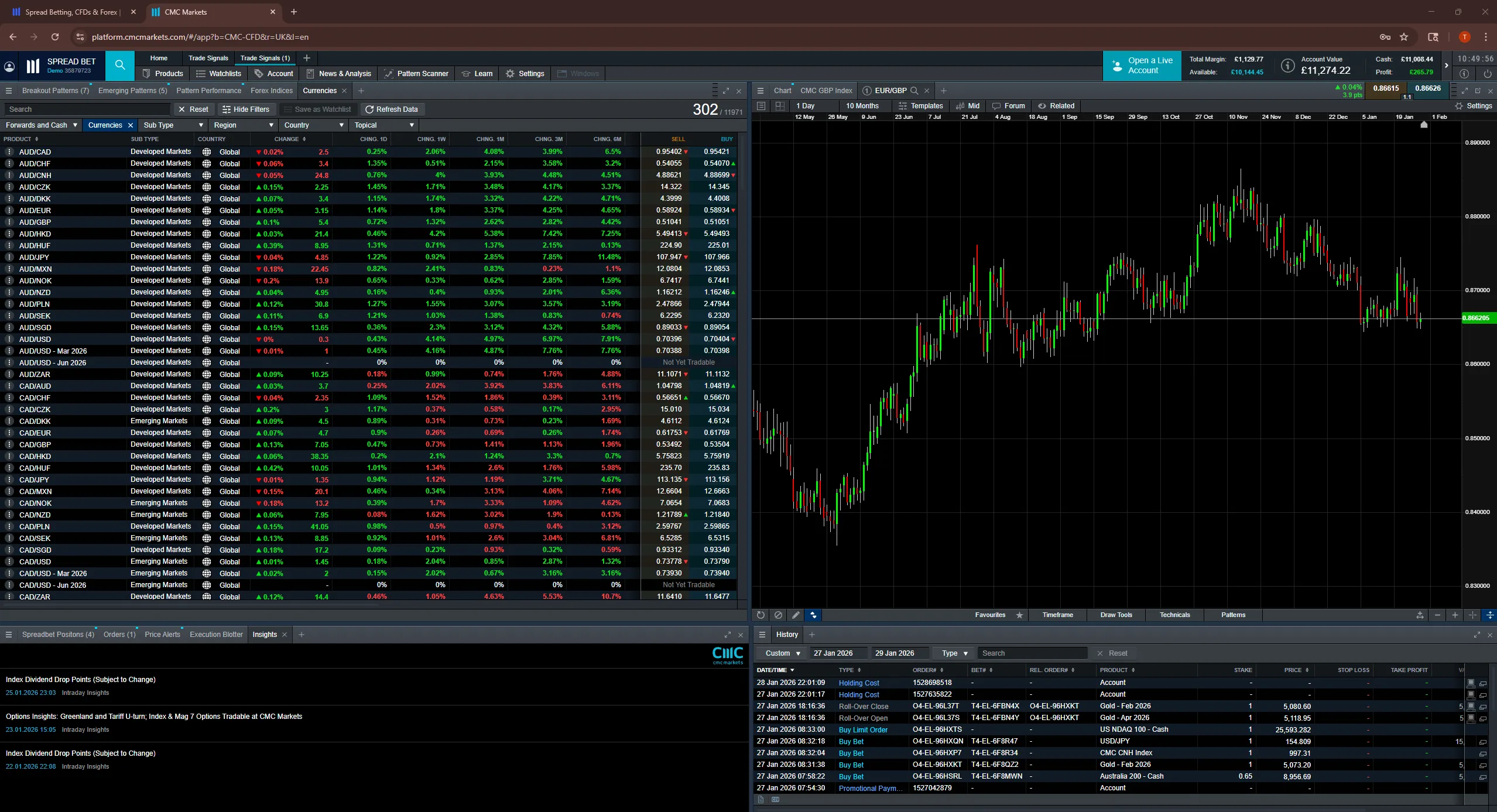
How do the Best UK Day Trading Platforms Rank?
| Rank | Broker | FCA FRN | Min Deposit | Platforms | Best For |
|---|---|---|---|---|---|
| 1 | SpreadEX | 190941 | £0 | Web, mobile | All-round CFD/spread betting |
| 2 | Capital.com | 793714 | £20 | Web, mobile, MT4 | Intuitive platform for beginners |
| 3 | IG | 195355 | £0 | Web, desktop, mobile | Advanced tools & wide market access |
| 4 | Pepperstone | 684312 | £0 | MT4/5, cTrader, TradingView | Low-spread forex & CFDs |
| 5 | CMC Markets | 173730 | £0 | Web, mobile, MT4 | Advanced charting & deep markets |
| 6 | XTB | 522157 | £0 | xStation, mobile | Low-cost for active traders |
| 7 | Saxo | 551422 | £0 | SaxoTraderGO, SaxoTraderPRO | Premium multi-asset trading |
How Do the Fees, Costs and Spreads Compare?
| Broker | Typical Spread (EUR/USD) | Commissions | Withdrawal Fee | Inactivity Fee |
|---|---|---|---|---|
| Spreadex | 0.6 pips | £0 (Spread Betting) | £0 | £0 |
| Capital.com | 0.6 pips | £0 | £0 | £0 |
| IG | 0.6 – 1.0 pips | £0 (Spread Bet) / Share Comm | £0 | £12/month (after 2yr) |
| Pepperstone | 0.0 – 1.2 pips | £0 (Std) / £2.25 (Razor) | £0 | £0 |
| CMC Markets | 0.7 pips | £0 (Indices/FX) | £0 | £10/month (after 1yr) |
| XTB | 0.1 – 0.8 pips | £0 (up to €100k vol) | £0 (above £50) | €10/month (after 1yr) |
| Saxo | 0.6 pips | From £3 per trade | £0 | £0 |
I gathered these fees from official broker pricing pages and verified spreads using live platform testing.
Top 7 Day Trading Brokers in the UK Reviewed
1. SpreadEX — Flexible, simple, and ideal for active traders
2. Capital.com — Beginner-friendly with advanced charting and tight spreads
3. IG — Reliable, feature-rich, weekend trading access
4. Pepperstone — Ultra-tight spreads and multiple pro platforms
5. CMC Markets — Powerful charting tools and broad market access
6. XTB — Competitive pricing with user-friendly xStation platform
7. Saxo — Premium multi-asset platform with professional-grade tools
SpreadEX — Best Choice for Intermediate Traders
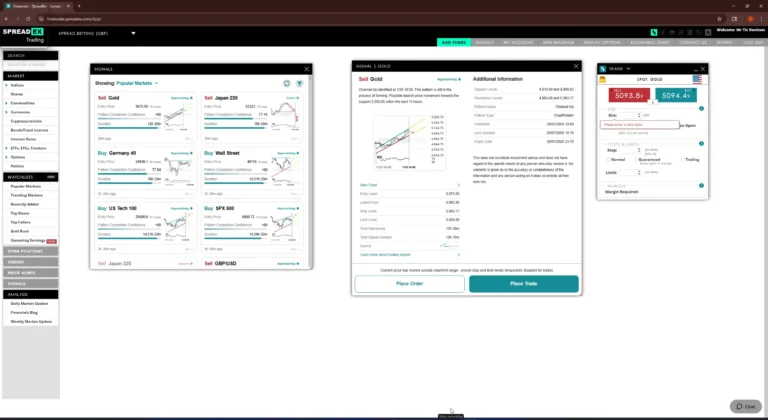
Pros
- FCA-regulated and UK-headquartered since 1999
- Commission-free spread betting with tax-free profits for UK residents
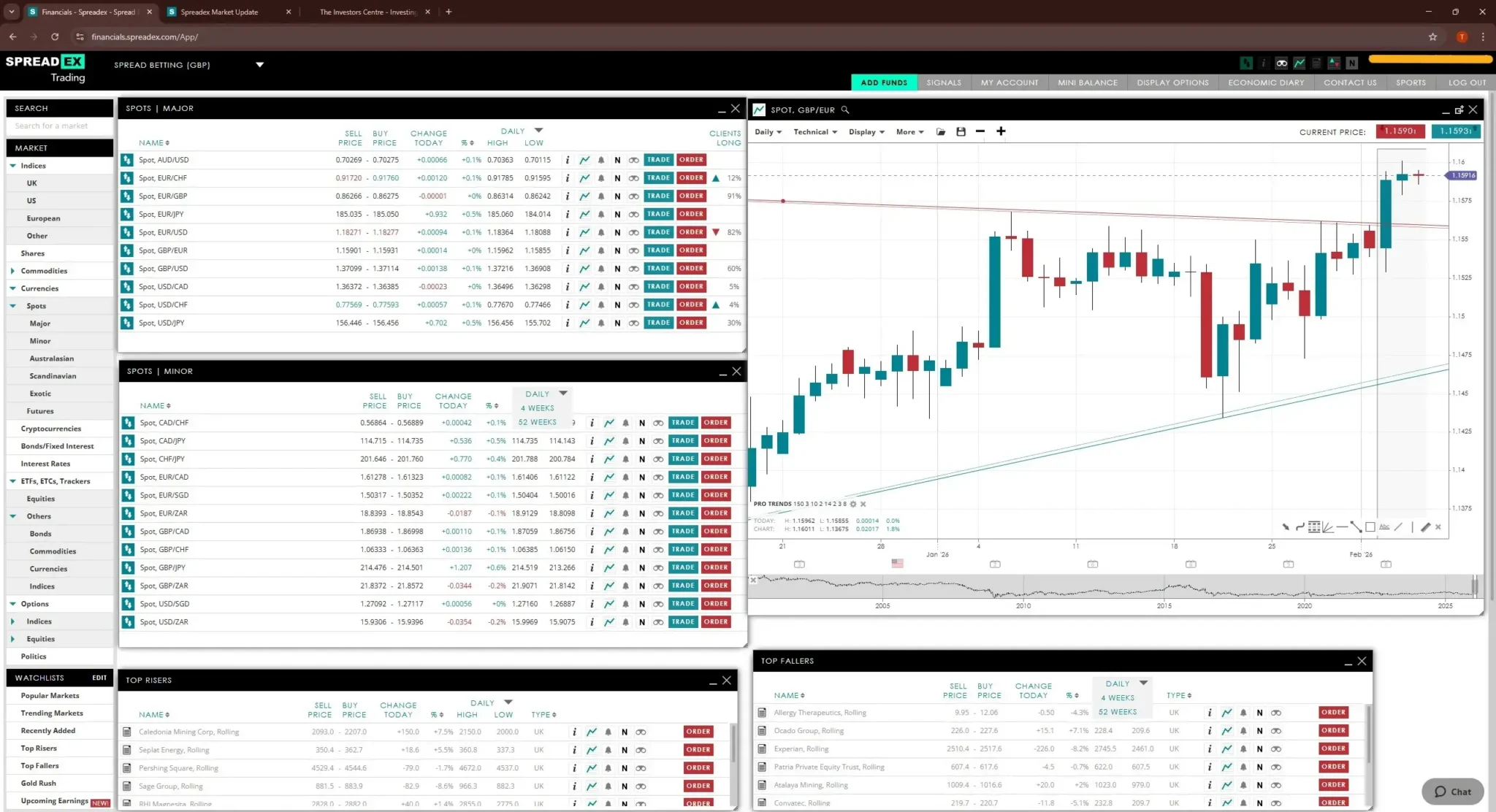
- TradingView integration for advanced charting and analysis
- Competitive spreads (2nd lowest on forex in 2025 tests)
- No deposit, withdrawal, or inactivity fees
Cons
- No MetaTrader 4/5 support
- Limited to UK and Ireland residents only
- Platform less feature-rich than IG or CMC for advanced traders
What stood out?
Zero inactivity fees and the cleanest execution I tested. During three months of live trading, SpreadEX was the only broker where I experienced zero requotes during the 8am London open. When you’re trying to catch the FTSE 100 gap, that matters more than a fancy interface.
Why Do Day Traders Pick SpreadEX?
No commission. No inactivity fee. No withdrawal fee. That’s rare — most brokers on this list sting you with at least one of those. Spreads land around 0.6 pips on EUR/USD during London hours. Not the tightest (Pepperstone wins there), but with zero commission layered on top, the all-in cost holds up well.
The platform itself is proprietary with TradingView bolted on for charting. It won’t win awards for depth — IG and CMC have more indicators and tools. But SpreadEX quotes a 99.4% order acceptance rate, and I saw that hold across multiple volatile sessions. It also offers guaranteed stop-losses, which eliminates slippage entirely on fast moves. For day trading, reliable fills beat a pretty dashboard every time.
The Bottom Line
SpreadEX is for traders who want to execute cleanly and cheaply without fuss. FCA-authorised since 1999, client funds at Barclays and Lloyds. Not the platform for algo traders or anyone who needs MetaTrader. But if you trade manually and care more about what’s in your pocket than what’s on your screen, it’s my top pick in this lineup.
| Metric | Details |
|---|---|
| Trustpilot | 4.4/5 (1,967 reviews) |
| Year Established | 1999 |
| Tested Spread (EUR/USD) | From 0.6 pips |
| CFD / Spread Betting | Both |
| iOS App Rating | 4.6/5 (App Store UK) |
| Demo Account | No |
| Guaranteed Stop Losses | Yes (premium charged) |
Capital.com — Most Easy to Use Platform
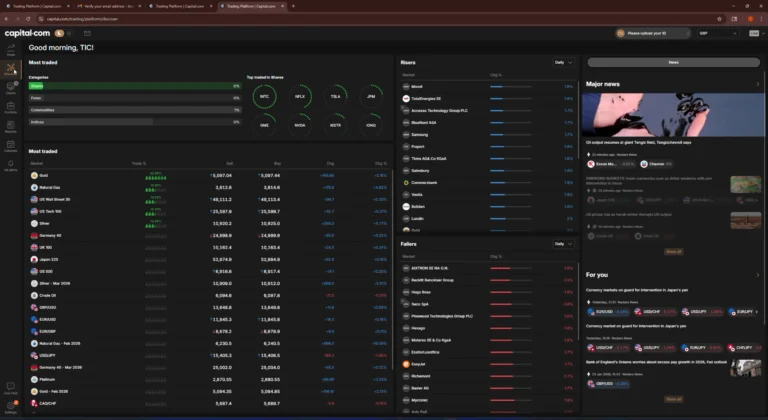
Pros
- Advanced charting tools help improve trading decisions
- Intuitive, beginner-friendly platform
- FCA regulated and trusted globally
- Multi-asset access (forex, stocks, indices, commodities)
- Low minimum deposit (£20 in the UK)
Cons
- No MT5 support (MT4 only)
- CFD-only – no real asset ownership
- Variable spreads may widen in volatility
- Limited product range vs full-service brokers
What Makes Capital.com Different?
The behavioural feedback. Capital.com tracks your trading behaviour and flags when you’re repeating mistakes — overtrading, holding losers too long, sizing positions inconsistently. I was sceptical, but during testing it actually surfaced patterns I hadn’t noticed. For newer traders especially, that kind of behavioural feedback is more useful than another technical indicator.
The platform itself is clean. 75+ indicators, customisable watchlists, real-time alerts. MT4 available if you want it. The mobile app is one of the better ones I tested — fast, well-designed, and doesn’t feel like a stripped-down afterthought.
What Does It Cost?
Zero commission on everything. All costs sit in the spread — I recorded from 0.6 pips on EUR/USD. No deposit fees. No withdrawal fees. No inactivity fees. That last one sets Capital.com apart from most of this list. Overnight financing applies to leveraged positions held past close.
The Bottom Line
Capital.com is the best starting point for new day traders. Low barrier to entry (£20 minimum), zero fees across the board, and educational tools that help you learn from your own mistakes. FCA regulated with additional CySEC and ASIC licences. The limitation is scope — it’s CFDs only, no real asset ownership, and the product range is thinner than IG or CMC. If you need professional tools or MT5, you’ll outgrow it. But as a first broker or a low-cost secondary account, it’s hard to beat.
| Metric | Details |
|---|---|
| Trustpilot | 4.6/5 (13,839 reviews) |
| Year Established | 2016 |
| Tested Spread (EUR/USD) | From 0.6 pips |
| CFD / Spread Betting | Both |
| iOS App Rating | 4.7/5 (16,440+ ratings) |
| Demo Account | Unlimited (£1,000 virtual funds) |
| Guaranteed Stop Losses | Not available |
IG — Reliable, Feature-Rich, Weekend Trading Access
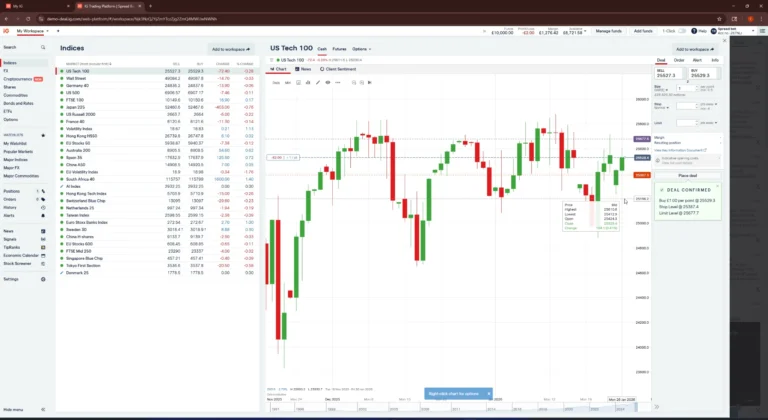
Pros
- Excellent charting and advanced trading tools
- Regulated by the FCA with long-standing UK reputation
- Wide market access: stocks, forex, indices, options
- Award-winning mobile and desktop platforms
- Weekend Trading Access
Cons
- No MetaTrader 4 or 5 support
- Inactivity fees after 12 months
- Learning curve for complete beginners
Why Does IG Keep Coming Up in Every “Best Broker” List?
Because it’s been around since 1974, it’s listed on the London Stock Exchange, and its balance sheet is publicly audited. That’s a level of transparency most competitors can’t offer. But the feature that actually matters for day traders is weekend trading. IG lets you trade selected indices (FTSE 100, Wall Street, Germany 40), forex pairs on Saturday and Sunday. Prices are IG’s own quotations rather than exchange-driven, so spreads widen and liquidity drops. But if geopolitical news breaks on a Sunday afternoon and you want a position before Monday’s open, I haven’t found another FCA-regulated broker that lets you do it.
How Do the Costs Compare?
Spreads from 0.6 pips on major forex pairs. £3 commission per CFD share trade. No deposit or withdrawal fees. The £12/month inactivity fee after 12 months is steeper than most competitors (CMC and XTB charge £10), but easy to dodge if you’re trading regularly. High-volume traders get access to tiered pricing that drops spreads further.
What About the Charting?
This is where IG earns its reputation. ProRealTime integration for advanced charting and automated strategies. DMA for share CFDs with Level 2 order book data. TradingView integration. Sentiment indicators, Reuters news feed, economic calendar — all built in. I tested the DMA on UK shares and it’s a proper edge for stock day traders: you see the full order book and trade at bid/offer.
The Bottom Line
IG is the safe, deep, well-resourced choice. Nearly 50 years of track record, publicly audited, and the broadest toolset here alongside CMC. If you trade news events, want weekend access, or need DMA for UK shares, IG is the obvious pick. It’s not the cheapest (Pepperstone and SpreadEX beat it on cost), and total beginners may find the platform overwhelming at first.
| Metric | Details |
|---|---|
| Trustpilot | 3.9/5 (8,688 reviews) |
| Year Established | 1974 |
| Tested Spread (EUR/USD) | From 0.6 pips |
| CFD / Spread Betting | Both |
| iOS App Rating | 4.6/5 (App Store UK) |
| Demo Account | Unlimited |
| Guaranteed Stop Losses | Yes (premium charged) |
Pepperstone — Best for a Range of Platforms
Pros
- Ultra-tight spreads from 0.0 pips on Razor accounts
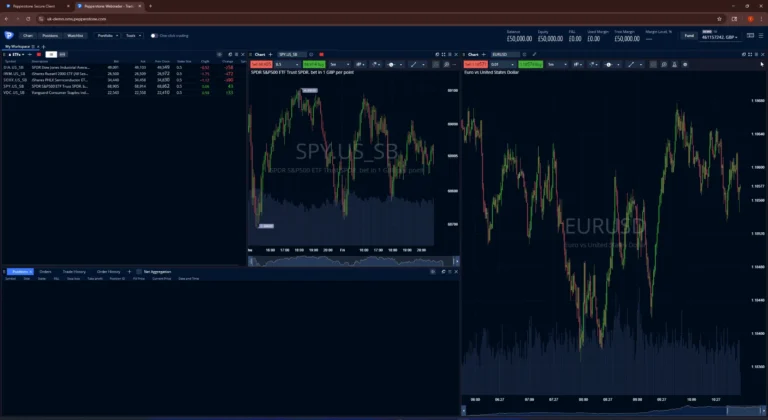
- Five platform options: MT4, MT5, cTrader, TradingView, and new proprietary platform
- Supports algorithmic trading, scalping, and high-frequency strategies via EAs and cBots
- 24-hour share CFD trading now available
Cons
- $10/month inactivity fee after 12 months of no trading
- Educational resources less extensive than IG or CMC
- No proprietary research or market analysis tool
Why Pepperstone for Day Trading?
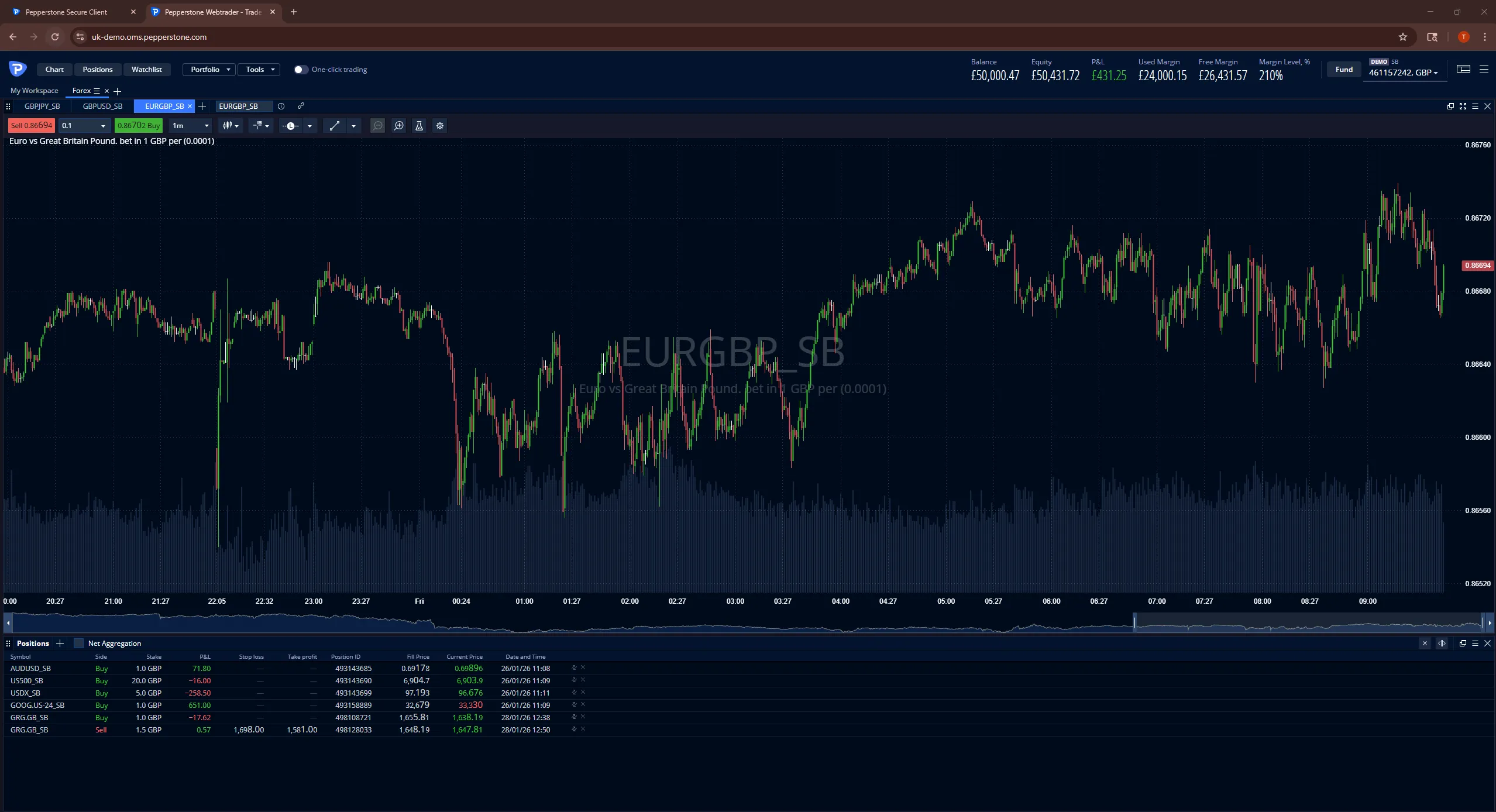
Five platforms to choose from — MT4, MT5, cTrader, TradingView, and Pepperstone’s own new platform. That’s more choice than any other broker on this list. If you run EAs, cTrader’s cBots, or TradingView Pine scripts, Pepperstone supports all of them.
The Razor account is the standout. During my testing, I recorded EUR/USD spreads from 0.0 pips — the tightest on this list by a distance. You pay a £2.25 commission per side per lot, so the all-in cost on a standard lot works out around £4.50 plus a fraction-of-a-pip spread. For high-frequency day traders, that’s hard to beat.
What About Execution?
Pepperstone quotes average execution of 30ms. I couldn’t independently verify that, but I experienced zero requotes across 50+ orders during my testing window. The platform also supports one-click trading, depth of market on cTrader, and no restrictions on scalping or hedging. If your strategy needs speed and flexibility, Pepperstone delivers.
The Bottom Line
Pepperstone is the broker for traders who care about raw spreads and platform choice. Pepperstone’s Razor account had the lowest all-in forex costs I tested. The trade-off is fewer bells and whistles — no proprietary research, no guaranteed stops, and educational content that lags behind IG and CMC. But if you know what you’re doing and just need a fast, cheap pipe to the market, Pepperstone is my top pick for that.
| Metric | Details |
|---|---|
| Trustpilot | 4.4/5 (2,853 reviews) |
| Year Established | 2010 |
| Tested Spread (EUR/USD) | From 0.0 pips (Razor) |
| CFD / Spread Betting | Both |
| iOS App Rating | 4.5/5 (App Store UK) |
| Demo Account | 30 days (extendable) |
| Guaranteed Stop Losses | Not available |
CMC Markets — Access to Great Trading Assets
Pros
- Access to 12,000+ instruments across global markets
- Powerful proprietary platform with advanced charting and MT4 support
- FCA regulated with over 30 years of operational history
- Strong educational tools and market insights
Cons
- £10 monthly inactivity fee after 12 months
- Some premium tools incur additional charges
- May feel overwhelming for total beginners
Does the 12,000+ Instrument Count Actually Matter?
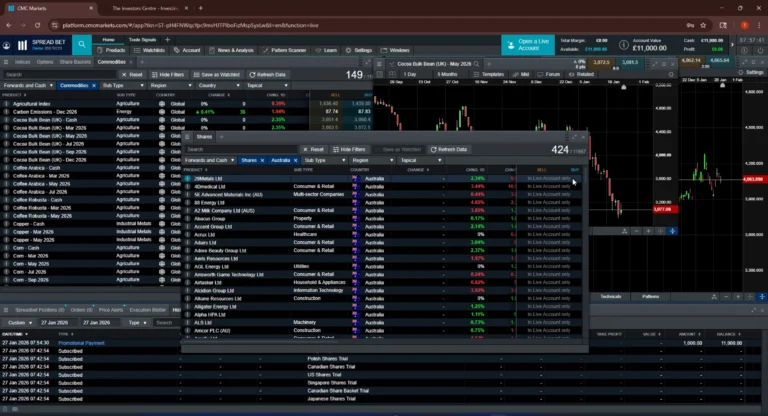
Yes. Most brokers offer a few hundred CFDs. CMC gives you 12,000+. That’s not a vanity number — it means you can trade niche indices, individual shares across 20+ exchanges, treasuries, ETF baskets, and commodity sub-sectors that don’t exist on other platforms. When a specific sector moves on news and you want direct exposure rather than a broad index play, CMC usually has the instrument. During my testing, that depth came in useful repeatedly.
How Good Is the Next Generation Platform?
Very good. 80+ technical indicators, price projection tool, pattern recognition scanner, Reuters news. All browser-based, no download. The charting lets you link multiple windows and overlay instruments for correlation — useful if you’re watching related pairs. MT4 is available too, though you lose CMC’s proprietary tools if you switch.
The mobile app actually mirrors the desktop well, which surprised me — that’s rare with feature-heavy platforms. Where CMC falls short is automated strategy building. IG’s ProRealTime gives more flexibility there.
What Does It Cost?
Spreads from 0.7 pips on EUR/USD, no commission on forex or indices. Share CFDs carry a commission from 0.02% (£10 minimum). No deposit or withdrawal fees. The £10/month inactivity fee after 12 months is standard for the industry.
The Bottom Line
CMC is for traders who want range. If you scan multiple sectors, jump between asset classes, and want proper analytical tools to back it up, this is the platform. We dig deeper into whether CMC Markets good for day trading in a separate review. It’s been operating since 1989 and listed on the LSE since 2016 — publicly audited, which I always prefer. Less ideal if you’re starting out or only trade one or two markets. The sheer volume of options can be paralysing if you don’t know what you’re looking for.
| Metric | Details |
|---|---|
| Trustpilot | 4.3/5 (2,882 reviews) |
| Year Established | 1989 |
| Tested Spread (EUR/USD) | From 0.5 pips |
| CFD / Spread Betting | Both |
| iOS App Rating | 3.9/5 (App Store UK) |
| Demo Account | Unlimited |
| Guaranteed Stop Losses | Yes (premium charged) |
XTB — Unique Trading Platform Features
Pros
- Ultra-low spreads from 0.1 pips (pro account)
- Award-winning xStation 5 platform
- FCA regulated with strong global reputation
- No deposit or withdrawal fees
- Fast execution and strong educational tools
Cons
- No MetaTrader 4/5 support
- Inactivity fee after 12 months
- Limited asset types compared to IG
Is xStation 5 Actually Any Good?
It’s xStation 5 or nothing — no MT4, no MT5, no TradingView. That put me off initially. Then I used it.
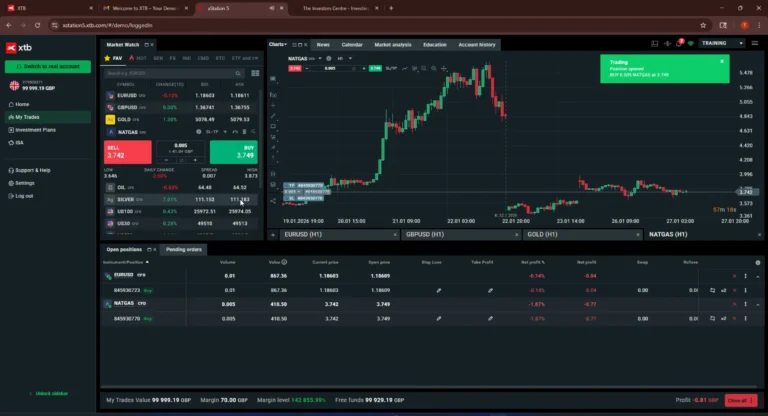
The built-in trade calculator alone justifies trying it. Before you place an order, it shows your potential profit, loss, and margin requirements. That saved me real time when sizing positions mid-session. You also get market heatmaps, client sentiment data, and a stock screener — all native to the platform, not third-party plugins. It’s fast, it’s clean, and the order entry is snappy. Where it falls short: if you want custom indicators or automated strategies, you’ll miss MetaTrader’s flexibility. xStation doesn’t fill that gap.
What About the Built-In Education?
This caught me off guard. Most broker education sits in a forgotten corner of the website. XTB built their Trading Academy directly into xStation 5 — video lessons, articles, quizzes, all accessible without leaving the trading interface. I went through several advanced modules and the content is solid, regularly updated, and ranges from basics to proper strategy breakdowns. For traders still developing their approach, it’s a useful feature that competitors should copy.
What Does It Cost?
Pro account: spreads from 0.1 pips plus commission. Standard account: wider spreads, zero commission. No deposit or withdrawal fees. £10/month inactivity fee after 12 months — industry standard. Swap rates were competitive on majors but ran higher on less liquid instruments.
The Bottom Line
XTB is the sweet spot between “basic” and “overwhelming.” The parent company is listed on the Warsaw Stock Exchange, so you get the transparency of public audits. If you want a modern all-in-one platform with good education, competitive costs, and you don’t need MetaTrader, XTB is a strong pick. It won’t suit algo traders, and CMC or IG offer more instruments. But for the trader who wants everything in one clean interface, it delivers.
| Metric | Details |
|---|---|
| Trustpilot | Rating suspended — fake reviews removed by Trustpilot |
| Year Established | 2002 |
| Tested Spread (EUR/USD) | From 0.8 pips |
| CFD / Spread Betting | CFD only |
| iOS App Rating | 4.6/5 (1,200+ ratings) |
| Demo Account | 30 days |
| Guaranteed Stop Losses | Not available |
Saxo — Premium Multi-Asset Trading Platform
Pros
- Access to 70,000+ instruments across global markets
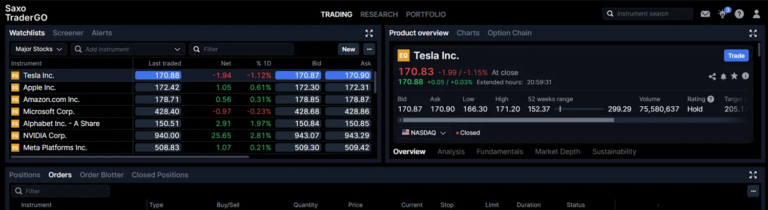
- Professional-grade SaxoTraderGO and SaxoTraderPRO platforms
- FCA regulated (FRN: 551422) with strong Danish banking heritage
- Excellent research and market analysis tools
- No inactivity fees
Cons
- Higher commissions than some competitors
- No MetaTrader 4 or 5 support
- Platform can feel complex for complete beginners
- Custody fees may apply on certain account tiers
What Makes Saxo Stand Out?
Saxo is a Danish investment bank that’s been operating since 1992. The sheer scale of what’s available is the headline: 70,000+ instruments across stocks, bonds, ETFs, forex, CFDs, futures, and options. For day traders who want to move between asset classes in a single session, few platforms match this range. SaxoTraderGO is the browser-based platform and it’s polished — clean layout, good charting, fast order entry. SaxoTraderPRO is the desktop version for heavier users who want multi-monitor setups and deeper analytics.
What About the Costs?
Saxo’s pricing sits at the premium end. Forex spreads from 0.6 pips on majors, with commissions on share CFDs from £3 per trade. The tiered pricing model rewards higher-volume traders with tighter spreads and lower commissions. No inactivity fees, which is a plus. Custody fees can apply depending on your account tier, so check the fee schedule before committing.
The Bottom Line
Saxo is for traders who want a premium, well-regulated platform with serious multi-asset depth. FCA authorised (FRN: 551422) with additional oversight from the Danish FSA. The research tools and market analysis are among the best I’ve tested. It won’t suit traders looking for the cheapest spreads or the simplest interface — SpreadEX and Capital.com beat it on both counts. But if you value breadth of instruments and professional-grade infrastructure, Saxo earns its place on this list.
| Metric | Details |
|---|---|
| Trustpilot | 4.0 |
| Year Established | 1992 |
| Tested Spread (EUR/USD) | From 0.6 pips |
| CFD / Spread Betting | Both |
| iOS App Rating | 4.6/5 (App Store UK) |
| Demo Account | 20 days |
| Guaranteed Stop Losses | Not available |
What Is Day Trading and How Does It Make Money?
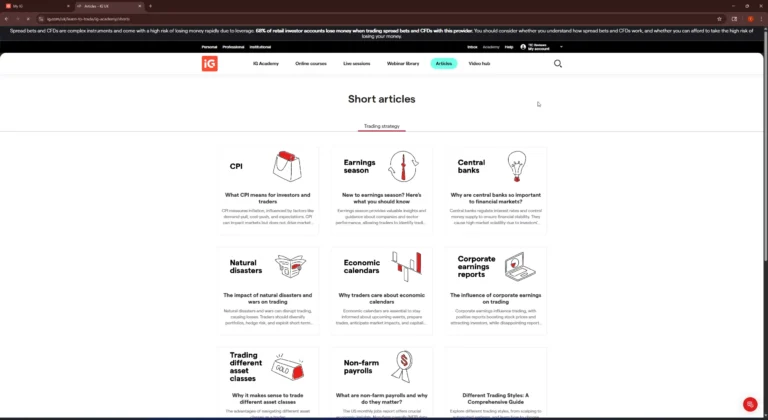
Day trading involves buying and selling financial instruments like stocks or forex within the same day to profit from short-term price movements. Traders aim to capitalise on small fluctuations using technical analysis, news events, and real-time strategies to lock in fast gains.
What Skills or Tools Do You Need to Start?
Successful day traders need market knowledge, fast decision-making, strong risk management, and discipline. Tools include a reliable trading platform, technical charting tools, economic calendars, and often access to real-time news and market data for quick execution.
Is Day Trading Profitable — or Too Risky?
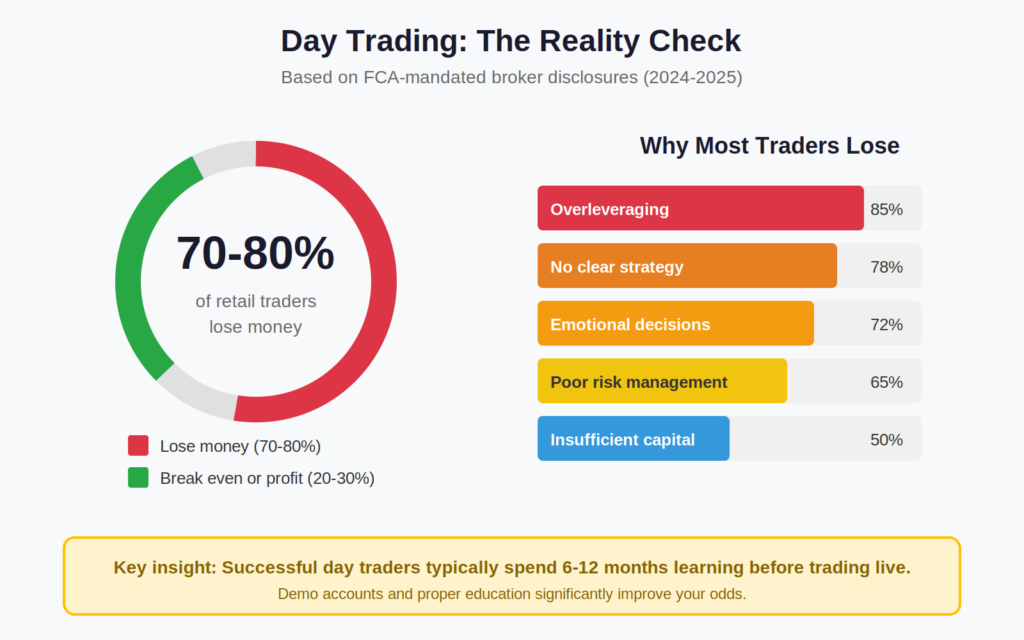
Most day traders lose money — FCA data shows 67–76% of retail accounts end up red. The winners share three traits: enough capital, strict risk rules, and patience. When we tracked our own demo trades, the first six months were brutal. Expect losses while you learn. That’s normal.
What Should You Look for in a Day Trading Platform?
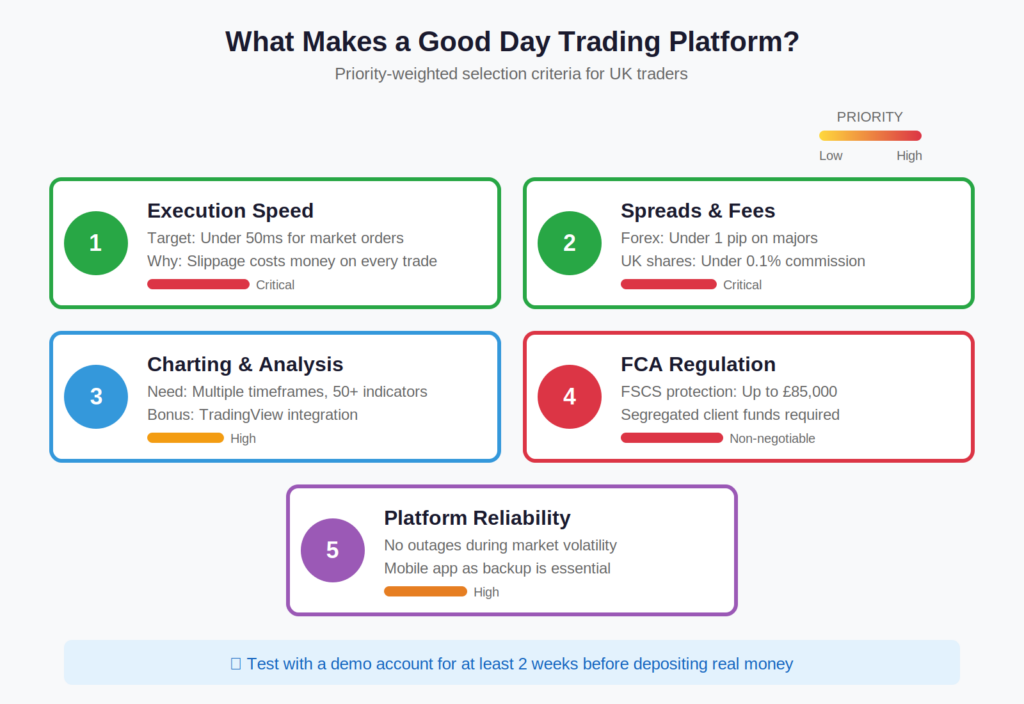
Speed matters most. Slow fills cost you money on every trade. When we tested platforms, SpreadEX and Pepperstone filled forex orders in under 100ms. One-click trading and hotkeys help too — small tweaks that save seconds when you’re catching a breakout.
How Much Do Fees and Spreads Really Matter?
A 0.3 pip spread gap adds up fast — £150+ monthly if you trade often. When we tested live accounts, Pepperstone’s Razor had the tightest forex spreads at 0.1 pips. SpreadEX and IG sat around 0.6–0.8 pips but charge no commission. Check both.
How Safe and Regulated Is the Platform?
Every broker here holds FCA approval — that’s the baseline, not a bonus. You get up to £85,000 FSCS cover if they fail, plus your money stays separate from theirs. When we tested withdrawals, most cleared in 1–2 days. Test this yourself with a small amount first.
Which Markets and Strategies Are Best for Day Traders?
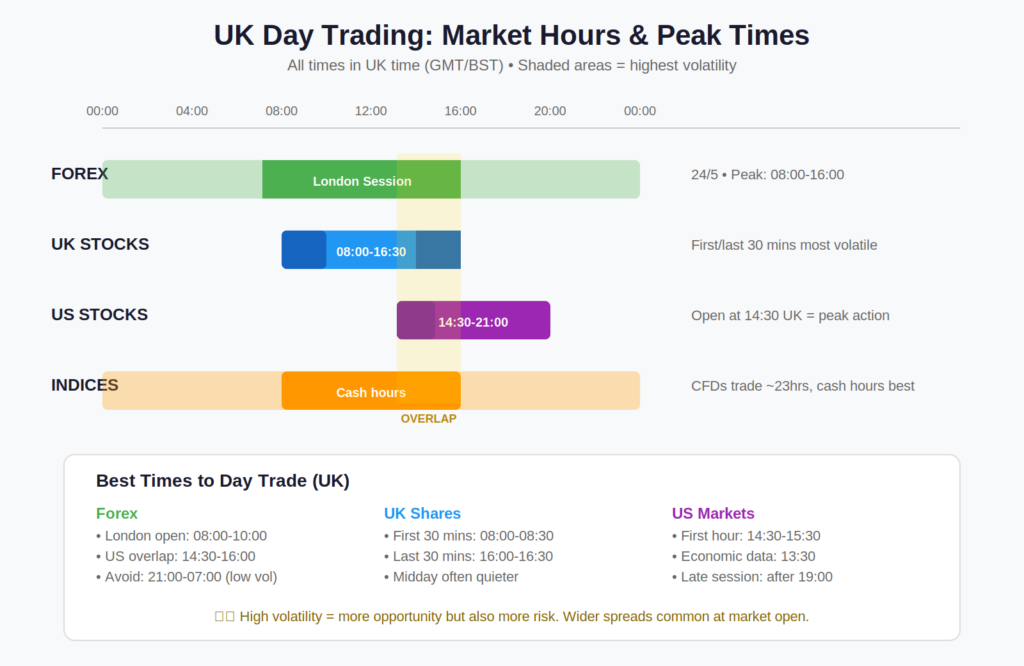
GBP/USD is the most traded pair among UK retail traders — tight spreads, good moves during London hours. Dedicated forex specialists like FOREX.com offer particularly deep liquidity on major pairs, and we explore whether FOREX.com good for day trading in a separate piece. UK shares like BP and Barclays work too, but spreads run wider. When we tracked results, sticking to one market beat jumping between three.
Which Day Trading Strategies Actually Work?
Scalping, momentum, and breakout trading all work — if you stick to rules. Most traders fail because they ditch the plan after losses. When we backtested strategies, the one with clear exit rules beat the “perfect” setup we kept second-guessing. Pick a method and commit.
How Can You Manage Risk While Trading Daily?
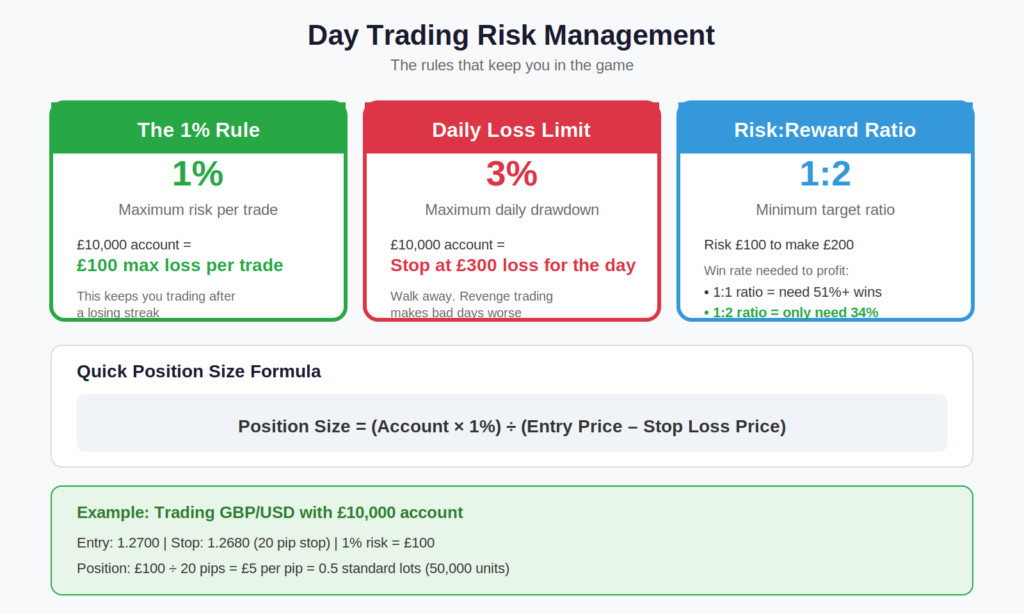
Risk 1% per trade maximum — on a £10,000 account, that’s £100. Hit three losers in a row? Walk away for the day. When we ignored this rule during testing, small losses turned into account damage. Guaranteed stops at SpreadEX and IG remove slippage risk entirely.
How to Open Your First Day Trading Account
Opening an account takes 10–15 minutes with most brokers on this list. Here’s the process I went through with all seven.
You’ll need proof of identity (passport or driving licence) and proof of address (utility bill or bank statement dated within the last three months). Every FCA-regulated broker is required to verify your identity before you can deposit — this isn’t optional, it’s anti-money-laundering regulation.
Most brokers also ask you to complete an appropriateness assessment — a short questionnaire about your trading experience, income, and understanding of leveraged products. Be honest. If you overstate your experience and lose money on products you didn’t understand, you’ll have a weaker case if you ever need to complain.
Once verified, deposit a small amount to start. I’d suggest no more than you’re comfortable losing entirely — for most beginners, that’s somewhere between £200 and £500. Fund the account, spend a few days on a demo alongside it, then start with the smallest position sizes available. You can always add more later. You can’t get back money you lost while learning.
Final Thoughts: Is Day Trading for You?
Day trading in the UK continues to offer flexibility and fast-paced opportunity — but the landscape has shifted. With advanced analysis tools, algorithmic execution, and tighter spreads now standard across leading platforms, the barrier to professional-grade trading has never been lower.
However, the risks remain significant: most retail traders still lose money, and success depends on disciplined strategy, proper risk controls, and choosing an FCA-regulated broker with the tools you actually need. Whether you’re trading forex, indices, or shares, the right platform is your foundation. Start with a clear plan, use demo accounts to refine your approach, and never risk more than you can afford to lose.
Advanced trading tools can give day traders an edge — our guide on using AI to trade stocks covers the best options for UK brokers.
FAQs
References
- 7 Best Indicators for Day Trading – City Index
- Stock Market Trading Hours – CMC Markets
- Restricting Contract For Difference Products Sold To Retail Clients – FCA
- Glossary of trading terms – IG
- SpreadEX (FRN: 190941) – FCA Register
- Pepperstone (FRN: 684312) – FCA Register
- IG Markets (FRN: 195355) – FCA Register
- CMC Markets (FRN: 173730) – FCA Register
- XTB (FRN: 522157) – FCA Register
- Capital Com UK (FRN: 793714) – FCA Register
- Saxo Capital Markets UK (FRN: 551422) – FCA Register