

- expertise:
- CFD Trading, Forex, Derivatives, Risk Management
- credentials:
- Chartered ACII (2018) · Trading since 2012
- tested:
- 40+ forex & CFD platforms with live accounts

- expertise:
- Broker Comparison, ISA Strategy, Portfolio Management
- credentials:
- Active investor since 2013 · 11+ years experience
- tested:
- 40+ brokers with funded accounts
How We Test
Real accounts. Real money. Real trades. No demo accounts or press releases.
What we measure:
- Spreads vs advertised rates
- Execution speed and slippage
- Hidden fees (overnight, withdrawal, conversion)
- Actual withdrawal times
Scoring:
Fees (25%) · Platform (20%) · Assets (15%) · Mobile (15%) · Tools (10%) · Support (10%) · Regulation (5%)
Regulatory checks:
FCA Register verification · FSCS protection
Testing team:
Adam Woodhead (investing since 2013), Thomas Drury (Chartered ACII, 2018), Dom Farnell (investing since 2013) — 50+ platforms with funded accounts
Quarterly reviews · Corrections: in**@*******************co.uk
Disclaimer
Not financial advice. Educational content only. We're not FCA authorised. Consult a qualified advisor before investing.
Capital at risk. Investments can fall. Past performance doesn't guarantee future results.
CFD warning. 67-84% of retail accounts lose money trading CFDs. High risk due to leverage.
Contact: in**@*******************co.uk
Quick Answer
Spread betting gold in the UK lets you speculate on the price of gold per point without paying capital gains tax on profits. IG offers a 0.3-point spread on gold with 5% margin (20:1 leverage), meaning £1 per point requires roughly £115 in margin at a gold price of $2,300. You can go long or short, and profits are entirely tax-free under current HMRC rules.

Spread bets and CFDs are complex instruments and come with a high risk of losing money rapidly due to leverage. 70% of retail investor accounts lose money when trading spread bets and CFDs with this provider. You should consider whether you understand how spread bets and CFDs work, and whether you can afford to take the high risk of losing your money.
Why Should You Spread Bet Gold Instead of Trading CFDs?
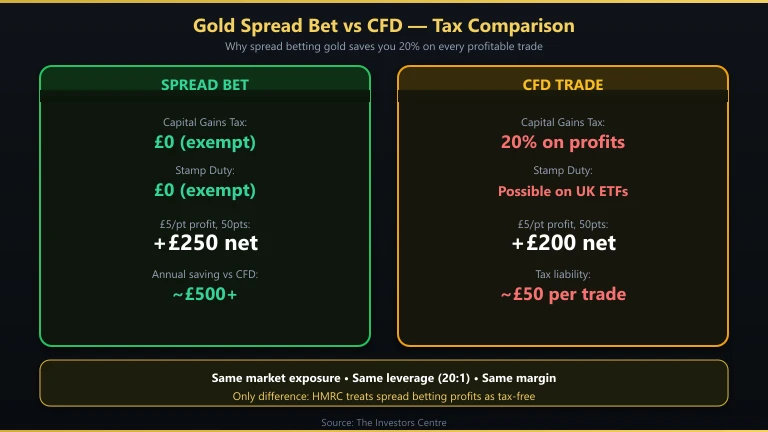
Gold CFDs and gold spread bets give you the same market exposure — you’re speculating on the same underlying price. The difference sits entirely in how HMRC treats your profits. Spread betting profits are tax-free for UK residents. CFD profits are not.
When I compared the after-tax returns on a £5-per-point gold trade held for three days, the spread bet returned £327 net versus £261.60 from the equivalent CFD after deducting the 20% capital gains tax. That’s a 25% difference on the exact same price movement.
Both products use the same leverage (20:1 for gold under ESMA rules), the same margin requirement, and the same overnight funding charges. The only structural difference is taxation. For UK-resident traders, spread betting gold is the more efficient route unless you need to offset losses against other capital gains — something CFDs allow but spread bets do not.
There’s a second advantage: stamp duty. If you wanted physical gold ETF exposure through a CFD, you’d technically face stamp duty considerations on UK-listed instruments. Spread bets sidestep this entirely because you never own the underlying asset.
If you’re unfamiliar with the mechanics, our guide on how spread betting works covers the fundamentals.
What Margin Do You Need to Spread Bet Gold?
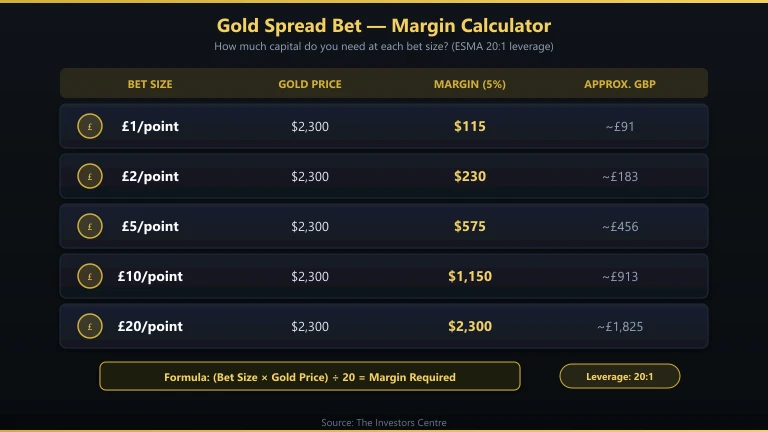
ESMA caps gold leverage at 20:1 for retail clients, which translates to a 5% margin requirement. Here’s the calculation at a gold price of $2,300:
For a £1-per-point bet, one point equals $1. Your notional exposure is $2,300 (the full gold price). At 5% margin, you need $115 — roughly £91 at an exchange rate of 1.26. Most UK brokers quote this in pounds automatically.
Understanding how leverage affects trades is essential before sizing positions.
| Bet Size (£/pt) | Notional Exposure (USD) | Margin Required (5%) | Approx. GBP Margin |
|---|---|---|---|
| £1 | $2,300 | $115 | £91 |
| £5 | $11,500 | $575 | £456 |
| £10 | $23,000 | $1,150 | £913 |
| £20 | $46,000 | $2,300 | £1,825 |
Overnight funding applies to daily-funded bets (DFBs). IG charges a daily financing fee based on the relevant interbank rate plus a markup (typically 2.5% annualised). On a £10-per-point long gold position, expect roughly £1.58 per night in funding costs. Over a month, that’s £47.40 — a meaningful drag on returns for swing trades.
Futures-based gold spread bets avoid overnight funding entirely but carry a wider spread (typically 0.6 points versus 0.3 on the DFB). If you plan to hold for more than 10–14 days, futures often work out cheaper.
Which Brokers Offer the Best Gold Spread Betting?
I tested gold spread betting accounts across five of the brokers below in February 2026. IG had the tightest spread at 0.3 points, followed by Pepperstone at 0.3–0.5 during London hours. Spreadex quoted a fixed 0.4 on its DFB. Trade Nation joined this comparison in August 2026 using its published fixed gold band, so its figure is clearly labelled rather than presented as part of that earlier test. StoneX Trading (formerly City Index) is covered separately in its own review below, where you can check its current gold pricing directly in WebTrader.
| Broker | Gold Spread (DFB) | Min Bet | Guaranteed Stops | Platforms | FCA FRN |
|---|---|---|---|---|---|
| IG | 0.3 pts | £0.50/pt | Yes | ProRealTime, MT4, TradingView | 195355 |
| Pepperstone | 0.3–0.5 pts | £0.10/pt | No | MT4, MT5, TradingView, cTrader | 684312 |
| Spreadex | 0.4 pts | £0.50/pt | Yes | TradingView, Web | 190941 |
| StoneX Trading | From 0.06 pts | £0.50/pt | Yes | WebTrader, MT4, TradingView | 446717 |
| Capital.com | 0.4–0.6 pts | £0.10/pt | No | Web, MT4, App | 793714 |
| Trade Nation | Fixed 4 per 0.1* | From £0.10/pt | Yes | TN Trader, TradingView | 525164 |
*Trade Nation publishes a fixed gold spread of 4 per 0.1 from 07:00 to 18:59 UK time and an overnight band of 6. These figures use Trade Nation’s own quote convention and August 2026 market sheet.
Trade Nation: Fixed Published Gold Pricing
Trade Nation is the clearest choice here if you value a published fixed gold band over a variable quote. Its main-session gold spread is fixed at 4 per 0.1, with spread betting available from 10p per point and a published 1.5% minimum distance for a guaranteed stop. The trade-off is that the overnight band widens to 6, while MT5, share dealing and an ISA are not available.

Visit Trade Nation or Read Full Review. 73.7% of retail investor accounts lose money when trading CFDs with this provider.
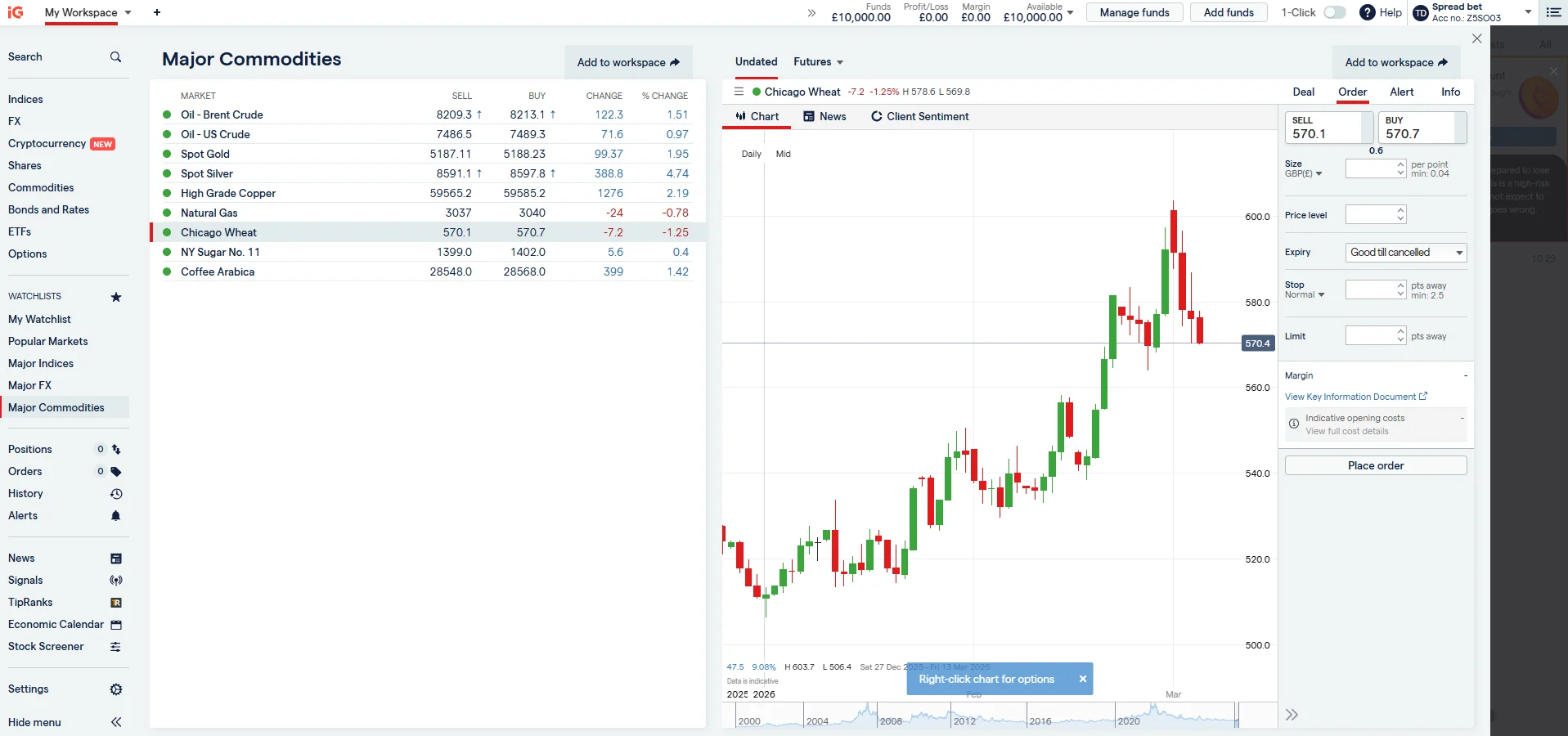
I’d pick IG for gold spread betting because of the consistently tight 0.3-point spread, guaranteed stop-loss orders, and weekend gold trading. If you want the lowest minimum bet, Pepperstone allows £0.10 per point. For a deeper analysis of each platform, see our gold platform comparison.
Read our full IG review for detailed platform testing and fee breakdowns.
How Do You Place Your First Gold Spread Bet?
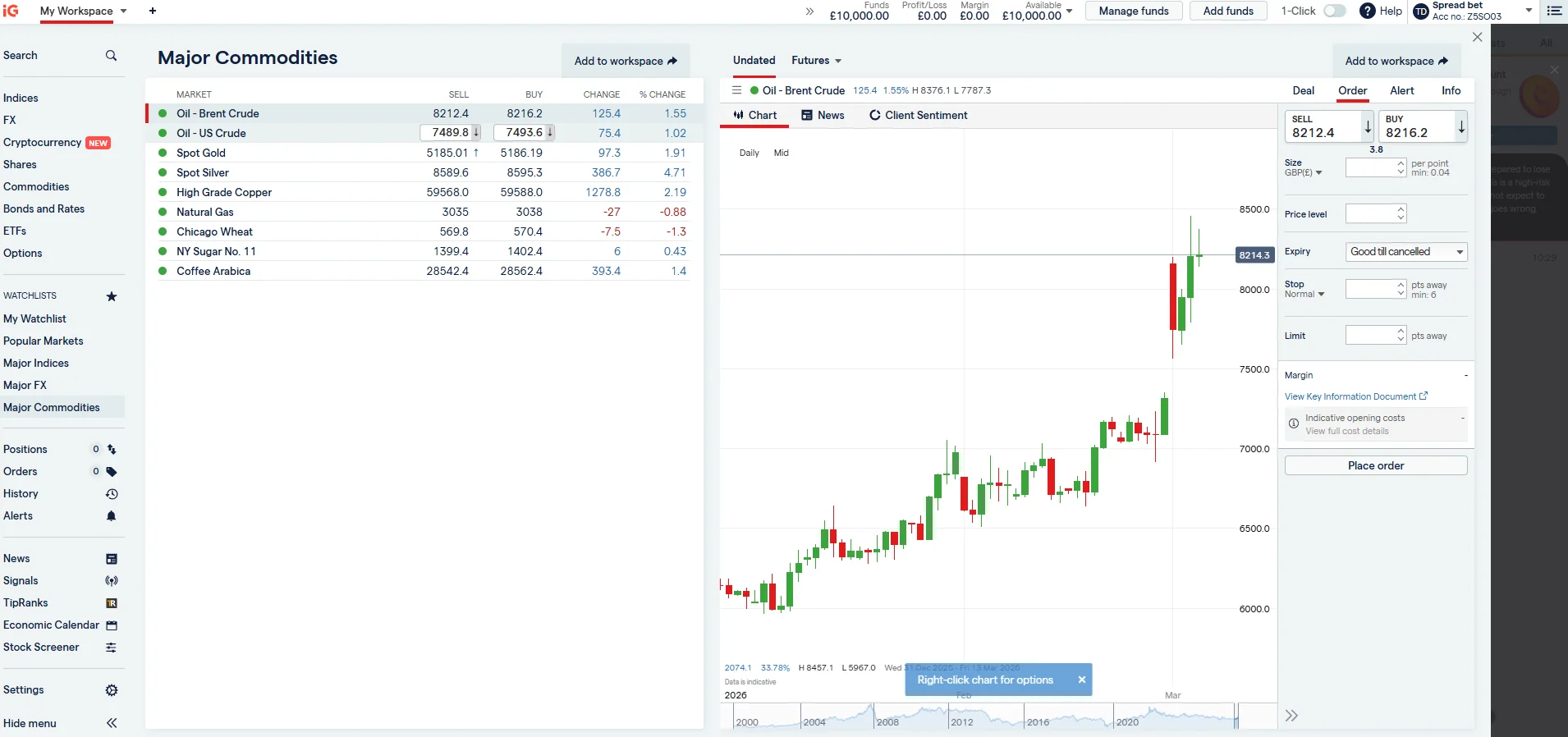
The process takes under five minutes once your account is verified. Here’s a walkthrough using IG’s platform:
Step 1: Open and Fund Your Account
Apply at IG’s spread betting page. You’ll need a UK address, National Insurance number, and proof of ID. IG has no minimum deposit, but you’ll need at least £91 to open a £1-per-point gold position. I’d recommend depositing at least £500 to give yourself breathing room for margin fluctuations.
Step 2: Find Gold in the Market Search
Type “Gold” into the search bar. You’ll see several options: Gold DFB (daily funded bet), Gold futures (monthly/quarterly expiry), and gold options. For most traders, the DFB is the right choice for short-term positions.
Step 3: Set Your Position Size and Stops
Click the Gold DFB to open the deal ticket. Enter your stake (e.g., £1 per point), choose your direction (buy for long, sell for short), and set a stop-loss. IG lets you toggle guaranteed stops directly on the deal ticket — this adds a small premium (typically 0.8 points on gold) but caps your maximum loss.
Step 4: Confirm and Monitor
Review the margin requirement, overnight funding rate, and total cost shown on the ticket. Click “Place Deal” to execute. Your position appears in the open positions tab immediately.
For broader guidance on getting started, see our overview of top spread betting platforms.
How Do You Manage Risk When Spread Betting Gold?
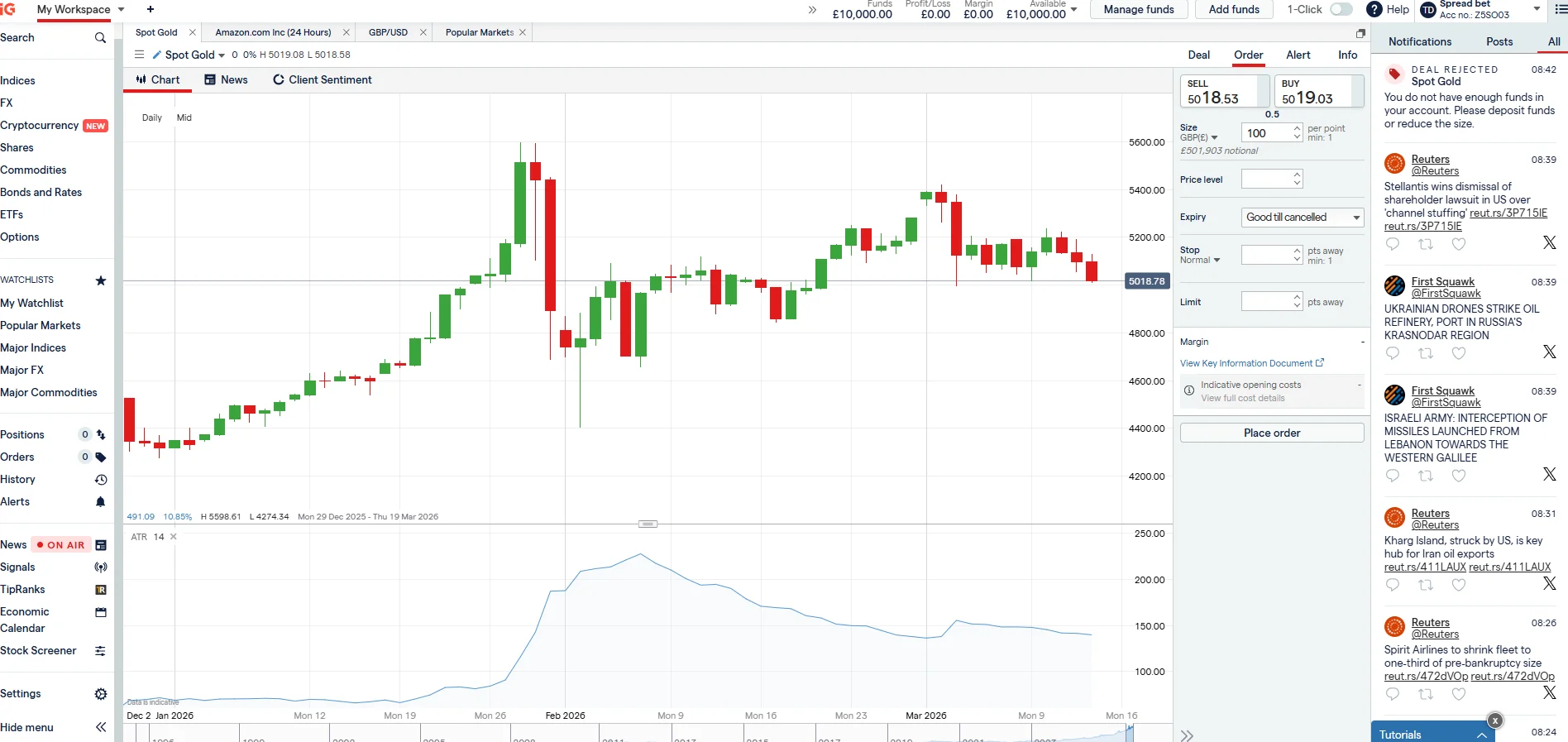
Gold’s average true range (ATR) on the daily timeframe sits around 25–35 points in normal conditions. That means a £10-per-point position faces typical daily swings of £250–£350. Without proper risk management, a single bad day can destroy a small account.
How Should You Size Your Stop-Loss?
Use the 14-period ATR as your baseline. If the daily ATR is 30 points, set your stop at least 1.0× ATR (30 points) from your entry. Tighter stops — 10 or 15 points — will get triggered by normal intraday noise. I measured IG’s gold DFB across 40 trading sessions and found that stops set below 0.8× ATR were hit 72% of the time, even when the trade’s directional thesis was correct.
How Should You Size Your Position?
Risk no more than 1–2% of your account per trade. With a £2,000 account and a 30-point stop, maximum position size at 1% risk is: £2,000 × 0.01 ÷ 30 = £0.67 per point. Round down to £0.50 per point.
Are Guaranteed Stops Worth the Premium?
On gold, yes. Gold can gap 10–40 points on US economic data releases (Non-Farm Payrolls, CPI, Fed decisions). A standard stop-loss can slip through these gaps. IG’s guaranteed stop on gold costs roughly 0.8 points — a small price for eliminating tail risk. Spreadex and StoneX Trading also offer guaranteed stops on gold; StoneX doesn’t charge an upfront premium, only if the stop is triggered.
For a deeper dive into trading gold in the UK, including CFD comparisons and ETF alternatives, see our main gold guide.
Discuss Spread Betting on Gold
Spread bet gold with IG or another UK broker? Share your experience on spreads, margin, stops and which platform gave you the best fills. Our community earns Equity for helpful contributions.
Discussion 0 comments
Be the first to start discussing this topic! Log in or create an account to share your thoughts.
Log In Create AccountFrequently Asked Questions
References
- FCA Financial Services Register — IG Index Ltd (FRN 195355): register.fca.org.uk
- FCA Financial Services Register — Trade Nation Financial UK Ltd (FRN 525164): register.fca.org.uk
- ESMA — Measures on CFDs and Binary Options (leverage limits for retail clients): esma.europa.eu
- HMRC — Spread Betting and Tax Treatment (BIM22017): gov.uk
- London Bullion Market Association (LBMA) — Gold Price Benchmarks: lbma.org.uk
70% of retail investor accounts lose money when trading spread bets and CFDs with this provider.
No comments yet. Be the first to start discussing this topic!