

- expertise:
- CFD Trading, Forex, Derivatives, Risk Management
- credentials:
- Chartered ACII (2018) · Trading since 2012
- tested:
- 40+ forex & CFD platforms with live accounts

- expertise:
- Broker Comparison, ISA Strategy, Portfolio Management
- credentials:
- Active investor since 2013 · 11+ years experience
- tested:
- 40+ brokers with funded accounts
How We Test
Real accounts. Real money. Real trades. No demo accounts or press releases.
What we measure:
- Spreads vs advertised rates
- Execution speed and slippage
- Hidden fees (overnight, withdrawal, conversion)
- Actual withdrawal times
Scoring:
Fees (25%) · Platform (20%) · Assets (15%) · Mobile (15%) · Tools (10%) · Support (10%) · Regulation (5%)
Regulatory checks:
FCA Register verification · FSCS protection
Testing team:
Adam Woodhead (investing since 2013), Thomas Drury (Chartered ACII, 2018), Dom Farnell (investing since 2013) — 50+ platforms with funded accounts
Quarterly reviews · Corrections: in**@*******************co.uk
Disclaimer
Not financial advice. Educational content only. We're not FCA authorised. Consult a qualified advisor before investing.
Capital at risk. Investments can fall. Past performance doesn't guarantee future results.
CFD warning. 67-84% of retail accounts lose money trading CFDs. High risk due to leverage.
Contact: in**@*******************co.uk
What is the Best Spread Betting Platform for Professional Traders UK 2026?
IG is my favourite spread betting platform for professional traders in the UK, providing 222:1 professional leverage and 50 years of market experience. Capital.com remains a strong choice, offering 4,800+ markets across forex, shares, indices and commodities, an intuitive, user-friendly interface, and commission-free trading (other fees apply).* StoneX Trading (formerly City Index) is a solid pick too, with a fixed 1-point UK 100 spread during market hours, TradingView Pro charts built into WebTrader, and professional leverage available subject to eligibility.
Note: Clients sign up for retail accounts by default, with full investor protections. Professional client status can be requested later and comes with fewer protections.
*I hold accounts with the original three platforms and actively trade on each. Those execution, withdrawal, support and stability tests were completed in January 2026. Trade Nation was added separately in August using its live platform journey and published cost schedule.

IG
- Best For
- Market Depth & Experience
- TIC Rating
- 4.85 / 5
- Community Rating
- 4.2 (449 ratings) Have Your Say →
70% of retail CFD accounts lose money.

Capital.com
- Best For
- Higher Leverage & Rebates
- TIC Rating
- 4.7 / 5
- Community Rating
- 4.2 (357 ratings) Have Your Say →
65% of Retail CFD Accounts Lose Money

StoneX Trading
- Best For
- Fixed UK 100 Spread & Performance Analytics
- TIC Rating
- 4.5 / 5
- Community Rating
- 4 (61 ratings) Have Your Say →
68% of retail CFD accounts lose money.

Trade Nation
- Best For
- Larger stakes with guaranteed stops and fixed costs
- TIC Rating
- 4.2 / 5
- Community Rating
- 4.1 (91 ratings) Have Your Say →
73.7% of retail CFD accounts lose money.
Top Professional Spread Betting Platforms
| Rank | Platform | Pro Leverage | Best For | FCA Regulated |
|---|---|---|---|---|
| #1 | IG | 222:1 | Market depth + 50 years experience | FRN 195355 |
| #2 | Capital.com | 500:1 | Traders requiring higher leverage + £10k bonus | FRN 793714 |
| #3 | StoneX Trading | Subject to eligibility | Fixed 1-point UK 100 spread + WebTrader | FRN 446717 |
| #4 | Trade Nation | Eligibility-based | Fixed costs + published GSLO distances | FRN 525164 |
Why Would a Professional Trader Choose Spread Betting Over CFDs?
Spread betting is generally treated as gambling for UK tax purposes, meaning it is currently not subject to capital gains tax or stamp duty, although tax treatment depends on individual circumstances and may change. CFDs, by contrast, are generally subject to capital gains tax, with the ability to offset losses against other capital gains, which may be relevant for some traders depending on their wider tax position.
One thing worth noting: for eligible professional clients, both spread betting and CFDs offer identical leverage and trading mechanics. Spreads and overnight charges are broadly comparable, meaning tax considerations are often a key factor when choosing between the two products.
What Are the Eligibility Requirements for a Professional Spread Betting Account?
You must meet at least two of three FCA requirements:
| Requirement | Criteria | Evidence Required |
|---|---|---|
| Trading Experience | An average of 10 significant trades per quarter, in the relevant market, for the last year | Trading history from existing broker |
| Portfolio Size | €500,000+ in financial instruments | Portfolio statements, bank records |
| Professional Experience | 1+ year in a relevant financial sector role | Employment verification, references |
‘Significant trades’ are typically assessed based on notional size and frequency, rather than fixed minimum amounts, although brokers may use indicative thresholds (for example, £10,000 for equities or £50,000 for forex and indices). Portfolios generally include cash deposits, ISAs, trading accounts and SIPPs, but exclude property or company pension schemes.
Already have a retail account elsewhere? Professional status requests are assessed by each broker individually, and processing times vary. Evidence may include screenshots or statements showing recent trading activity.
Having applied for professional status on all three platforms, Capital.com had the smoothest process. IG required more documentation - including a formal declaration letter - but their compliance team was thorough and responsive. StoneX Trading's process sat somewhere between the two, with a compliance follow-up call before approval, though timelines vary case by case.
What Do You Gain and Lose as a Professional Spread Better?
Professional status involves significant trade-offs. Before considering the features available, it’s essential to understand which retail protections no longer apply.
What Professional Traders Lose
| Protection | Retail | Professional |
|---|---|---|
| Negative Balance Protection | ✓ Protected | ✗ Can lose more than deposit |
| Risk Warnings | ✓ Required | ✗ Reduced regulatory protections |
| Financial Ombudsman Service | ✓ Full access | ✗ May be limited |
| Leverage Limits | ✓ Capped at 30:1 | ✗ May be available |
| FSCS Protection | ✓ Up to £85,000 | ✓ Up to £85,000 |
The loss of negative balance protection is the most significant trade-off. During extreme market events, losses may exceed your initial deposit, creating an obligation to deposit additional funds.
What Professional Traders Gain
| Feature | IG | Capital.com | StoneX Trading |
|---|---|---|---|
| Maximum Leverage | 222:1 | 500:1 | Subject to eligibility |
| Tax-Free Profits | ✓ | ✓ Spread betting gains are generally not subject to CGT | ✓ |
| Dedicated Account Manager | ✓ | ✓ | ✓ 24/5 phone, email and live chat |
| Volume Rebates | Volume-based rebates | 5-20% spread rebates | Not advertised |
| Signing Bonus | - | - | - |
Higher leverage allows traders to control larger positions with less capital, but it also means losses are magnified proportionally. At very high leverage, relatively small adverse market movements can result in rapid losses, including the loss of your entire margin.
Note: FSCS protection generally does not apply to professional trading accounts.
How Do the Top UK Professional Spread Betting Platforms Compare?
| Feature | IG | Capital.com | StoneX Trading |
|---|---|---|---|
| Pro FX Leverage | 222:1 | 500:1 | Subject to eligibility |
| Pro Index Leverage | 222:1 | 500:1 | Subject to eligibility |
| Pro Share Leverage | 20:1 | 33:1 | N/A (no share dealing) |
| Total Markets | 17,000+ | 4,800+ | 13,500+ |
| Spread EUR/USD | 0.6 pips | From 0.6 pips | From 0.5 points |
| Rebate Programme | Volume-based | Volume-based spread rebates | Not advertised |
| Platforms | IG Platform, MT4, ProRealTime | TradingView, MT4 | WebTrader, MT4, TradingView |
| No-Leverage Option | - | - | - |
| Founded | 1974 | 2016 | 1983 |
| FCA FRN | 195355 | 793714 | 446717 |
My withdrawal test results (January 2026): Capital.com processed a £1,000 withdrawal to UK bank in 3 hours. IG took 24 hours. StoneX Trading offers free deposits and withdrawals by card and bank transfer, in line with the other platforms here. Processing speed can vary depending on verification status, payment method, and individual circumstances.
What I Found Testing Each Platform for Professionals
1. IG - Best Overall for Market Depth and Established Reputation
2. Capital.com - Best for Traders Requiring Higher Leverage
3. StoneX Trading - Best for Fixed Spreads and Institutional-Grade Platform Tools
4. Trade Nation: Best for Larger Stakes with Fixed Costs and Guaranteed Stops
IG - My Favourite Spread Betting Platform for Professionals
- Fees & Spreads
- 4.2
- Platform & Tools
- 4.5
- Customer Service
- 3.8
- Ease of Use
- 4.1
- Mobile App
- 4.2
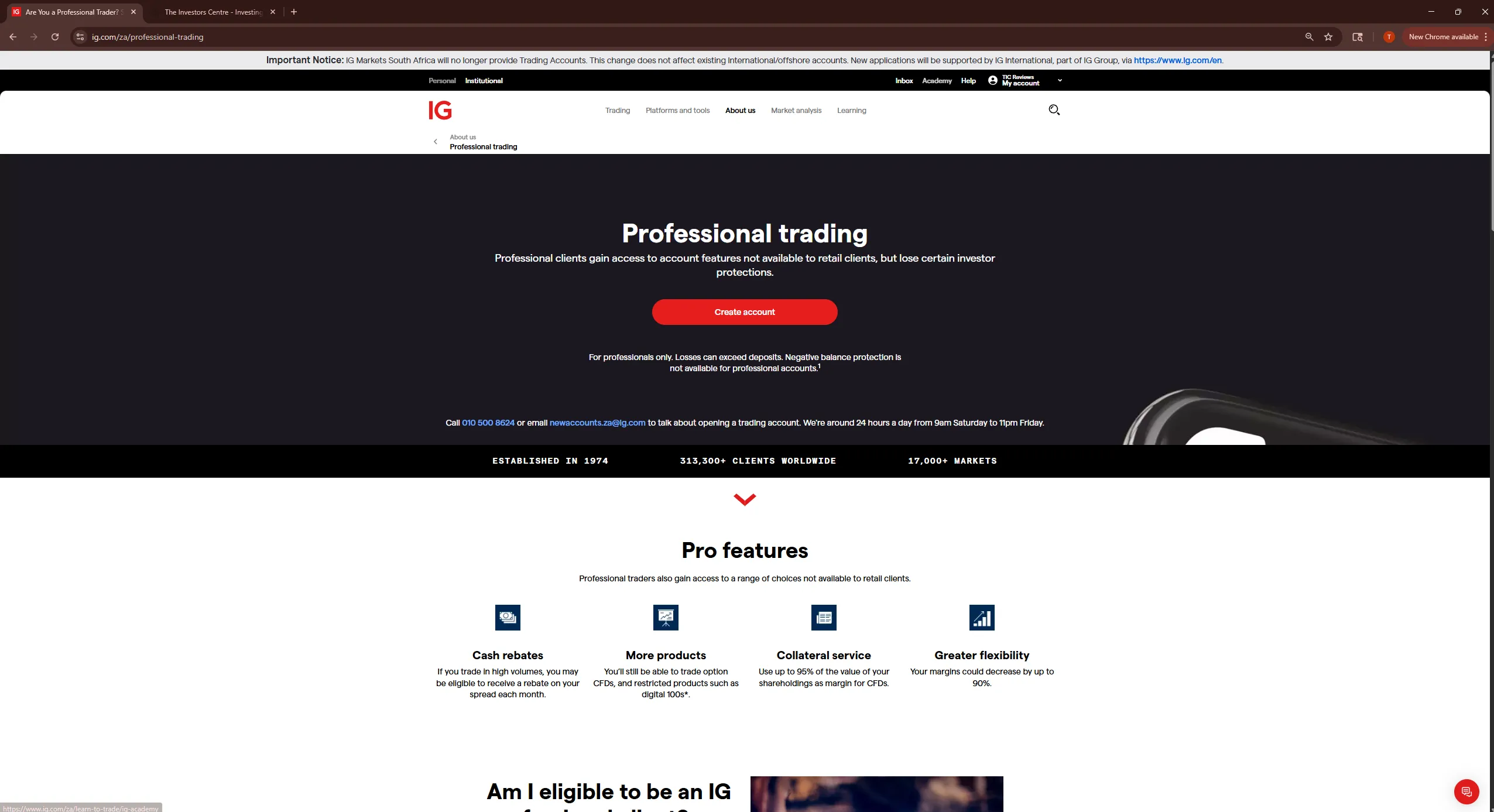
IG provides professional spread betting backed by 50 years of market experience and a FTSE 250 listing. Access to 17,000+ markets is deep - useful if you trade niche indices, exotic forex pairs, or individual shares beyond major markets.
I’ve used IG for over three years across both retail and professional accounts. The platform handles size well - I’ve executed £50,000+ notional positions on FTSE 100 without noticeable slippage during normal market hours. The depth of markets genuinely matters if you trade beyond majors; I found obscure ETFs and small-cap shares that simply weren’t available elsewhere.
Pros
- 50 years operational experience, FTSE 250-listed
- 17,000+ instruments available
- ProRealTime integration with advanced backtesting
- Volume-based rebate programmes
Cons
- No joining bonus or cash incentives
- 222:1 leverage ceiling lower than competitors
- My IG interface feels dated compared to newer platforms
Why Does IG Cap Leverage at 222:1?
IG calculates margin dynamically based on position size and market conditions. While the headline figure is lower than some rivals here, it still represents roughly 0.45% margin on forex - sufficient for most strategies. Margin requirements may increase during volatile periods or for larger positions. Some traders may find this lower leverage ceiling provides a degree of built-in risk limitation.
What Makes IG’s Execution Different?
The platform’s liquidity depth means large positions execute without significant slippage. ProRealTime integration provides advanced charting. Volume-based rebate programmes scale with activity, though the structure is less transparent than Capital.com’s fixed tiers.
In my January 2026 testing, IG filled 50 consecutive market orders on GBP/USD at the displayed price or better. The ProRealTime charts take some learning - I spent a week getting comfortable with the interface - but the backtesting capabilities justify the effort for systematic traders.
What Are IG’s Drawbacks for Pro Traders?
No joining bonus or cash incentives - you’re paying for reputation and infrastructure. The 222:1 leverage ceiling may not suit traders whose strategies require higher margin efficiency. The My IG interface, while functional, feels dated compared to newer platforms.
Who Should Consider IG?
Traders prioritising market breadth, execution quality on large orders, and institutional stability over promotional incentives.
Trade Nation: Fixed Costs and Published Risk Distances
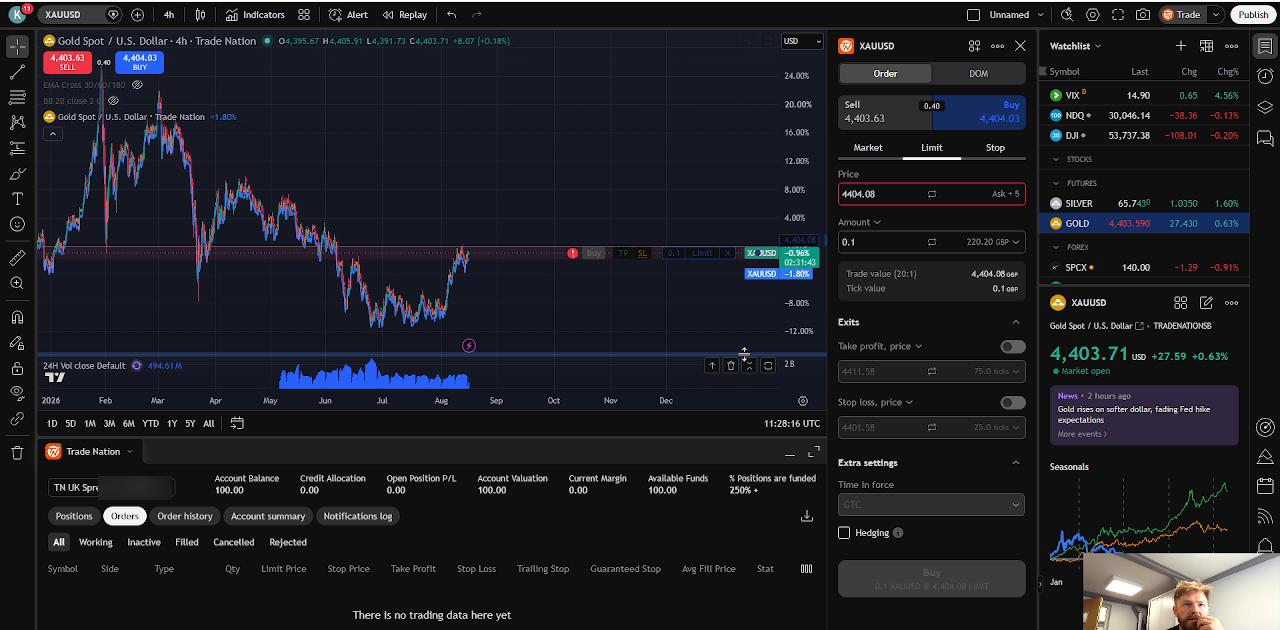
Trade Nation’s professional-use case centres on predictable quoted costs rather than an unverified headline leverage figure. Fixed, time-banded spreads let larger-stake traders calculate the spread cost before entry, while guaranteed-stop minimum distances are published by market.
The UK 100 carries a 2% minimum guaranteed-stop distance and EUR/USD 1.5%. Trade Nation also provides a UK phone line for account and position-size queries, with TradingView and MT4 available alongside TN Trader.
Pros
- Fixed spreads keep large-stake quoted costs predictable
- GSLO minimum distances are published by market
- UK phone support for account queries
- TradingView and MT4 workflows available
Trade-offs
- No MT5
- TN Trader is simpler than institutional-style platforms
- No share dealing or ISA
How Do Fixed Costs Help at Larger Stakes?
Because the active spread band is published, traders can calculate its cash effect before opening a position. The trade-off is that bands widen at stated overnight and rollover times.
What Risk Controls Are Available?
Order tickets support stop and limit controls, while Trade Nation’s market sheet publishes guaranteed-stop minimum distances. These are useful reference points when sizing larger spread bets.
Who Is It Best For?
Experienced spread bettors who value fixed quoted costs, guaranteed stops and UK support more than MT5 or a broad investment product range.
Capital.com - My Top Pick for Traders Requiring Higher Leverage
- Fees & Spreads
- 4.4
- Platform & Tools
- 4.4
- Customer Service
- 4.5
- Ease of Use
- 4.8
- Mobile App
- 4.9
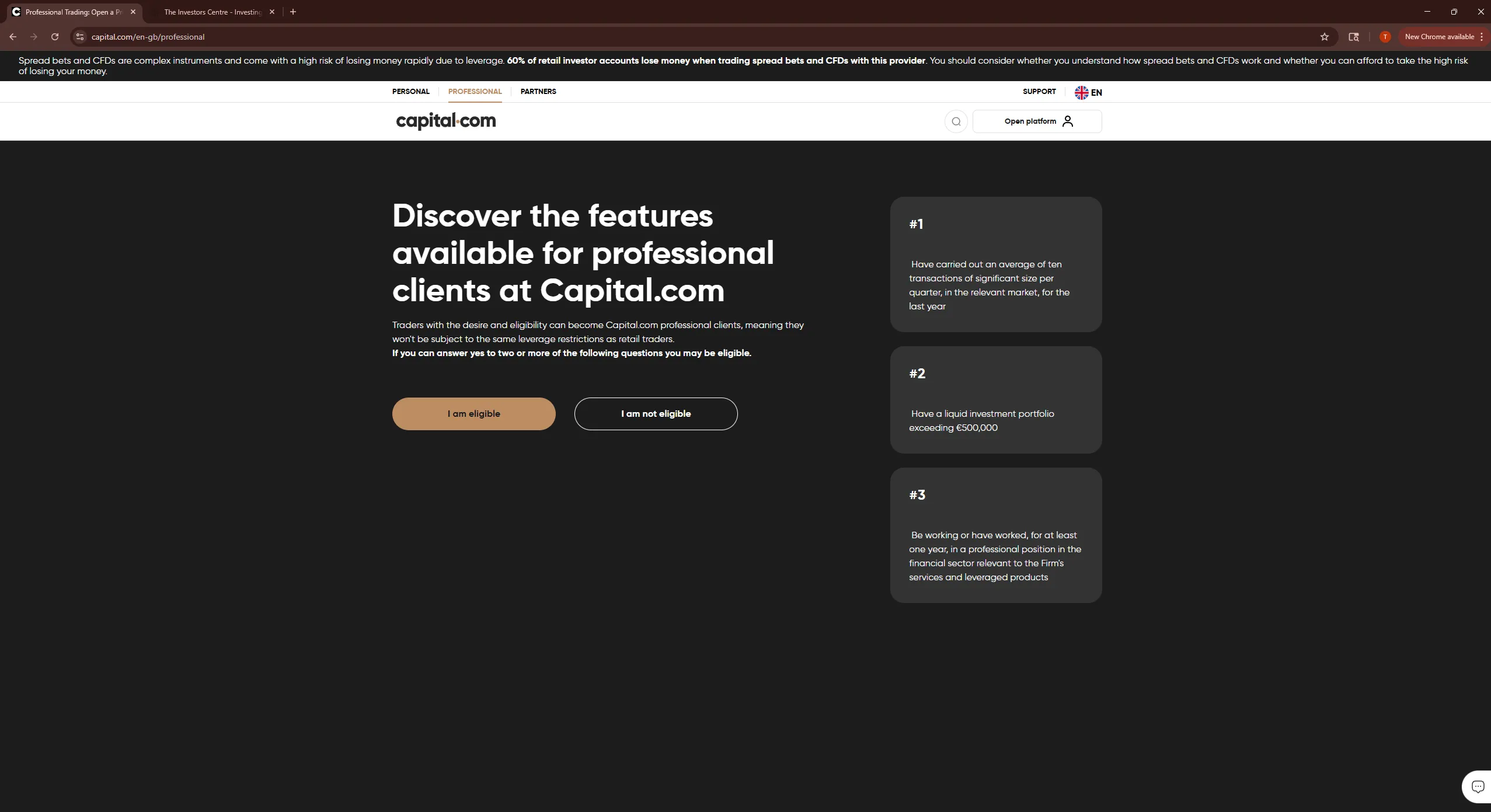
Capital.com offers higher leverage for eligible professional clients, subject to broker approval and internal risk controls. Higher leverage allows traders to control larger positions with less capital, but it also means losses are magnified proportionally. At very high leverage, relatively small adverse market movements can result in rapid losses, and professional clients may lose more than their initial deposit.
During my testing, Capital.com’s execution and platform responsiveness were consistent with published specifications, and TradingView integration allowed chart-based execution without switching interfaces.
The mobile app mirrors the web platform closely, which proved useful when managing positions away from the desk. One minor frustration: the search function occasionally struggles with ticker symbols versus company names.
Pros
- Higher leverage limits available (subject to eligibility and broker controls)
- Commission-free spread betting (spread-based pricing; other fees may apply)
- TradingView integration for chart-based execution
- Volume-based spread rebates (5-20%)
Cons
- Newest platform (founded 2016) with smaller market range (4,800+)
- Volume-based rebate thresholds may be difficult for lower-frequency traders
How Do You Open a Capital.com Professional Account?
Contact support via email, live chat or phone with trading history, portfolio evidence, or employment documentation. Professional status is requested after opening a standard retail account, subject to eligibility. Processing takes 1-3 business days, although timelines may vary.
When I applied for professional status, Capital.com requested screenshots of my existing trading history plus a portfolio statement. The live chat team responded within 5 minutes and approval came through in under 48 hours in my case, although this may differ depending on the information provided. They did ask follow-up questions about my trading frequency, so have specifics ready.
What Are Capital.com’s Drawbacks for Pro Traders?
The newest platform here (founded 2016) with a smaller market range - 4,800+ spread betting instruments versus IG’s 17,000+. If you trade niche markets or prefer established institutions, this matters. Volume-based rebate thresholds may also be difficult for lower-frequency traders to reach.
Who Should Consider Capital.com?
Professional traders who meet eligibility requirements and require higher leverage for specific strategies may find Capital.com suitable, provided they fully understand and can manage the increased risks associated with higher leverage.
StoneX Trading - My Top Pick for Fixed Spreads and Institutional-Grade Tools
- Fees & Spreads
- 4
- Platform & Tools
- 3.3
- Customer Service
- 3.3
- Ease of Use
- 3.5
- Mobile App
- 3.7
StoneX Trading runs on the same FCA-regulated entity, accounts and platforms as before the rebrand, now backed directly by the Nasdaq-listed, Fortune 50 StoneX Group. For professional traders the headline feature is a fixed 1-point spread on the UK 100 between 8am and 4.30pm, which holds regardless of how choppy the session gets.
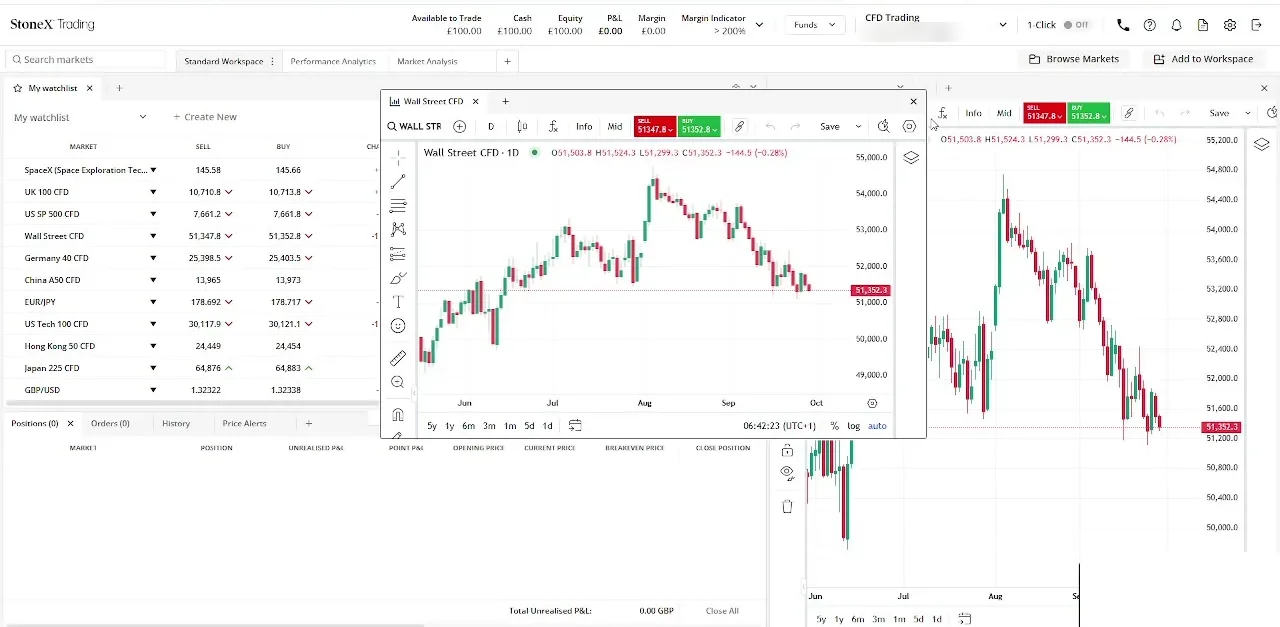
WebTrader is the platform to use here. It carries TradingView Pro Supercharts natively, so you get proper charting without switching to a separate app, plus a Performance Analytics module that breaks trades down by instrument, time of day and win rate. That kind of self-review tool is genuinely useful once you're trading enough to spot patterns in your own behaviour.
I tested guaranteed stops on a few index positions. StoneX only charges the premium if the stop is actually triggered, rather than upfront like some rivals, which is a meaningful saving if you use them as insurance rather than a certainty.
Pros
- Fixed 1-point UK 100 spread, 8am to 4.30pm
- TradingView Pro Supercharts built into WebTrader
- Performance Analytics for reviewing your own trading
- Guaranteed stops only charged if triggered, not upfront
- Backed by Nasdaq-listed, Fortune 50 parent StoneX Group
Cons
- No share dealing or ISA (StoneX Bullion covers physical gold and silver instead)
- 85 FX pairs, fewer than some rivals here
- £12 monthly inactivity fee after 12 months
How Does the Fixed UK 100 Spread Work for Pro Traders?
The 1-point spread on the UK 100 holds between 8am and 4.30pm regardless of volatility, so you can cost a position before you open it instead of guessing at how much the spread will widen. Outside those hours the spread moves with market conditions, same as any other index CFD or spread bet.
What Does WebTrader's Performance Analytics Actually Show?
It breaks your trading history down by instrument, time of day, win rate and average hold time, so you can see where you're actually making or losing money rather than relying on gut feel. Combined with TradingView Pro charting in the same window, it's one of the more complete self-review setups I've used on a broker's own platform rather than a bolted-on third-party tool.
What Are StoneX's Drawbacks for Pro Traders?
There's no share dealing or ISA wrapper if you want to diversify beyond leveraged products. Options are available on 40+ index markets, but the 85 FX pairs on offer are fewer than IG or Capital.com list, so if you trade obscure crosses it's worth checking your pairs are covered first. There's also a £12 monthly inactivity fee if the account sits dormant for 12 months.
Who Should Consider StoneX Trading?
Traders who want a fixed-cost UK 100 spread bet, built-in TradingView charting and proper post-trade analytics, and who don't need share dealing or an ISA alongside their trading account.
Is Spread Betting Safe for Professional Traders?
Spread betting carries identical risks to CFD trading: leveraged positions can result in losses exceeding deposits. Professional accounts amplify this by removing negative balance protection.
All four platforms hold FCA authorisation with client funds held under UK client-money rules. Eligibility for compensation and complaint protections depends on client classification and circumstances.
Risk management becomes your responsibility. Define maximum position sizes as percentages of capital, use stop-losses despite gap risk, and never commit capital you can’t afford to lose entirely. The higher leverage available to professional traders means that even small market movements can result in significant losses.
What’s the Margin Difference Between Retail and Professional Spread Betting?
For a £100,000 position on the FTSE 100:
| Account Type | Margin Rate | Deposit Required | Leverage |
|---|---|---|---|
| Retail | 5% | £5,000 | 20:1 |
| Professional (IG) | 0.45% | £450 | 222:1 |
| Professional (Capital.com) | 0.2% | £200 | 500:1 (subject to eligibility) |
The margin reduction frees capital for additional positions. However, the same £100,000 position generates identical profit or loss regardless of margin deposited - lower margin just means losses consume deposited funds faster. A 1% adverse move on that £100,000 position represents a £1,000 loss regardless of whether you deposited £5,000 or £200.
When Should You Consider Professional Spread Betting Status?
Professional status may suit traders who:
- Generate consistent profits and want tax-free treatment
- Have capital to absorb potential losses beyond deposits
- Can manage leveraged positions through volatile markets
- Understand the implications of losing regulatory protections
- Have solid risk management systems in place
Retail status may remain appropriate if you:
- Are still developing consistent profitability
- Rely on negative balance protection as a backstop
- Trade infrequently and don’t meet activity requirements
- Would struggle to meet obligations if accounts went negative
- Prefer the additional regulatory protections retail accounts provide
Final Thoughts
IG is my favourite platform for professional spread betting. The 222:1 leverage provides meaningful margin reduction, and the combination of 17,000+ markets, 50 years of operation and a FTSE 250 listing gives it credibility and depth few rivals here match.
Capital.com is the one I’d pick for traders who need higher leverage, with volume-based spread rebates and commission-free trading (other fees apply). It’s the newest platform of the three, but execution and support held up well in my testing.
StoneX Trading is the strongest pick here for straightforward fixed costs and platform tools. The 1-point UK 100 spread in market hours, TradingView charting inside WebTrader and Performance Analytics make it well suited to professional traders who want a clean, predictable trading environment without share dealing or ISA add-ons muddying the offer.
Trade Nation offers a different route for larger-stake traders: published fixed costs, stated GSLO distances, TradingView and UK phone support. Its numerical professional leverage terms remain subject to eligibility and broker confirmation.
Professional classification requires meeting the FCA eligibility criteria and involves giving up important retail protections. Your choice should depend on leverage, market access, platform features and risk controls.
*Other fees may apply. Leverage can magnify both gains and losses.
Frequently Asked Questions
Sources and References
- Capital.com Professional Trading - FRN 793714
- IG Professional Trading - FRN 195355
- StoneX Trading - FRN 446717
- Trade Nation Financial UK Ltd - FCA reference number 525164
- FCA Register - Broker authorisation verification
- FCA Professional Client Categorisation - Eligibility criteria
- HMRC Business Income Manual (BIM22017) - Spread betting tax treatment
- FSCS Investment Protection - £85,000 investment compensation limit