

- expertise:
- CFD Trading, Forex, Derivatives, Risk Management
- credentials:
- Chartered ACII (2018) · Trading since 2012
- tested:
- 40+ forex & CFD platforms with live accounts

- expertise:
- Broker Comparison, ISA Strategy, Portfolio Management
- credentials:
- Active investor since 2013 · 11+ years experience
- tested:
- 40+ brokers with funded accounts
How We Test
Real accounts. Real money. Real trades. No demo accounts or press releases.
What we measure:
- Spreads vs advertised rates
- Execution speed and slippage
- Hidden fees (overnight, withdrawal, conversion)
- Actual withdrawal times
Scoring:
Fees (25%) · Platform (20%) · Assets (15%) · Mobile (15%) · Tools (10%) · Support (10%) · Regulation (5%)
Regulatory checks:
FCA Register verification · FSCS protection
Testing team:
Adam Woodhead (investing since 2013), Thomas Drury (Chartered ACII, 2018), Dom Farnell (investing since 2013) — 50+ platforms with funded accounts
Quarterly reviews · Corrections: info@theinvestorscentre.co.uk
Disclaimer
Not financial advice. Educational content only. We're not FCA authorised. Consult a qualified advisor before investing.
Capital at risk. Investments can fall. Past performance doesn't guarantee future results.
CFD warning. 67-84% of retail accounts lose money trading CFDs. High risk due to leverage.
Contact: info@theinvestorscentre.co.uk
Quick Answer: How Do You Use AI to Trade Stocks?
UK traders can use AI to trade stocks through automated trading robots, AI-powered analysis platforms, and intelligent stock screeners. FCA-regulated brokers like IG, Pepperstone, and eToro offer built-in AI features or support third-party AI tools — though no AI system guarantees profits and leveraged stock trading carries significant risk to your capital.

IG — Best Broker for AI Stock Trading in the UK
IG is our top pick for AI-assisted stock trading. Their platform integrates ProRealTime’s advanced charting with automated strategy tools, offers access to over 17,000 markets, and provides Reuters news feeds and AI-generated market analysis directly within the platform.
- FCA Regulated – Authorised and regulated by the Financial Conduct Authority (FRN 195355)
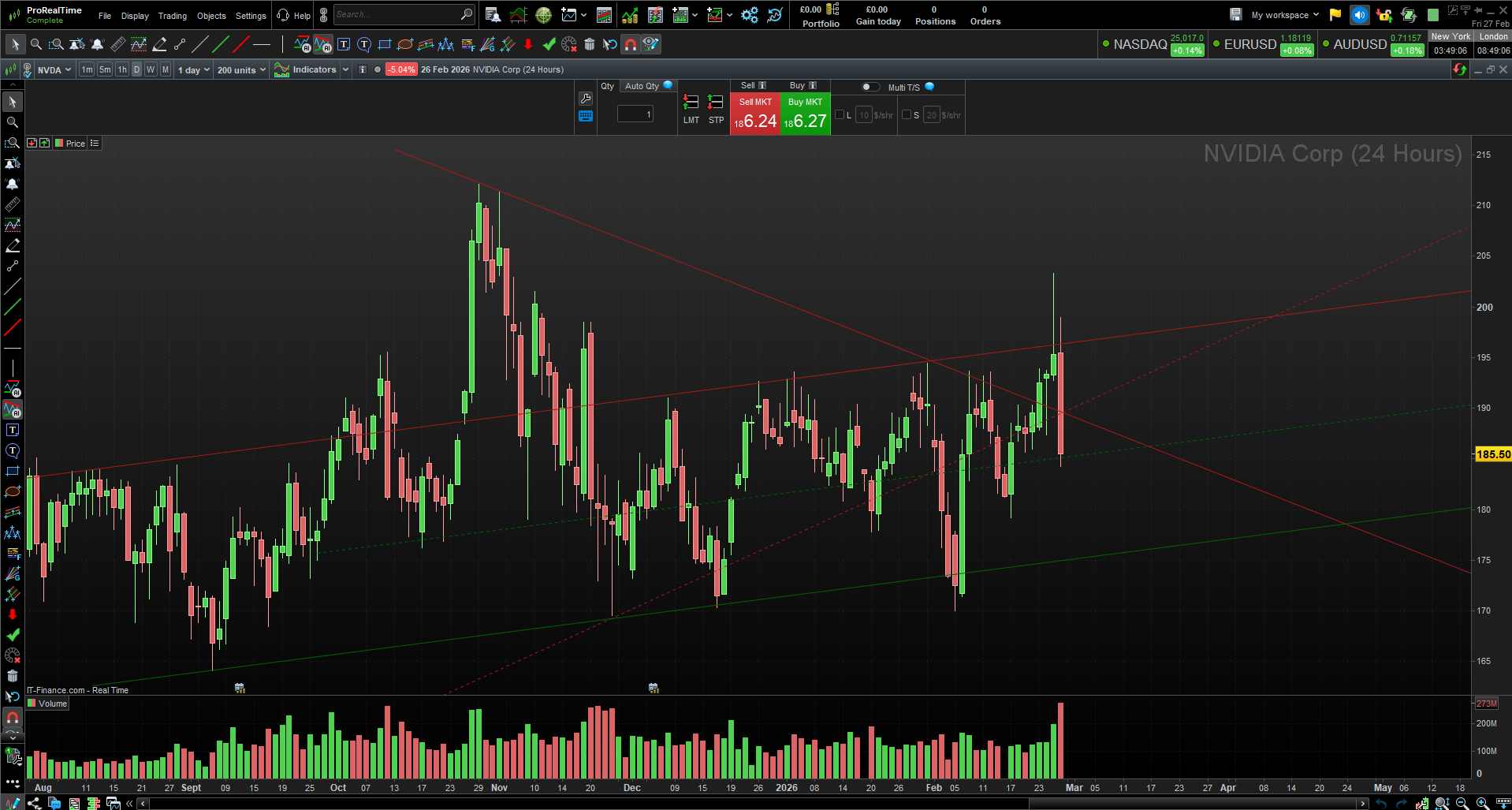
- ProRealTime Integration – Automated trading strategies with AI-assisted pattern recognition and backtesting
- 17,000+ Markets – Trade UK, US, and international stocks via CFDs or invest in shares directly
- AI Market Analysis – Integrated Reuters news, Autochartist pattern recognition, and PIA analytics
68% of retail CFD accounts lose money.
What Is AI Stock Trading?
AI stock trading uses artificial intelligence — machine learning, natural language processing, and pattern recognition — to analyse market data and make trading decisions. Rather than relying solely on human judgement, AI systems process vast amounts of information in seconds: price data, technical indicators, news sentiment, earnings reports, and even social media trends.
For UK retail traders, AI stock trading typically takes one of four forms: fully automated trading robots that execute orders independently, AI-powered analysis tools built into broker platforms, standalone AI screeners that flag opportunities, and general-purpose AI assistants like ChatGPT used for research and strategy development.
The technology has become far more accessible in recent years. What was once exclusive to hedge funds and institutional desks is now available through standard FCA-regulated brokers. However, “AI” is also an overused marketing term — not every tool labelled “AI-powered” uses genuine machine learning, so it’s worth understanding what each tool actually does.
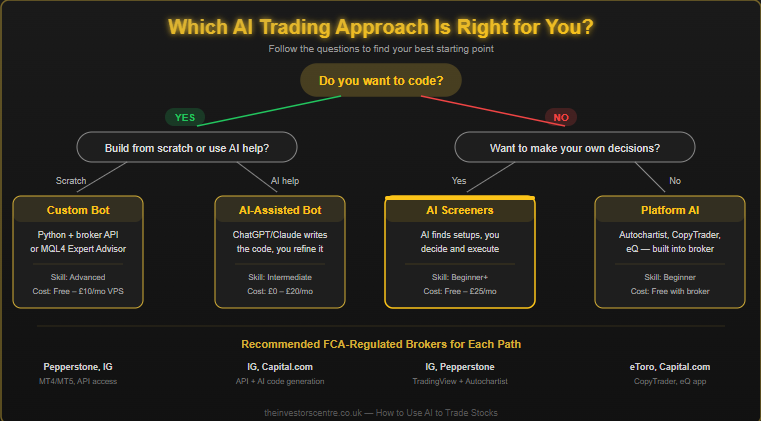
What Are the Best Ways to Use AI for Stock Trading?
AI Trading Robots and Bots
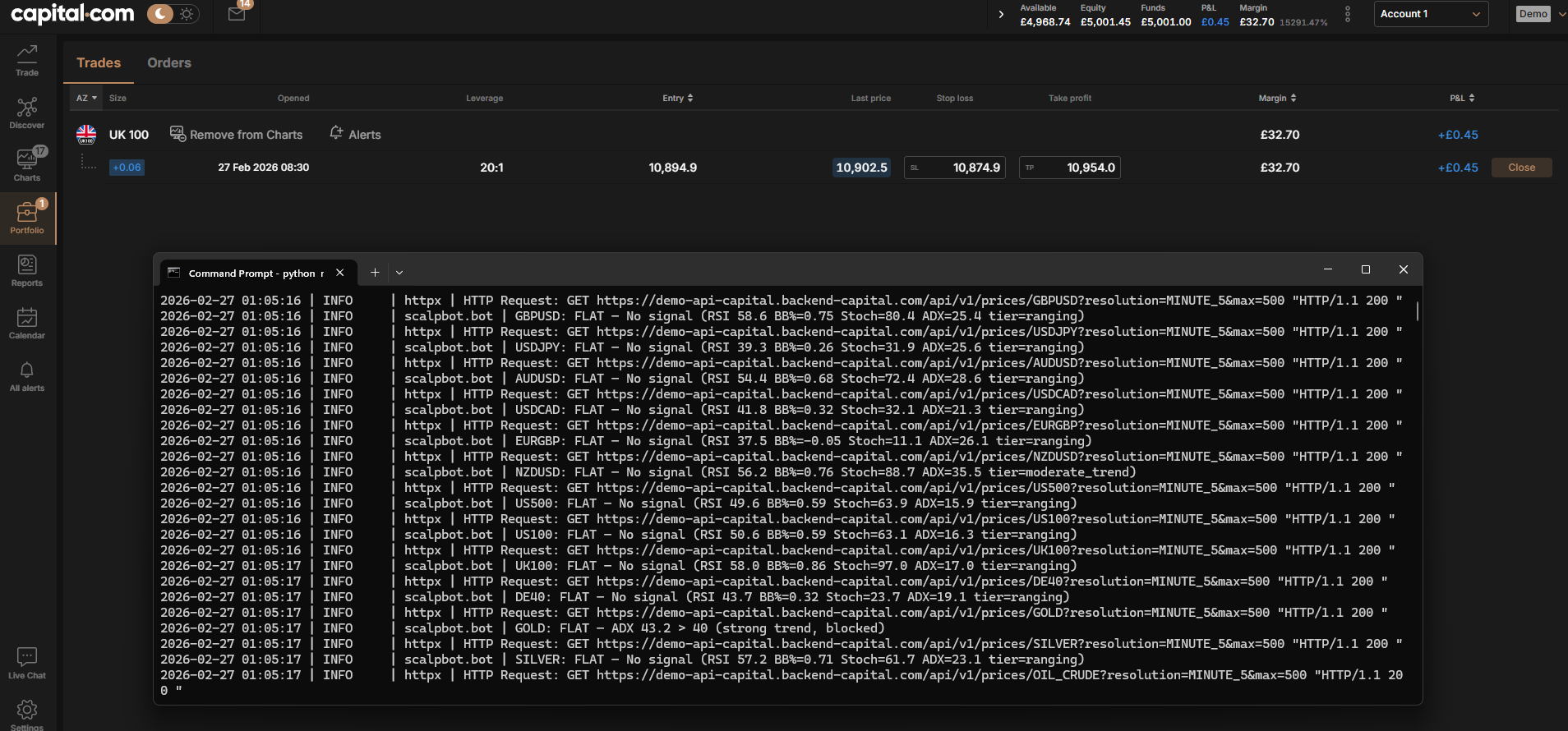
AI trading robots execute trades automatically based on machine-learning models trained on historical price data. Unlike traditional rule-based bots, AI robots can adapt to changing market conditions by continuously learning from new data. Our guide to the best AI trading robots ranks the top options available to UK traders.
Most AI robots work through MetaTrader 4/5 or via API connections to your broker. Some, like those offered through IG’s ProRealTime, run directly within the broker’s platform. Expect to pay between £30 and £300 for reputable AI trading software, or a monthly subscription of £20–100.
AI-Powered Broker Platform Tools
Several FCA-regulated brokers now embed AI features directly into their trading platforms. IG offers Autochartist for automatic chart pattern detection, ProRealTime for coded strategies with AI-assisted optimisation, and PIA (Performance & Intelligence Analytics) for trade analysis. Capital.com uses AI to analyse your trading behaviour and flag potential biases.
AI Stock Screeners and Scanners
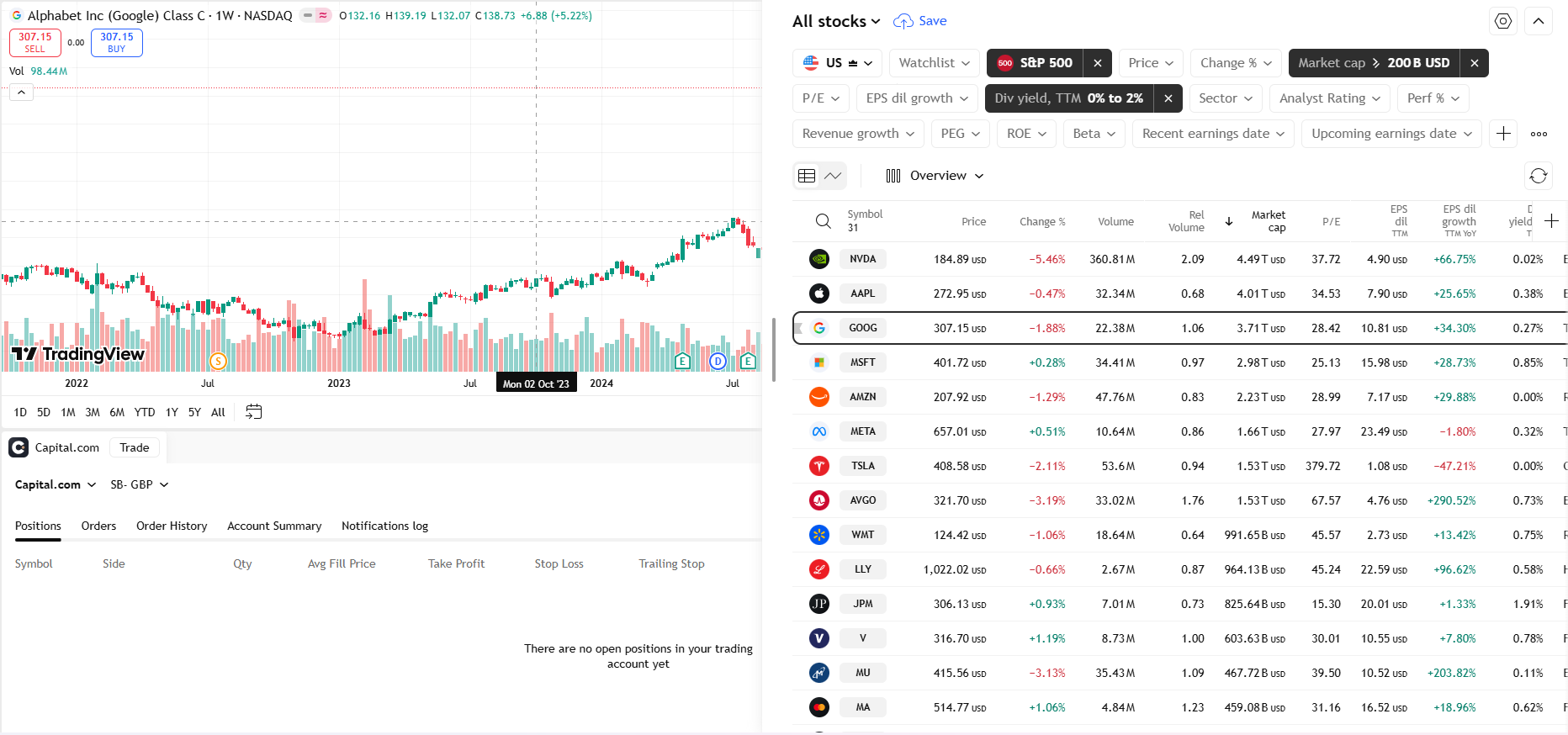
AI-powered screeners scan thousands of stocks simultaneously, identifying patterns, unusual volume, sentiment shifts, and technical setups that human traders would miss. Tools like TradingView’s screener (available through TradingView-compatible brokers) use community-built AI indicators alongside standard filters.
These tools work best as a research layer rather than a direct trading signal. Use them to narrow your watchlist, then apply your own analysis before entering any position.
Using ChatGPT and AI Assistants for Trading Research
General-purpose AI models like ChatGPT, Claude, and Google Gemini can analyse earnings reports, summarise market news, explain technical concepts, and even help you build a trading bot. They won’t tell you what to buy, but they can accelerate your research process significantly.
Limitations to keep in mind: AI assistants can produce inaccurate information (“hallucinations”), their training data has a cutoff date, and they cannot access real-time market data unless connected to a live feed. Treat AI output as a starting point for your own analysis, not as financial advice.
Which UK Brokers Offer AI Trading Features?
| Broker | AI/Automated Features | Stock Access | Regulation |
|---|---|---|---|
| IG | ProRealTime automation, Autochartist, PIA analytics | 17,000+ markets (CFDs & share dealing) | FCA (FRN 195355) |
| Pepperstone | MT4/MT5 EAs, Autochartist, Smart Trader Tools | 1,200+ instruments (CFDs) | FCA (FRN 684312) |
| eToro | CopyTrader (AI-assisted social trading), Smart Portfolios | 5,000+ stocks (real shares & CFDs) | FCA (FRN 583263) |
| Capital.com | AI-powered behavioural analysis, eQ app | 3,000+ markets (CFDs) | FCA (FRN 793714) |
| CMC Markets | Pattern recognition, CMC Alpha analytics | 10,000+ instruments (CFDs & share dealing) | FCA (FRN 173730) |
All five brokers are authorised by the FCA and offer FSCS protection on eligible funds up to £85,000. For active stock trading with AI tools, IG and Pepperstone stand out for their automation capabilities. For a more passive AI-assisted approach, eToro’s CopyTrader lets you automatically mirror the trades of successful investors.
How Do You Get Started with AI Stock Trading?
Step 1: Choose Your AI Approach
Decide which type of AI trading suits your experience level. Beginners should start with broker-integrated tools like IG’s Autochartist or eToro’s CopyTrader. Intermediate traders can explore AI-powered screeners and custom indicators. Advanced traders may want to build or purchase dedicated AI trading robots.
Step 2: Open an Account with an FCA-Regulated Broker
Choose a broker that supports your preferred AI tools. Verify they are FCA-regulated — check the Financial Services Register for their firm reference number. Most brokers require ID verification, proof of address, and an appropriateness assessment for leveraged products.
Step 3: Start with a Demo Account
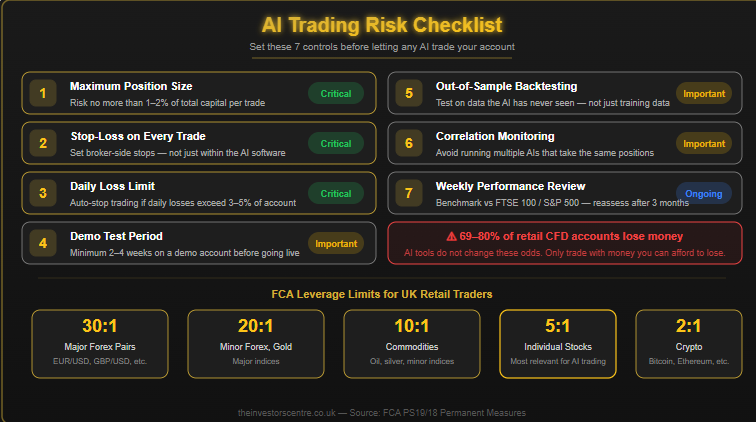
Test any AI tool on a demo account before committing real capital. This lets you understand how the AI makes decisions, how often it trades, and what drawdowns look like — without financial risk. Run your demo test for at least 2–4 weeks across different market conditions.
Step 4: Set Risk Parameters
Never let AI trade without risk controls. Set maximum position sizes (1–2% of capital per trade), daily loss limits, and stop-losses on every position. Even the most sophisticated AI can suffer extended losing streaks during unusual market conditions.
Step 5: Monitor and Evaluate
Track your AI’s performance weekly. Compare its returns against a simple benchmark like the FTSE 100 or S&P 500. If the AI consistently underperforms after 3 months, reassess rather than hoping for improvement.
What Are the Risks of AI Stock Trading?
Overfitting: AI models trained too closely on historical data may perform brilliantly in backtests but fail in live markets. A model that “learned” the 2020 crash won’t necessarily predict the next one. Always demand out-of-sample test results.
Black-box decision-making: Many AI trading systems don’t explain why they enter a trade. If you can’t understand the logic, you can’t assess whether a losing streak is normal drawdown or a broken strategy.
Marketing hype: “AI-powered” is the most overused phrase in trading software marketing. Some tools are simple technical indicators dressed up with AI branding. Evaluate what the tool actually does, not what it claims.
Technology failures: AI systems need stable internet connections, functioning APIs, and responsive broker servers. Outages can leave positions unmanaged. Always set broker-side stop-losses as a safety net.
Leverage risk: CFD trading on stocks uses leverage (up to 5:1 for UK retail on shares). AI robots that trade frequently can accumulate large leveraged positions quickly. The FCA’s negative balance protection prevents you from losing more than your deposit, but you can still lose your entire account balance.
Capital at Risk
Between 69% and 80% of retail CFD accounts lose money. AI trading tools do not change these underlying odds. Only trade with money you can afford to lose, and never rely on AI as a guaranteed income source.
Can AI Actually Beat the Stock Market?
The honest answer: sometimes, temporarily, but not consistently for everyone. Institutional AI systems at Renaissance Technologies and Two Sigma have produced extraordinary returns, but these firms employ hundreds of PhDs and invest billions in infrastructure. Retail AI tools are fundamentally different in scale, data access, and execution speed.
Academic research shows AI can identify short-term inefficiencies and sentiment-driven patterns, particularly in individual stocks. However, the more traders use the same AI signals, the faster those edges get arbitraged away. AI is best treated as a powerful analytical tool that gives you an edge in research and execution — not a money-printing machine.
For most UK traders, the realistic benefit of AI is efficiency: scanning more stocks, backtesting more strategies, and removing emotional bias. If you’re new to active trading, our best day trading platforms guide covers the fundamentals before adding AI into the mix.
FAQs
References
68% of retail investor accounts lose money when trading spread bets and CFDs with this provider.