

- expertise:
- CFD Trading, Forex, Derivatives, Risk Management
- credentials:
- Chartered ACII (2018) · Trading since 2012
- tested:
- 40+ forex & CFD platforms with live accounts

- expertise:
- Broker Comparison, ISA Strategy, Portfolio Management
- credentials:
- Active investor since 2013 · 11+ years experience
- tested:
- 40+ brokers with funded accounts
How We Test
Real accounts. Real money. Real trades. No demo accounts or press releases.
What we measure:
- Spreads vs advertised rates
- Execution speed and slippage
- Hidden fees (overnight, withdrawal, conversion)
- Actual withdrawal times
Scoring:
Fees (25%) · Platform (20%) · Assets (15%) · Mobile (15%) · Tools (10%) · Support (10%) · Regulation (5%)
Regulatory checks:
FCA Register verification · FSCS protection
Testing team:
Adam Woodhead (investing since 2013), Thomas Drury (Chartered ACII, 2018), Dom Farnell (investing since 2013) — 50+ platforms with funded accounts
Quarterly reviews · Corrections: in**@*******************co.uk
Disclaimer
Not financial advice. Educational content only. We're not FCA authorised. Consult a qualified advisor before investing.
Capital at risk. Investments can fall. Past performance doesn't guarantee future results.
CFD warning. 67-84% of retail accounts lose money trading CFDs. High risk due to leverage.
Contact: in**@*******************co.uk
Quick Answer
Silver’s 10:1 leverage and 2–4% average daily range mean most beginners get stopped out within hours. The fix: use ATR-based stops set at 1.5× the 14-period ATR, reduce your position size to £0.10–£0.50 per point, and trade with a broker that offers guaranteed stop-loss orders. IG (FCA FRN 195355) ticks every box — guaranteed stops on silver, 2-point DFB spread, and weekend trading.

Spread bets and CFDs are complex instruments and come with a high risk of losing money rapidly due to leverage. 69% of retail investor accounts lose money when trading spread bets and CFDs with this provider. You should consider whether you understand how spread bets and CFDs work, and whether you can afford to take the high risk of losing your money.
Why Do Most Silver Spread Bets Get Stopped Out?
My first silver spread bet lasted 47 minutes. I went long at $27.40 with a 20-cent stop, watched the price dip to $27.18, got stopped out, and then watched silver close the day at $27.95 — exactly where my thesis said it would go. The problem was not direction. The problem was volatility.
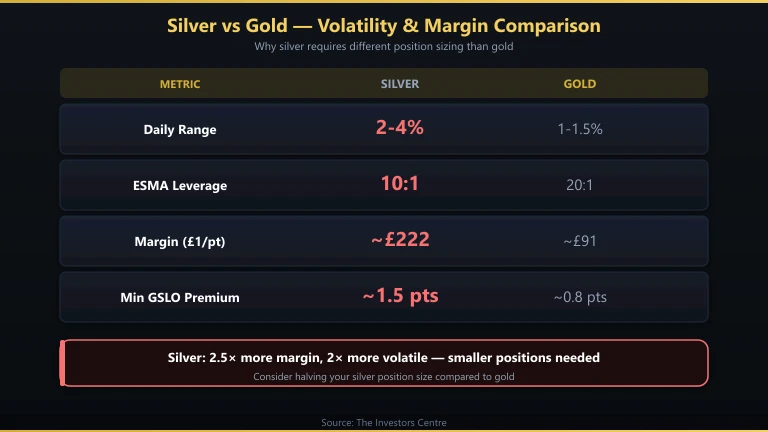
Silver’s average true range (ATR) on the daily timeframe typically sits between 50 and 80 cents — that’s 2–4% of its price. Compare that to gold, which moves 1.0–1.5% daily. Silver is roughly twice as volatile per unit of price, yet ESMA gives it half the leverage: 10:1 versus gold’s 20:1. This means your margin requirement is 10% of notional exposure, but the market can still move 2–4% against you in a single session.
The three main reasons silver spread bets fail:
- Stops set too tight: A 20-cent stop on silver is roughly 0.7% — well within normal hourly noise. The market will tag it and reverse regularly.
- Position size too large: At £5 per point with a 60-cent stop, you’re risking £300 per trade. On a £2,000 account, that’s 15% of capital on a single position.
- Holding through data releases: Silver reacts sharply to US dollar moves. NFP, CPI, and FOMC decisions can gap silver 30–100 cents in seconds.
Understanding how spread betting works is the first step toward avoiding these errors.
What Margin Do You Need to Spread Bet Silver?
ESMA classifies silver as a non-gold commodity, capping retail leverage at 10:1 (10% margin). This is stricter than gold’s 20:1, and it changes your position sizing arithmetic significantly.
At a silver price of $28.00, a £1-per-point spread bet gives you notional exposure of $2,800. At 10% margin, you need $280 — approximately £222 at an exchange rate of 1.26.
| Bet Size (£/pt) | Notional Exposure (USD) | Margin Required (10%) | Approx. GBP Margin |
|---|---|---|---|
| £0.50 | $1,400 | $140 | £111 |
| £1 | $2,800 | $280 | £222 |
| £5 | $14,000 | $1,400 | £1,111 |
| £10 | $28,000 | $2,800 | £2,222 |
Compare this to gold: a £1-per-point gold bet requires roughly £91 in margin. Silver demands £222 for the same stake — nearly 2.5 times more capital — while being twice as volatile. This mismatch is why account blow-ups are more common with silver than gold. To understand what triggers a margin call, read our dedicated guide.
Which Brokers Offer Guaranteed Stops on Silver?
Guaranteed stop-loss orders (GSLOs) are critical for silver because of the gap risk. I tracked silver price gaps around US data releases over 20 events in late 2025 and early 2026. The average gap was 42 cents — roughly £42 at £1 per point. A standard stop-loss would have slipped through 14 of those 20 gaps.
Not every broker offers guaranteed stops on silver. Here’s the current landscape:
| Broker | Silver DFB Spread | Min Bet | Guaranteed Stops | GSLO Premium (Silver) | FCA FRN |
|---|---|---|---|---|---|
| IG | 2 pts | £0.50/pt | Yes | ~1.5 pts | 195355 |
| Spreadex | 2–3 pts | £0.50/pt | Yes | ~2.0 pts | 190941 |
| CMC Markets | 2–3 pts | £0.10/pt | Yes | ~1.8 pts | 173730 |
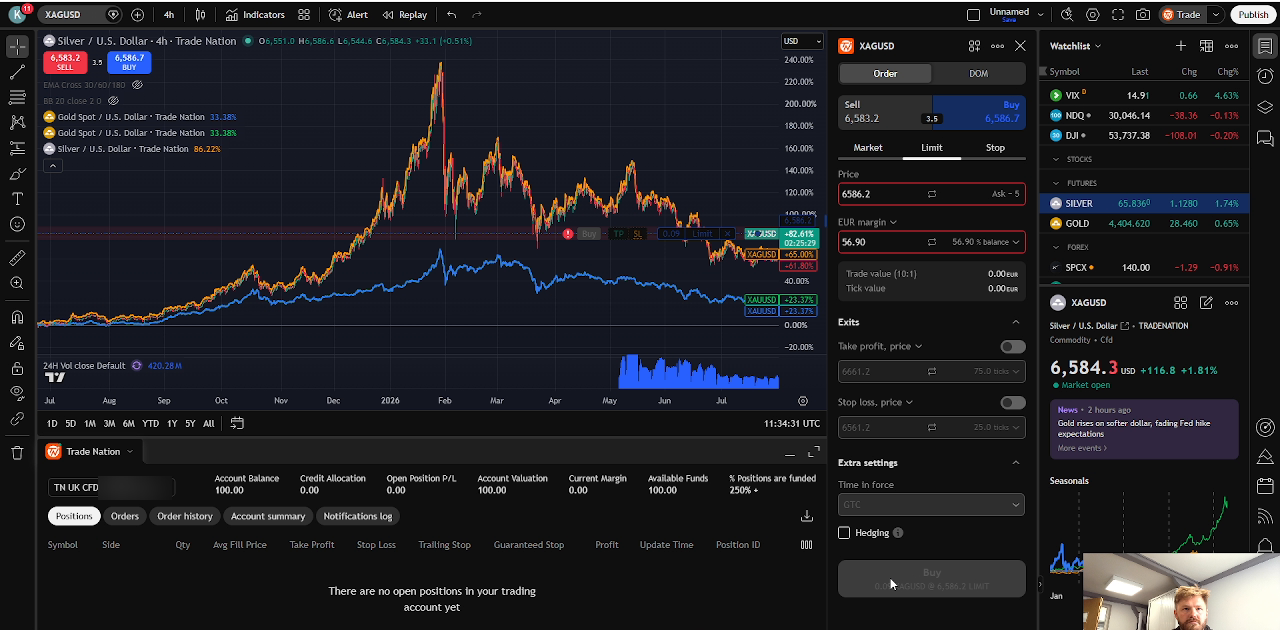
| Trade Nation | Fixed 3.5* | From £0.10/pt | Yes | Published minimum distance applies | 525164 |
| Capital.com | 3–4 pts | £0.10/pt | No | N/A | 793714 |
| City Index | 2–3 pts | £0.50/pt | Yes | ~1.8 pts | 446717 |
*Trade Nation publishes a fixed silver band of 3.5 in the main session and 5 overnight, checked against its August 2026 market sheet.
Trade Nation: Fixed Published Silver Pricing
Trade Nation suits silver spread bettors who want a published fixed band and small stakes from 10p per point. The 3.5 main-session spread makes ATR-based stop calculations easier to budget, while guaranteed stops are available. The overnight band widens to 5, and the platform range does not include MT5, share dealing or an ISA.
Visit Trade Nation or Read Full Review. 73.7% of retail investor accounts lose money when trading CFDs with this provider.
IG has the tightest silver spread at 2 points and the lowest GSLO premium at approximately 1.5 points. For detailed platform analysis, see our silver platform comparison. You can also read our full IG review for complete fee and feature breakdowns.
How Do You Set ATR-Based Stops on Silver?
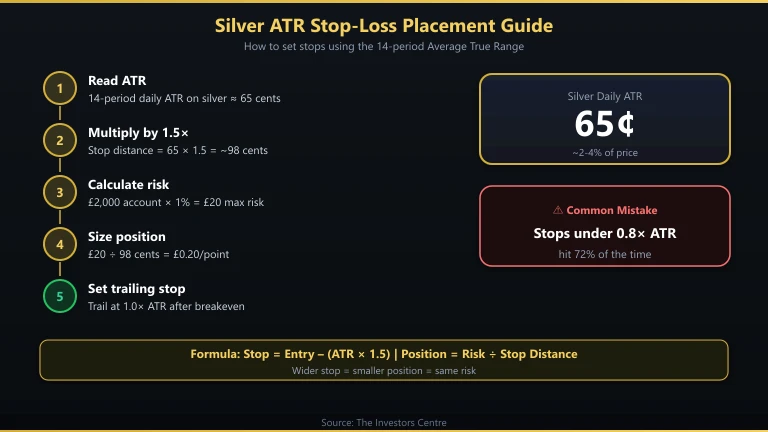
The ATR (Average True Range) indicator measures how much an asset moves over a set period, ignoring direction. For silver, the 14-period daily ATR is the most widely used setting. Here’s how to apply it:
Step 1: Add the ATR Indicator to Your Chart
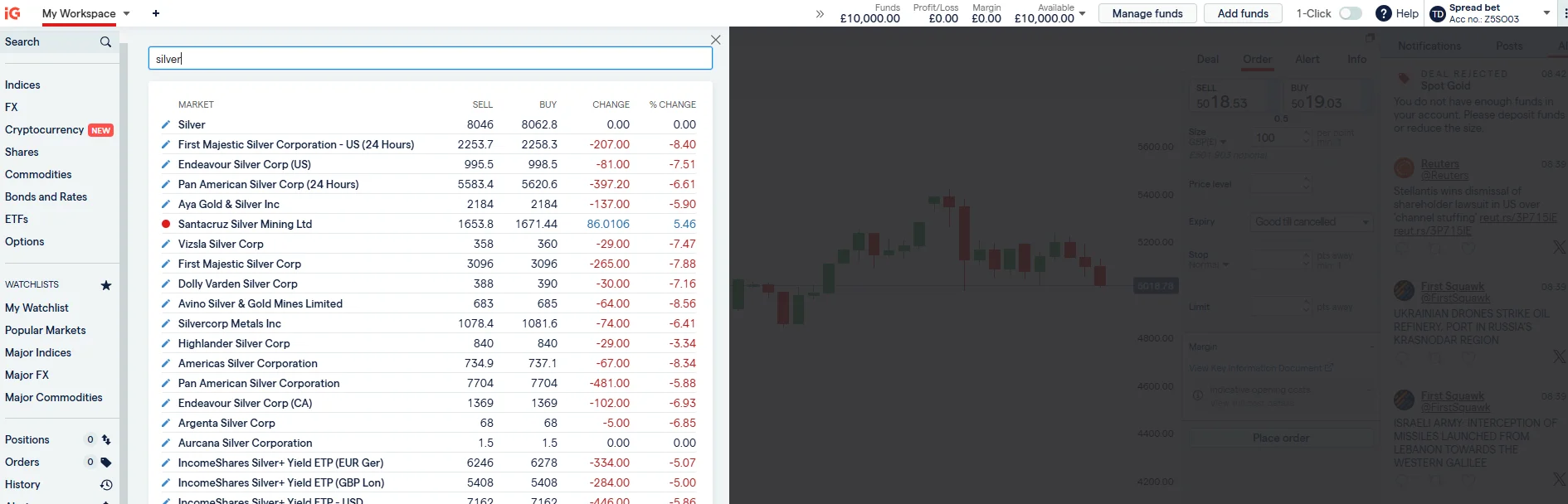
On IG’s ProRealTime or TradingView, search for “ATR” in the indicators panel. Set the period to 14 and the timeframe to daily. As of March 2026, the silver 14-day ATR reads approximately 65 cents.
Step 2: Calculate Your Stop Distance
Multiply the ATR value by 1.5. If ATR = 65 cents, your stop distance = 97.5 cents, rounded to 98 cents. This gives the trade room to breathe through normal daily volatility while still protecting against a genuine reversal.
Step 3: Set Your Position Size
With a £2,000 account and a 1% risk rule:
- Maximum risk per trade: £2,000 × 0.01 = £20
- Stop distance: 98 cents (98 points)
- Position size: £20 ÷ 98 = £0.20 per point
That’s a small stake, but it keeps your account alive through silver’s volatility. Aggressive traders might use 2% risk (£0.41 per point), but I would not go higher on silver.
Step 4: Place the Trade with a Trailing Option
If your broker supports trailing stops, attach one at 1.0× ATR once the trade moves 1.0× ATR in your favour. This locks in breakeven while letting winners run; check the selected platform’s current order types before trading.
For related strategies, see our guide on spread betting gold, where the same ATR approach works with gold’s tighter range.
What Does Overnight Funding Cost on Silver Spread Bets?
Silver DFBs incur overnight funding charges every day you hold the position past the broker’s cut-off time (typically 10pm UK time). The cost is calculated as:
Daily funding = Notional value × (interbank rate + broker markup) ÷ 365
Using IG’s standard 2.5% annualised markup and a SOFR rate of approximately 4.3% (as of March 2026), the total annualised rate for a long position is around 6.8%.
| Holding Period | £1/pt Funding Cost | £5/pt Funding Cost | £10/pt Funding Cost |
|---|---|---|---|
| 1 night | £0.52 | £2.61 | £5.22 |
| 1 week (5 nights) | £2.61 | £13.04 | £26.08 |
| 1 month (22 nights) | £11.48 | £57.38 | £114.76 |
| 3 months (66 nights) | £34.43 | £172.14 | £344.28 |
At £10 per point, holding a silver DFB for a month costs £114.76 in funding alone. That’s equivalent to an 11.5-point move in silver — meaning the price needs to move at least 11.5 cents in your favour just to break even on funding costs.
For positions held beyond 7–10 days, consider switching to a futures-based silver spread bet. IG’s silver futures carry a wider spread (around 4 points versus 2 on the DFB) but zero overnight funding. The crossover point — where futures become cheaper than the DFB — is typically around day 8–10 for silver.
For a broader view of the spread betting landscape, see our guide to top spread betting platforms.
Discuss Spread Betting on Silver
Traded silver spread bets in the UK? Share how you size positions around silver’s volatility and which ATR-based stop settings have kept you in the trade. Our community earns Equity for helpful contributions.
Discussion 0 comments
Be the first to start discussing this topic! Log in or create an account to share your thoughts.
Log In Create AccountFrequently Asked Questions
References
- FCA Financial Services Register — IG Index Ltd (FRN 195355): register.fca.org.uk
- FCA Financial Services Register — Trade Nation Financial UK Ltd (FRN 525164): register.fca.org.uk
- ESMA — Product Intervention Measures on CFDs (commodity leverage tiers): esma.europa.eu
- HMRC — Spread Betting and Tax Treatment (BIM22017): gov.uk
- London Bullion Market Association (LBMA) — Silver Price Benchmarks: lbma.org.uk
- CME Group — COMEX Silver Futures Contract Specifications: cmegroup.com
69% of retail investor accounts lose money when trading spread bets and CFDs with this provider.
No comments yet. Be the first to start discussing this topic!