

- expertise:
- CFD Trading, Forex, Derivatives, Risk Management
- credentials:
- Chartered ACII (2018) · Trading since 2012
- tested:
- 40+ forex & CFD platforms with live accounts

- expertise:
- Broker Comparison, ISA Strategy, Portfolio Management
- credentials:
- Active investor since 2013 · 11+ years experience
- tested:
- 40+ brokers with funded accounts
How We Test
Real accounts. Real money. Real trades. No demo accounts or press releases.
What we measure:
- Spreads vs advertised rates
- Execution speed and slippage
- Hidden fees (overnight, withdrawal, conversion)
- Actual withdrawal times
Scoring:
Fees (25%) · Platform (20%) · Assets (15%) · Mobile (15%) · Tools (10%) · Support (10%) · Regulation (5%)
Regulatory checks:
FCA Register verification · FSCS protection
Testing team:
Adam Woodhead (investing since 2013), Thomas Drury (Chartered ACII, 2018), Dom Farnell (investing since 2013) — 50+ platforms with funded accounts
Quarterly reviews · Corrections: in**@*******************co.uk
Disclaimer
Not financial advice. Educational content only. We're not FCA authorised. Consult a qualified advisor before investing.
Capital at risk. Investments can fall. Past performance doesn't guarantee future results.
CFD warning. 67-84% of retail accounts lose money trading CFDs. High risk due to leverage.
Contact: in**@*******************co.uk
Quick Answer: Is Trading.com Worth It?
Trading.com is an FCA-regulated UK broker (FRN 705428) that offers two products under one login: a mature CFD account and a newer commission-free* Investment Account with real share ownership. I rate it 3.9/5 — strong on regulation, competitive on CFD spreads, with a £50 Welcome Credit and 3.05% AER interest on uninvested cash on the Invest side — but held back by the lack of a Stocks & Shares ISA. Note that CFDs are complex, leveraged products and most retail traders lose money on them.
*Commission-free refers to dealing commission only. A currency-conversion (FX) spread applies to USD- or EUR-denominated holdings (most UCITS ETFs and US shares), and a £20 minimum withdrawal applies – so “commission-free” is not “cost-free”.


Trading.com Overview
Trading.com is really two brokers in one app, and they're not equally mature. The CFD product is solid, well-spec'd, and clearly the older sibling. The Invest product is newer, deliberately simpler, and held back by a few gaps that UK investors will care about. Both run inside an FCA-regulated UK firm with FSCS cover up to £85,000.
- FCA regulated (FRN 705428) — FSCS protected up to £85,000
- Two account types: a leveraged CFD account and a real-share Investment Account (no leverage)
- EUR/USD spreads from 0.8 pips on the CFD account
- TradingView-powered charts and MetaTrader 5 connectivity
- £10,000 demo account with no expiry
- £50 Welcome Credit on the Invest account (not withdrawable) and 3.05% AER interest on uninvested GBP cash
- CFDs are complex, leveraged products — most retail traders lose money on them
What Are the Pros and Cons of Trading.com?
- FCA-authorised UK entity with FSCS protection.
- A genuinely useful dual product — CFDs and real share dealing under one login.
- Competitive CFD spreads — EUR/USD from 0.8 pips.
- £10,000 demo account with no expiry.
- £50 Welcome Credit on the Invest account and 3.05% AER interest on uninvested GBP cash.
- TradingView charts and MetaTrader 5 connectivity for advanced users.
- No Stocks & Shares ISA for tax-efficient investing.
- No UK spread-betting account.
- Some finance-jargon defaults in the screener that won't suit absolute beginners.
What Do Our Community Traders Think?
Real ratings and reviews from verified traders in The Investors Centre community.
Community Rating
Who Is Trading.com, and Where Does It Come From?
Trading.com markets itself as a multi-regulated online trading and investing brand, but in the UK, you're dealing with a specific legal entity: Trading.com Markets UK Limited, incorporated in England and Wales (company number 09436004), with a registered address at Coppergate House, 10 Whites Row, Spitalfields, London E1 7NF.
The interesting detail most reviews skip: this legal entity isn't new. It's the rebranded UK arm of www.xm.co.uk, which has been an FCA-authorised UK firm since 2016. In 2019, the parent group, Trading Point Holdings, renamed the UK trading name from XM to Trading.com. XM.com still exists as a separate brand, now operated out of the Cyprus entity for non-UK clients.
That matters for one reason: when you onboard with Trading.com in the UK, you're not opening an account with a 2019 startup. You're opening an account with a firm that has more than a decade of FCA-regulated operating history under a previous name, sitting inside a sizable multi-jurisdictional group.
Is Trading.com Safe to Deposit Money With?
For UK clients, yes. The firm is regulated by the Financial Conduct Authority (FRN 705428), your eligible cash is FSCS-protected up to £85,000, and client money is segregated under FCA CASS rules. The signup flow runs proper KYC (ID, utility bill, selfie). I cover the regulatory and money-safety detail in my Is Trading.com Safe? guide.
What Can I Trade with Trading.com?
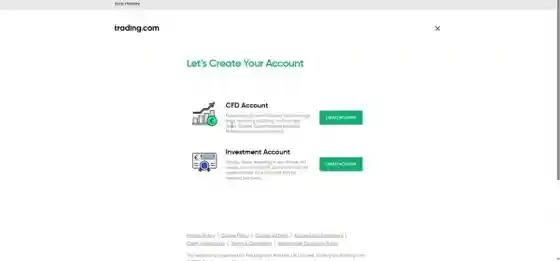
Here's where the split-personality framing matters most. Trading.com gives you two separate account types, with two different product lines, on two slightly different platforms.
What Does the CFD Account Offer?
The CFD side is the more mature product. You get leveraged exposure to seven asset classes:
- Forex: 55 currency pairs from majors through to exotics (USDTRY, EURPLN, USDZAR)
- Indices: global equity index CFDs including FTSE, S&P 500, DAX
- Thematic Indices: baskets like AI, EVs, and Clean Energy
- Soft Commodities: corn, sugar, cocoa
- Metals: gold, silver, platinum
- Energies: oil and natural gas
- Single-stock CFDs: a broad list of individual stocks as CFDs
Maximum retail leverage is the FCA-mandated 1:30 on majors, lower on equities. You get negative-balance protection. The CFD account requires an appropriateness questionnaire (loss tolerance, trading experience).
What Does the Investment Account Offer?
The Invest side is newer and narrower. You get real-share ownership (not CFDs) across UK Large, EU Large and US Large stocks, plus UCITS ETFs (the iShares core range, with Invesco, HSBC and Amundi).
It's a general investment account: no ISA, no SIPP, one account per client. The most you can lose is what you put in. There's no questionnaire to clear, and no leverage to manage. I cover the Invest side in much more depth, including the full ETF list, the £50 Welcome Credit mechanics, and where it falls short for UK investors, in Is Trading.com Good for Investing?
What Does It Cost to Trade with Trading.com?
This is genuinely competitive on the CFD side and fair-to-good on the Invest side.
How Tight Are Trading.com's Spreads?
Trading.com quotes its forex spreads "as low as", which means the floor, not the average, but the floor is competitive with the lowest tier of UK brokers. Here are the headline majors:
| Pair | Spread (as low as) |
|---|---|
| EUR/USD | 0.8 pips |
| GBP/USD | 0.8 pips |
| USD/JPY | 0.8 pips |
| USD/CHF | 1.1 pips |
| AUD/USD | 1.3 pips |
| GBP/JPY | 1.5 pips |
| EUR/GBP | 1.7 pips |
| EUR/JPY | 1.7 pips |
That 0.8 pip floor on EUR/USD sits in the same range as CMC, IG and Pepperstone. The broader picture: spreads are competitive on majors, fair on minor crosses (1.5–3 pips), and widen significantly on exotics — EUR/TRY can be 680 pips, USD/MXN around 156, the Scandi crosses 100+. That's normal for exotics but worth knowing if you're an EM trader.
There are no commissions on the standard CFD account, the cost is in the spread and overnight funding charges. A £10/month inactivity fee applies after twelve consecutive idle months, and the minimum withdrawal is £20.
What Does Invest Cost?
Zero commissions on share and ETF trades is the headline. There's an FX-conversion spread on USD- or EUR-denominated holdings, which is standard at every UK commission-free broker.
What you get back: 3.05% AER interest on uninvested GBP cash (opt-in, variable), a £50 Welcome Credit when you open and fund, and £50 per successful referral. None of those are universal — Trading 212 has comparable cash interest — but the £50 credit is more generous than most peers' new-customer offers.
What's the Trading.com Platform Actually Like?
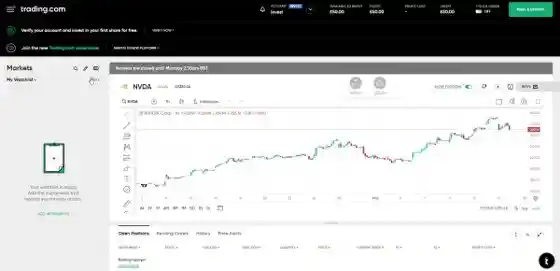
Two platforms run in parallel. The CFD account opens on the legacy WebTrader at trading.com/uk/dashboard. The Invest account opens on the new Trading.com app at trading.com/app/dashboard. There's a "SWITCH TO NEW PLATFORM" banner on the legacy view, and a "SWITCH BACK" button on the new one — Trading.com is clearly mid-redesign.
How Does the Chart and Trading Interface Stack Up?
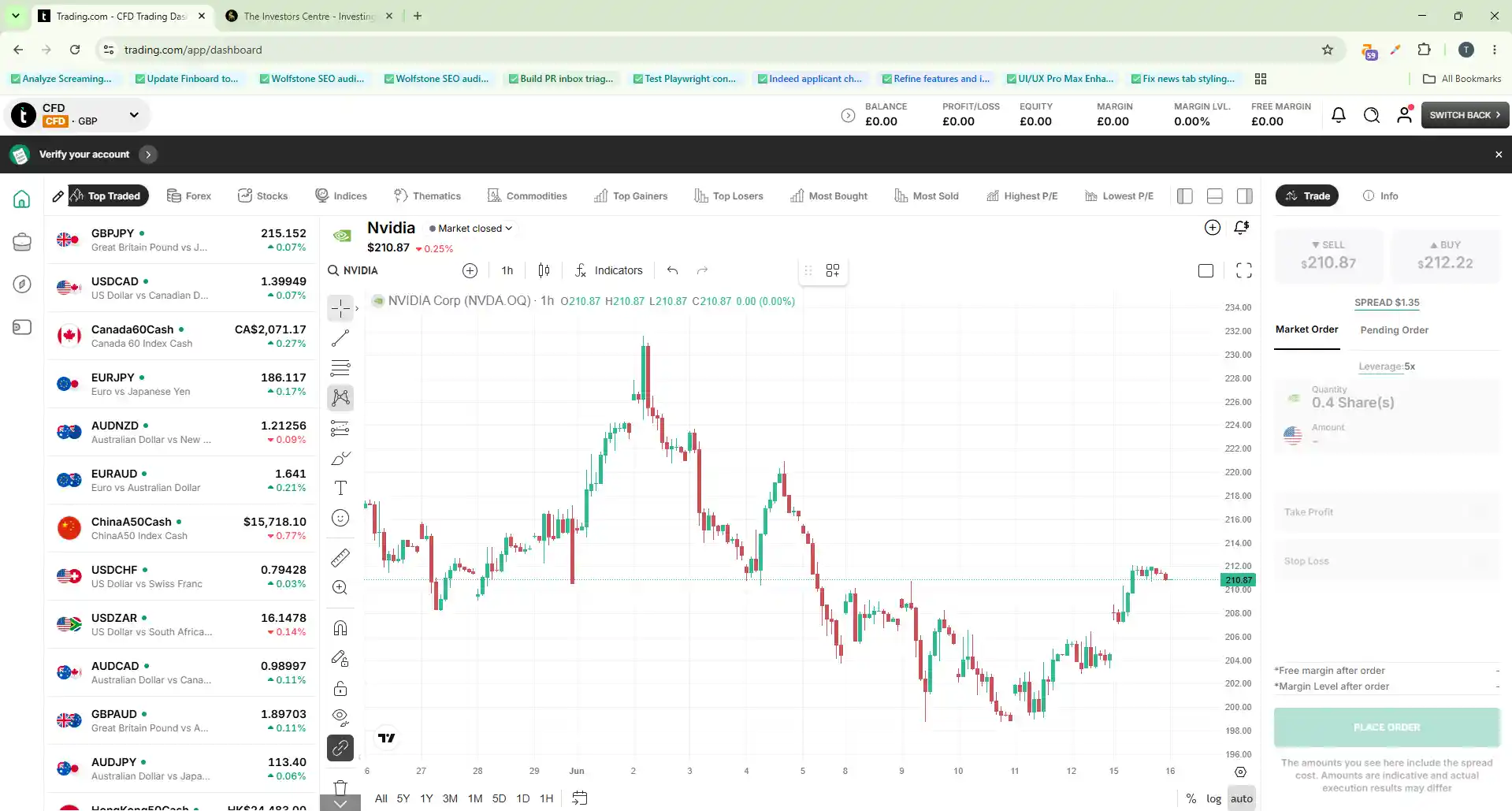
The web platform is built around a single, clean three-panel layout: markets sidebar on the left, chart in the middle, position-and-order panel along the bottom. Charts are powered by TradingView, which is the industry standard and the same engine you'd find on a much pricier subscription elsewhere. You get 38 indicators, drawing tools, multiple timeframes from 1-hour up to 5-year, and a clean order ticket.
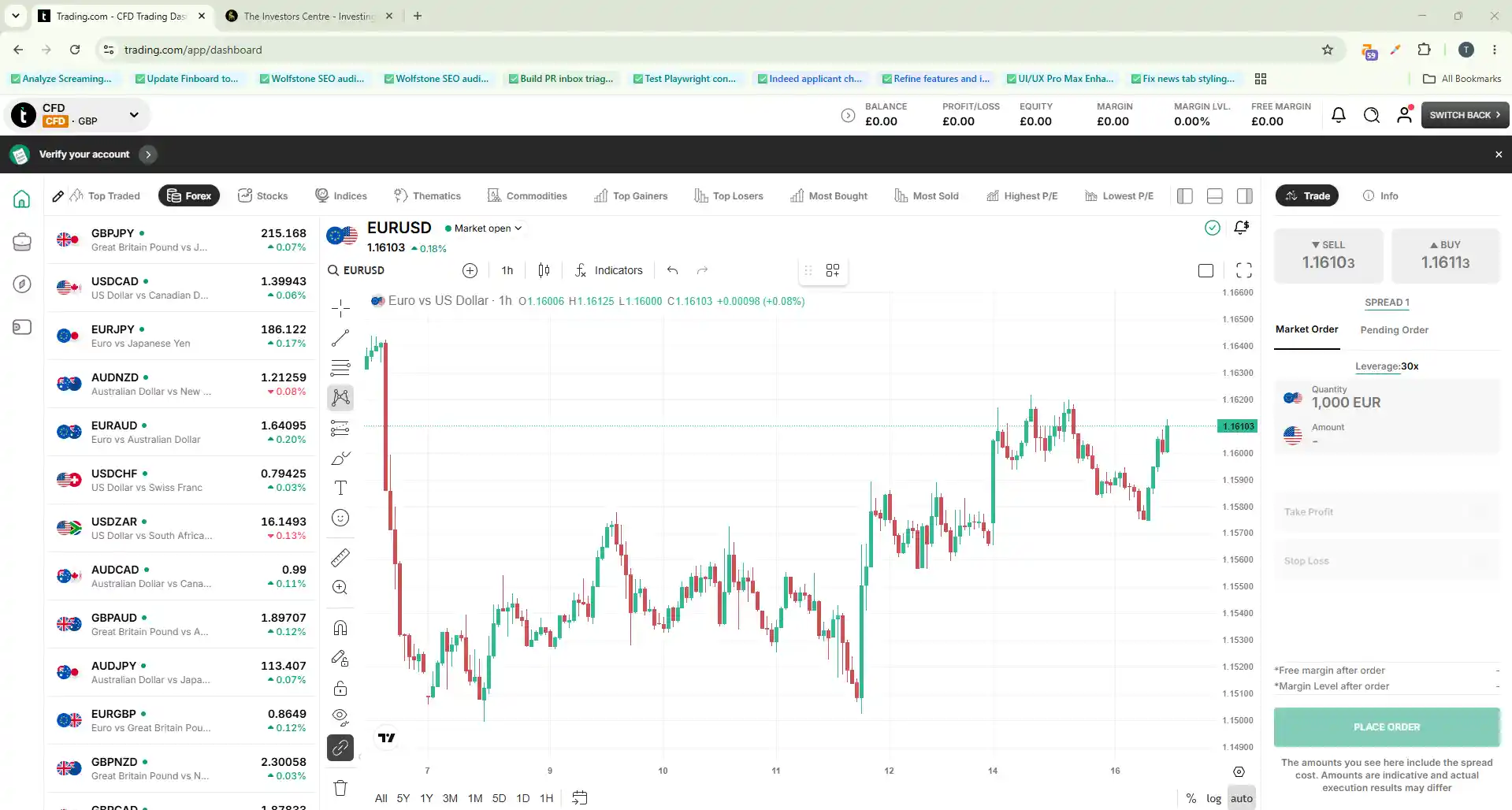
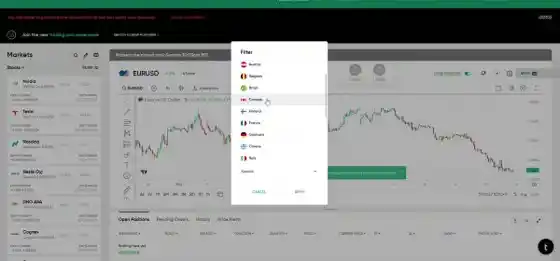
The screener gives you sensible top-level categories — Forex, Stocks, Indices, Thematics, Commodities — plus filters by Top Gainers, Top Losers, Highest P/E and Lowest P/E. The "Lowest P/E" default tab is the one piece of UX I'd flag: P/E filters are useful, but it's a finance-literate choice for a platform that markets itself at retail clients. I dig into that more in Is Trading.com Good for Beginners?
Is There a Mobile App, and Is There MT5 Support?
Both. The Trading.com mobile app runs on iOS and Android with feature parity to the web platform — same charts, same order tickets, same watchlists. And for traders who want a more advanced experience than the WebTrader offers, MetaTrader 5 connects directly to your account. That's a useful escape valve: you don't outgrow Trading.com and have to switch brokers, you just plug into MT5 for advanced workflows.
What About Charting Tools and Analysis Features?
The Invest side's chart defaults to a clean line chart rather than candlesticks, a sensible default for long-term investors who aren't reading price action minute-by-minute. The TradingView engine underneath is the same on both sides, so you can pull up candlesticks, drawing tools, and 38 technical indicators whenever you want them.
Is Trading.com Good for Beginners?
I rate beginner-friendliness at 4.0/5. The big positives: the £10,000 demo with no expiry, the streamlined signup with progress bars, the £50 Welcome Credit and the cleaner UI than IG/CMC. The negatives: the Lowest P/E screener default and no copy or social trading.
I cover all of this in detail, including a sensible first-90-days plan, in Is Trading.com Good for Beginners?
Is Trading.com Good for Investing?
I rate it 3.9/5 overall, 3.7/5 on the investing dimension specifically. The Invest account is a real, commission-free share-dealing product with a wide UCITS ETF universe (S&P 500 trackers, MSCI World, MSCI ACWI, UK Gilts, gold) and a sensible interest rate on uninvested cash. But there's no Stocks & Shares ISA wrapper — the one gap that keeps it behind Trading 212 for pure long-term UK investing.
The full breakdown is in Is Trading.com Good for Investing?
How Do I Rate Trading.com, and What Would Push the Score Higher?
My 3.9/5 rests on Trading.com being a strong but still-maturing all-rounder. It's a relatively new platform shipping features at pace, but it isn't yet as broad or established as the long-standing names — and two specific structural gaps stand out. The strengths are real: FCA regulated, dual-product flexibility, competitive CFD spreads, the £50 + 3.05% AER interest combo on the Invest side, TradingView charts, and the MT5 escape valve. The gaps are equally real:
An ISA wrapper would push my score to roughly 4.2/5. UK long-term investors really need tax-efficient wrappers, and the absence of one is the single biggest gap right now.
Adding a UK spread-betting account would push it further — it would give UK CFD traders the tax-efficient alternative they get at IG and CMC. Together with an ISA, that would put Trading.com in the same conversation as the very biggest brokers.
None of these are unfixable. They're a roadmap. And the broker is clearly investing in product — the new platform UI, the dual-account model, the 3.05% AER cash interest and the £50 credit are all relatively recent additions. The trajectory matters.
How Do Trading.com's Customer Support and Education Stack Up?
Honest answer: better than I expected on education, narrower than I expected on support. The Discover hub bundles tutorials, video tutorials, calculators, a glossary, an economic calendar and a curated news feed — a real content layer rather than the token glossary some brokers ship. The MetaTrader 5 connectivity adds a whole second layer of education through the wider MT5 community.
Support is 24/7 chatbot, with human agents Mon–Fri 8:00–16:00 (Cyprus time GMT+2) — that's roughly 6:00–14:00 UK time in winter. Narrower than the "24/5 live chat" claim some third-party reviews repeat. Fine if you're early-bird; less useful if a problem hits in the UK evening.
My Verdict on Trading.com
Trading.com is a genuinely interesting UK broker with an unusual proposition: it gives you a real CFD trading platform and a real commission-free share-dealing account inside the same login, regulated by the FCA, with FSCS protection. The CFD product is competitive on spreads, well-built on the platform side, and has TradingView and MT5 connectivity baked in. The Invest product is younger and narrower, but it's a credible commission-free option with a £50 Welcome Credit and 3.05% AER interest on uninvested cash.
If you're a beginner looking for a simple, FCA-regulated home for your first investments, Trading.com's Invest account is a reasonable place to start — I'd point most newcomers there first, not at CFDs. If you're an existing CFD trader looking for a tighter platform with MT5 connectivity, the CFD account is competitive. If you're a tax-conscious UK long-term investor who specifically needs an ISA, this isn't the right broker for you yet — Trading 212 or InvestEngine will serve you better until Trading.com adds wrappers.
My 3.9/5 rating reflects all of that — strong fundamentals on a young, fast-improving platform, named gaps, and a clear upgrade path. With an ISA, that rating moves to 4.2. With a UK spread-betting account on top, we're talking 4.5+. Those things are perfectly addressable, and worth watching for as Trading.com continues to build out the product.
Discuss Trading.com
Traded or invested with Trading.com? Share your experience, ask questions, or help other UK traders and investors decide. Our community earns Equity for quality contributions.
Discussion 0 comments
Be the first to start discussing this topic! Log in or create an account to share your thoughts.
Log In Create AccountFAQs
Corrections & Update Log
- 24 Jun 2026: Trading.com onboarding/offer update — removed all references stating Vanguard ETFs are unavailable (now offered on the Investment Account, confirmed by Trading.com 23 Jun 2026) and updated all fractional-shares references to reflect availability. Overall rating reviewed and held at 3.9/5 (young, fast-evolving platform with room to grow; consistent with the community rating); score rationale reframed around platform maturity rather than the now-closed feature gaps.
- 16 Jun 2026: Compliance update (Trading.com) — corrected FCA-authorisation date to 2016; set XM reference to www.xm.co.uk; added "AER" to all interest figures; standardised "uninvested cash"; moved the inactivity fee to the CFD section (it does not apply to the Investment Account); added overnight funding charges to the CFD cost line; removed product-feature framing of regulatory checks.
If you spot an error or outdated information in this review, please let us know and we'll correct it promptly.
References
- Financial Conduct Authority (FCA) – Financial Conduct Authority | FCA
- FCA Register – Trading.com Markets UK Limited – FRN 705428
- FSCS – What We Cover | FSCS
- Companies House – Trading.com Markets UK Limited (09436004) – Companies House
- TradingView Official Website – TradingView
No comments yet. Be the first to start discussing this topic!