

- expertise:
- CFD Trading, Forex, Derivatives, Risk Management
- credentials:
- Chartered ACII (2018) · Trading since 2012
- tested:
- 40+ forex & CFD platforms with live accounts

- expertise:
- Platform Testing, Cryptocurrency, Retail Investing
- credentials:
- Active investor since 2013 · 11+ years experience
- tested:
- 50+ platforms · 200+ guides authored
How We Test
Real accounts. Real money. Real trades. No demo accounts or press releases.
What we measure:
- Spreads vs advertised rates
- Execution speed and slippage
- Hidden fees (overnight, withdrawal, conversion)
- Actual withdrawal times
Scoring:
Fees (25%) · Platform (20%) · Assets (15%) · Mobile (15%) · Tools (10%) · Support (10%) · Regulation (5%)
Regulatory checks:
FCA Register verification · FSCS protection
Testing team:
Adam Woodhead (investing since 2013), Thomas Drury (Chartered ACII, 2018), Dom Farnell (investing since 2013) — 50+ platforms with funded accounts
Quarterly reviews · Corrections: in**@*******************co.uk
Disclaimer
Not financial advice. Educational content only. We're not FCA authorised. Consult a qualified advisor before investing.
Capital at risk. Investments can fall. Past performance doesn't guarantee future results.
CFD warning. 67-84% of retail accounts lose money trading CFDs. High risk due to leverage.
Contact: in**@*******************co.uk
Quick Answer — Is Trading.com Good for Investing?
Yes, conditionally. The Trading.com Investment Account is a genuine commission-free* share-dealing product with a real UCITS ETF universe, a £50 Welcome Credit and 3.05% AER interest on uninvested cash. But one gap — no Stocks & Shares ISA — keeps it behind Trading 212 for pure long-term UK investing. As with any investment, your capital is at risk and the value of your investments can fall as well as rise.
*Commission-free refers to dealing commission only. A currency-conversion (FX) spread applies to USD- or EUR-denominated holdings (most UCITS ETFs and US shares) and a £20 minimum withdrawal applies – explained in full below, so “commission-free” is not “cost-free”.

Is Trading.com Good for Investing? A Real Product With One Honest Gap
When most people hear "Trading.com" they think CFDs and forex. That used to be accurate. It isn't any more. Trading.com now runs a separate Investment Account alongside its CFD service — a commission-free share-dealing product with real ownership, a £50 Welcome Credit and 3.05% AER interest on uninvested cash. I opened one, funded it and used it for several days before writing this.
The short version: it's a real investing product, and a credible one. The longer version: there's one thing still missing that stops me ranking it alongside Trading 212 or InvestEngine for UK long-term investors. I'm going to walk through what's good first, then the gaps, then who it actually suits. For the broader broker picture, my full Trading.com review is here.
What Is the Trading.com Investment Account?
When you open an account with Trading.com, you choose between a CFD Account and an Investment Account.
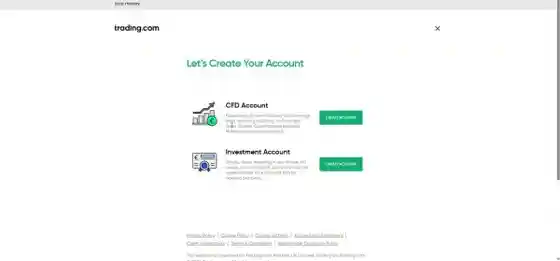
The Investment Account is described as "simple, direct investing in real shares. No swaps, no commission, just ownership." You buy a share, you own it. You get the dividend, you can sell it, you can hold it as long as you want. It's an unleveraged general investment account.
How Does It Differ from the CFD Account?
Three big ways:
- You own the asset. With a CFD, you're contracting on price movement — you don't own the underlying. With the Invest Account, you're a registered shareholder.
- There's no questionnaire. The CFD account requires you to pass an appropriateness test (loss tolerance, trading experience). The Invest Account doesn't, because there's no leverage and no derivative risk to assess. But still your capital is at risk when investing in non-high-risk products.
- One per client. You can hold multiple CFD accounts (useful for separating strategies), but only one Investment Account.
The two sit under the same login, on the same app, in the same dashboard. You can flip between them via the account-switcher at the top of the screen.
What Can I Actually Invest In?
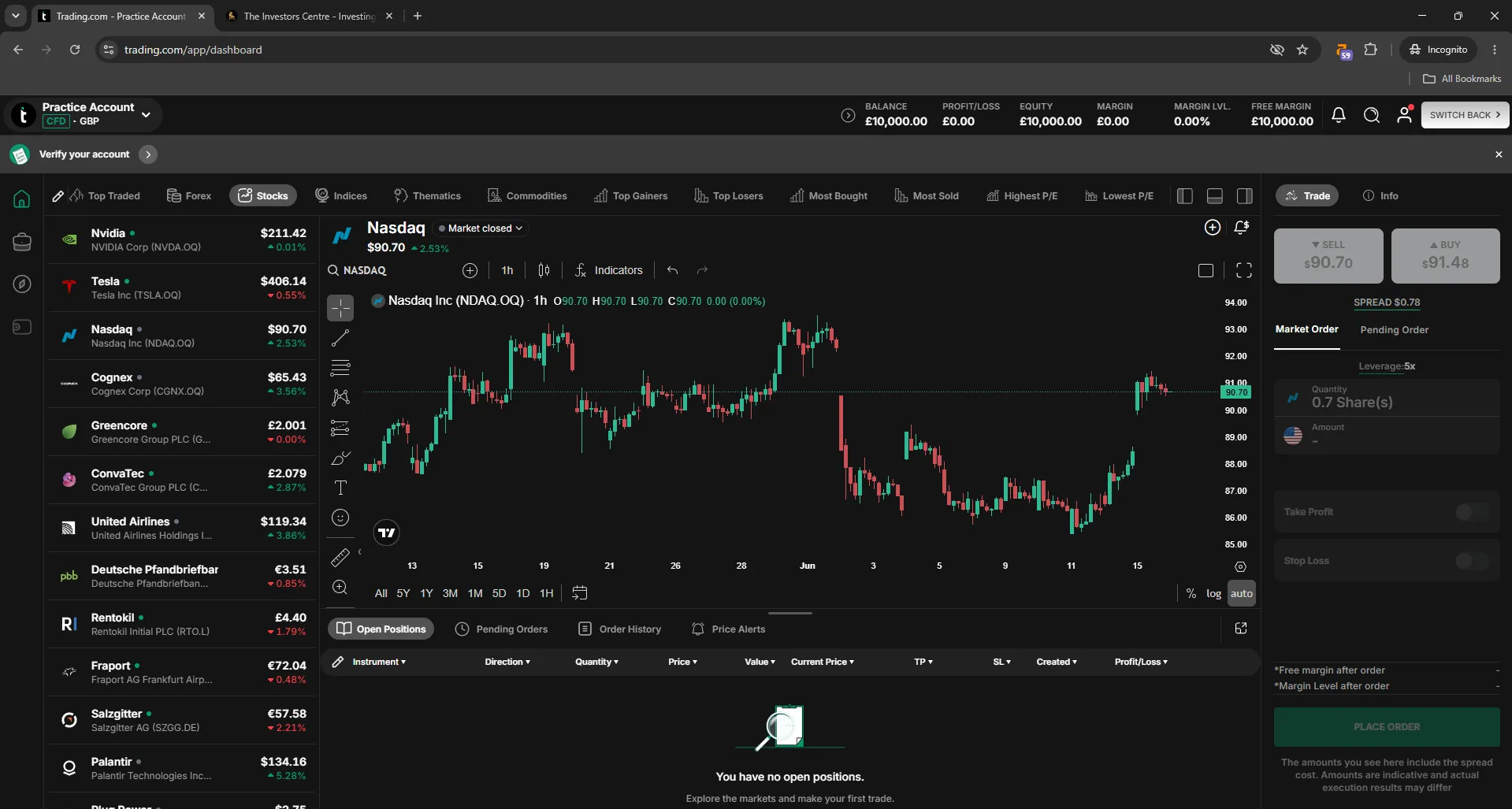
The Invest platform splits its universe into clear categories — UK Large, EU Large, US Large and ETFs — alongside Top Traded, Top Gainers and Top Losers. There's also a country filter and sector filter built into the stock screener, which is more granular than I expected.
Which ETFs Are Available?
This is the part most reviews skip, so I'll be specific. The ETF list is UCITS-only, the UK/EU regulatory standard, and it leans heavily on iShares, with Invesco, HSBC and Amundi making up the rest. Here's a slice of what I saw on the live screener:
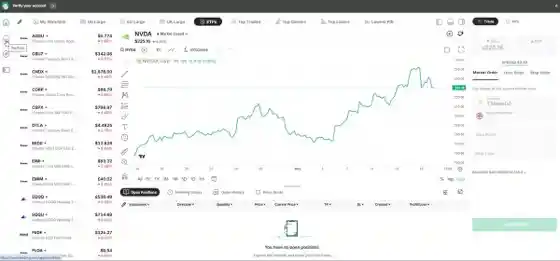
The headline trackers a UK investor would actually want are all there:
- S&P 500: CSPX (iShares Core S&P 500 accumulation), IDUS, GSPX
- Nasdaq 100: CNDX, EQQQ (Invesco), EQQU
- MSCI World: HMWO (HSBC)
- MSCI ACWI (the FTSE All-World equivalent): ISAC
- MSCI Europe: IMEU · MSCI Japan: IJPA · MSCI Emerging Markets: EIMI, EMIM
- UK Gilts: IGLS (0–5yr), IGLT (broad)
- Investment-grade bonds: CORP, IEAC · High yield: IHYA, IHYG, IHYU
- US Treasuries: IB01, IBTA, DTLA
- Gold: IGLN · Money market: FEDF · ESG: EEDS
That's a solid core universe for building a long-term portfolio — and it now includes Vanguard ETFs alongside the iShares, Invesco, HSBC and Amundi ranges.
How Much Does It Cost to Invest with Trading.com?
What Does the "Zero Commission" Claim Actually Mean?
The headline is genuine: there are no commissions on share and ETF trades on the Invest account. That puts Trading.com in the same fee bracket as Trading 212 and eToro for trade execution.
The asterisk to know about: any USD- or EUR-denominated holding (which includes most ETFs in the UCITS universe, plus all US stocks) will involve an FX-conversion spread when you fund a position from your GBP balance. That's standard across UK brokers — Trading 212, eToro and InvestEngine all charge an FX margin too — but it's worth understanding so the "zero commissions" line doesn't get mistaken for "zero cost".
The standard housekeeping fee to note is a £20 minimum withdrawal, which isn't unusual for the sector.
What Is the £50 Welcome Credit?
When you open and fund your Invest account, you receive a £50 credit. It sits in your account as a CREDIT alongside your Available-to-Invest and Equity figures. The credit isn't withdrawable as cash.
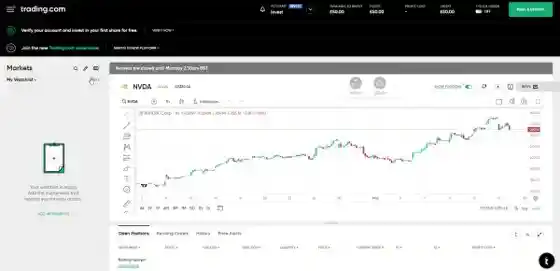
That's a nice touch, and a meaningful onboarding incentive — and now that fractional shares are available on the Invest account, you can deploy it against any holding rather than just lower-priced tickers.
How Does the 3.05% AER Interest on Uninvested Cash Work?
In the Discover hub, Trading.com offers 3.05% AER on uninvested GBP cash, opt-in, variable. If your strategy involves cash drag (waiting for opportunities, dollar-cost-averaging slowly), that's a sensible default that most pure-CFD brokers don't offer.
The opt-in part matters. The rate isn't automatic — you have to enable it from the Discover tab. Pre-publishing this article I'd want to verify the full T&Cs (eligible balance cap, how the cash is held, FSCS treatment), but on headline terms it's a competitive number — Trading 212 currently offers a similar rate on uninvested GBP, and most legacy share-dealing platforms offer 0%.
Is There a Refer-a-Friend Programme?
Yes, Trading.com offers £50 credit for every successful referral. T&Cs apply. Combined with the £50 Welcome Credit and the cash interest, it's a thoughtful trio of inducements for someone genuinely getting started.
What's Missing for UK Investors?
This is where I have to be specific, because this is where the score lands at 3.9 rather than higher.
Where Is the ISA Wrapper?
There isn't one. Trading.com Invest is a general investment account only — no Stocks & Shares ISA. For UK long-term investors, that's the single biggest gap. An ISA shields you from Capital Gains Tax and dividend tax up to your £20,000 annual allowance. Without one, every gain you make on Trading.com Invest is potentially taxable.
If an ISA were added, I'd push my rating from 3.9/5 up to roughly 4.2/5 — that's how material this gap is. Until it is, Trading 212, AJ Bell, Hargreaves Lansdown and InvestEngine remain better homes for any UK investor's tax-wrapper money.
Does Trading.com Offer Fractional Shares?
Yes. Trading.com now offers fractional shares on the Invest account, so you can buy a slice of a high-priced share or ETF rather than a whole unit. That matters for the £50 Welcome Credit: previously a single share of CSPX (roughly $800) or EQQQ (around £536) was out of reach of the credit, but with fractional dealing you can put it toward any holding you like.
That also makes Trading.com suitable for long-term pound-cost averaging — you can invest a set amount on a schedule regardless of individual share prices, the same way you can at Trading 212 or eToro.
Are There SIPPs, Funds, Bonds or Spread Betting?
No on all four. The Invest account is shares and ETFs, full stop. No SIPP for pension investing. No OEICs or unit trusts. No direct gilts or bonds (you can hold them via the ETF wrappers, IGLT, IB01, but not buy individual bonds). And on the CFD side, Trading.com doesn't offer a UK spread-betting account, which would be a tax-efficient CFD alternative for UK clients.
The remaining absence of wider assets and a UK spread-betting account is what keeps a higher rating in check — spread betting in particular would push the broker toward 4.5/5 territory.
How Does Trading.com Invest Compare to Trading 212?
The closest UK competitor head-to-head:
| Feature | Trading.com | Trading 212 | Edge |
|---|---|---|---|
| Wrappers | General account only | ISA + general account | Trading 212 |
| Fractional shares | Yes | Yes | Tied |
| Commissions | Zero | Zero | Tied |
| Interest on cash | Yes (GBP) | Yes (GBP) | Roughly tied |
| ETF universe | UCITS, incl. Vanguard | Includes Vanguard | Tied |
| CFD product | TradingView + MT5 | More basic | Trading.com |
| Welcome credit | £50 | Free-share offer | Trading.com |
For pure long-term UK investing, Trading 212 is the stronger pick at the time of writing, primarily because of the ISA. For someone who wants a single app to handle both serious CFD trading and a buy-and-hold share-dealing pot, Trading.com is the more compelling all-in-one option.
My Verdict: Is Trading.com Good for Investing?
Yes, conditionally. The Invest account is a genuine, well-built product with a real UCITS ETF universe, no commission, 3.05% AER interest on uninvested cash and a £50 Welcome Credit. The dual-account convenience with the CFD side is unusual and useful. The platform is clean and easy to use.
The lack of a Stocks & Shares ISA — together with the fact this is still a young, fast-evolving product that's narrower than the established names — keeps my overall rating at 3.9/5, with a slightly lower 3.7/5 on the long-term-investing dimension specifically. Add an ISA wrapper and I'd move toward 4.2+.
Who should consider Trading.com Invest right now? Existing CFD users who want a buy-and-hold pot in the same app; self-directed investors who already know which UCITS ETF tickers they want; anyone happy to use a general account rather than an ISA. Who should look elsewhere? Anyone who specifically wants ISA tax efficiency — Trading 212 or InvestEngine will serve you better until Trading.com adds a wrapper.
If you're new to investing in general, my beginner-focused take on Trading.com is here, and the full broker review is here.
Discuss Investing with Trading.com
Using the Trading.com Invest account? Share which ETFs you hold, how you've found the £50 credit and cash interest, or help other UK investors decide. Our community earns Equity for quality contributions.
Discussion 0 comments
Be the first to start discussing this topic! Log in or create an account to share your thoughts.
Log In Create AccountFAQs
References
- Financial Conduct Authority (FCA) – Financial Conduct Authority | FCA
- FCA Register – Trading.com Markets UK Limited – FRN 705428
- GOV.UK – Individual Savings Accounts (ISAs) – ISA allowance and rules
- FSCS – What We Cover | FSCS
No comments yet. Be the first to start discussing this topic!