

- expertise:
- CFD Trading, Forex, Derivatives, Risk Management
- credentials:
- Chartered ACII (2018) · Trading since 2012
- tested:
- 40+ forex & CFD platforms with live accounts

- expertise:
- Platform Testing, Cryptocurrency, Retail Investing
- credentials:
- Active investor since 2013 · 11+ years experience
- tested:
- 50+ platforms · 200+ guides authored
How We Test
Real accounts. Real money. Real trades. No demo accounts or press releases.
What we measure:
- Spreads vs advertised rates
- Execution speed and slippage
- Hidden fees (overnight, withdrawal, conversion)
- Actual withdrawal times
Scoring:
Fees (25%) · Platform (20%) · Assets (15%) · Mobile (15%) · Tools (10%) · Support (10%) · Regulation (5%)
Regulatory checks:
FCA Register verification · FSCS protection
Testing team:
Adam Woodhead (investing since 2013), Thomas Drury (Chartered ACII, 2018), Dom Farnell (investing since 2013) — 50+ platforms with funded accounts
Quarterly reviews · Corrections: in**@*******************co.uk
Disclaimer
Not financial advice. Educational content only. We're not FCA authorised. Consult a qualified advisor before investing.
Capital at risk. Investments can fall. Past performance doesn't guarantee future results.
CFD warning. 67-84% of retail accounts lose money trading CFDs. High risk due to leverage.
Contact: in**@*******************co.uk
Quick Answer — Is Trading.com Safe?
Yes — for UK clients Trading.com is a safe, FCA-regulated broker (FRN 705428). Client money is segregated under FCA CASS rules, eligible cash is FSCS-protected up to £85,000 if the firm fails, and the legal entity has more than a decade of FCA history. But a safe, well-regulated broker is not the same as safe trading: the CFD account is a leveraged, high-risk product and most retail traders lose money on it.

Is Trading.com Safe? My Honest Take on the FCA Broker
Short answer: yes, Trading.com is a safe broker for UK clients. It's authorised and regulated by the Financial Conduct Authority, and the firm sits inside a long-established group with more than a decade of operating history in the UK.
But "safe" actually means three different things: how the firm is regulated, how your money is held, and the risk of the products themselves. Trading.com is strong on the first two. The third one is on you. I'll walk through each layer. For my fuller take on the broker, see my Trading.com review.
How Is Trading.com Regulated in the UK?
Who Is Trading.com Markets UK Limited?
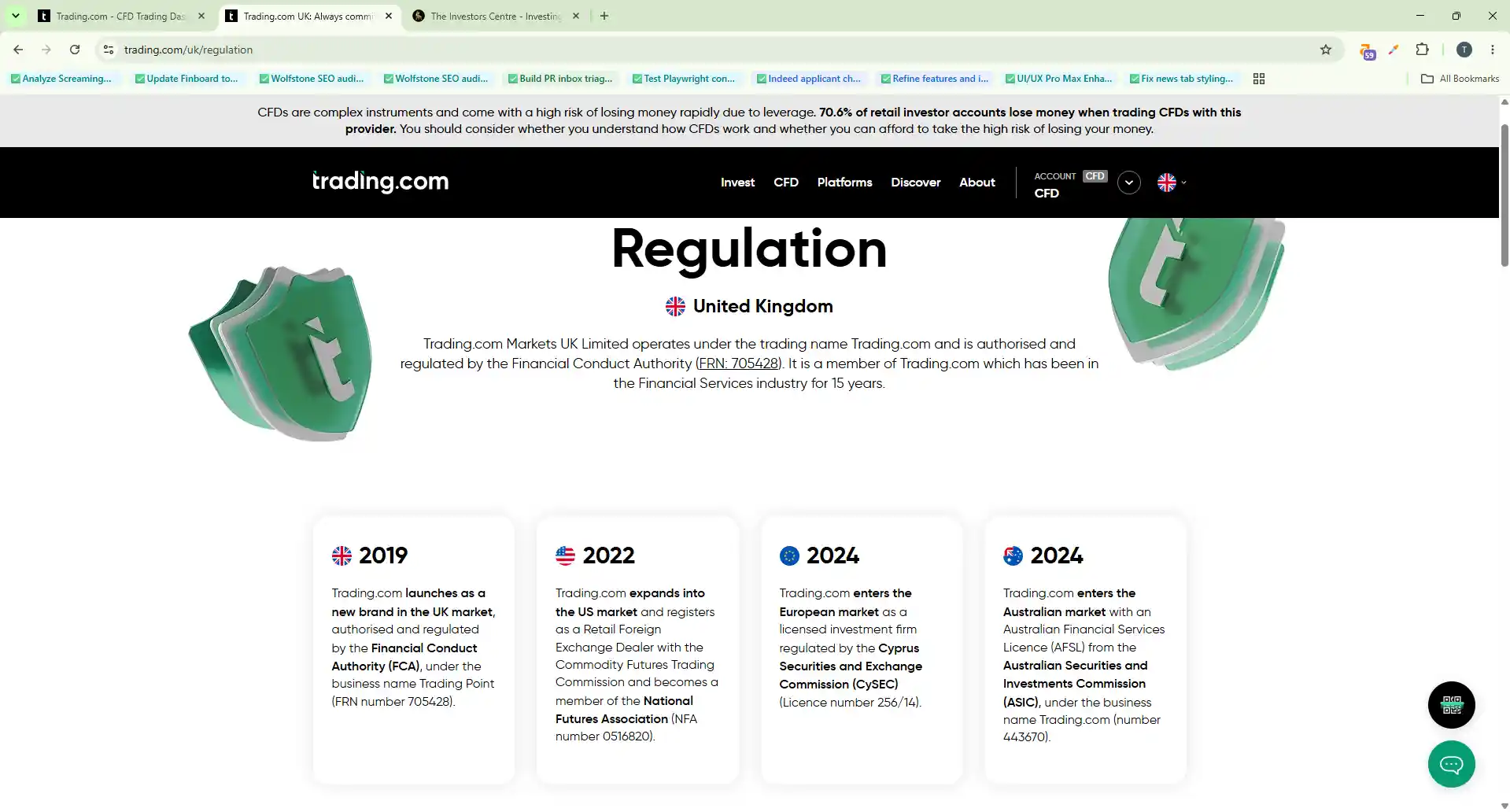
Trading.com is the trading name for Trading.com Markets UK Limited, a company registered in England and Wales (Companies House number 09436004) at Coppergate House, 10 Whites Row, Spitalfields, London E1 7NF. The firm is authorised and regulated by the Financial Conduct Authority under firm reference number 705428.
Here's something a lot of reviews don't tell you. This legal entity isn't new — it's the same company that operated in the UK as www.xm.co.uk until 2019. Trading.com is a rebrand of XM's UK arm, with the same FCA permissions and the same operating history. So while the brand "Trading.com" launched in 2019, the underlying entity has been an FCA-authorised firm since 2016. The parent group, Trading Point Holdings, is a sizable multi-jurisdictional financial-services group that also owns the XM brand.
What Protection Does FCA Authorisation Actually Give Me?
FCA-authorised firms have to meet hard rules on capital adequacy, client-money handling, complaints procedures and conduct. Three protections that matter most for a retail client:
- CASS (client-money) rules: Trading.com is required to keep client funds in segregated bank accounts, separate from the firm's own money.
- Conduct: the firm has to act in your best interests.
- Negative balance protection: for retail CFD clients, you can never lose more than the balance on your account.
You can verify Trading.com's status yourself on the FCA Register by searching for FRN 705428.
Is My Money Safe with Trading.com?
Are Client Funds Segregated?
Yes. Under FCA CASS rules, Trading.com Markets UK Limited has to hold client money in dedicated, segregated bank accounts at tier-1 institutions, kept entirely separate from the firm's own working capital. If something happened to Trading.com as a business, those client funds shouldn't be available to its creditors.
Am I Covered by FSCS?
Yes. Trading.com is a member of the Financial Services Compensation Scheme, which covers eligible UK clients up to £85,000 per person per firm if the broker fails. That's the same FSCS protection you'd get with Hargreaves Lansdown, Trading 212, AJ Bell or any other FCA-authorised UK broker. It's the floor every UK firm has to meet, and Trading.com meets it.
A specific note for the cautious: FSCS covers you against the firm failing, not against losing money on your trades. Two different things, and an important distinction I'll come back to.
What About the Financials of the UK Firm?
I'll be transparent here. Trading.com Markets UK Limited's most recent published accounts show the UK arm has been loss-making on a small revenue base. That's worth knowing, but it doesn't change the position for client money, because client funds are held in segregated bank accounts ring-fenced from the firm's P&L. Corporate profitability and client-money safety are separate questions. And the parent group, Trading Point Holdings, is a substantial operating business across multiple jurisdictions.
What Safety Checks Does Trading.com Run on Me?
What KYC and Verification Will I Need?
The standard FCA package, applied properly:
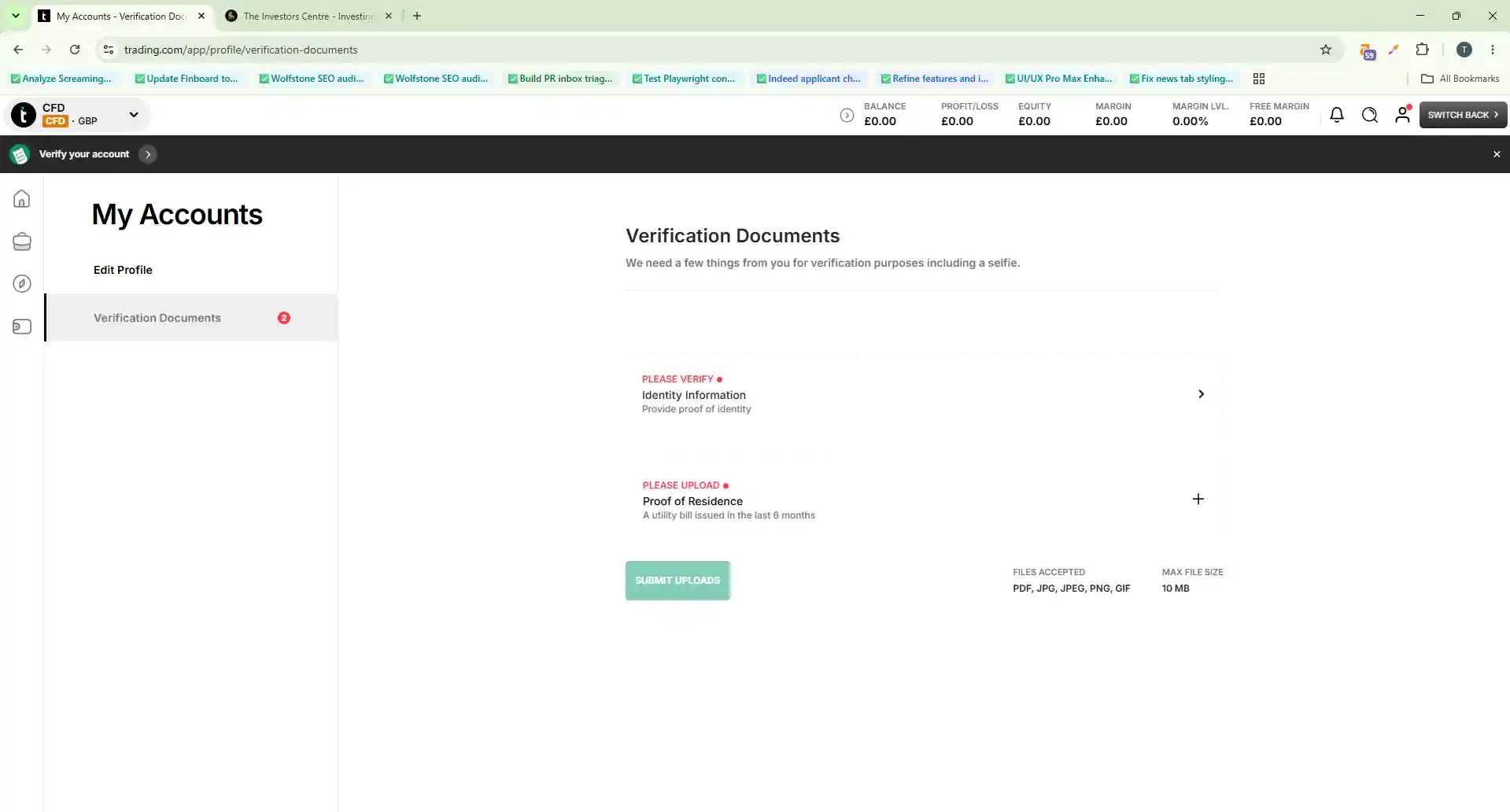
To activate your account, Trading.com asks for:
- Proof of identity, usually a passport or driving licence
- Proof of residence, a utility bill issued in the last 6 months that matches your registered address
- A selfie, for biometric matching against the ID document
Files accepted are PDF, JPG, JPEG, PNG or GIF, up to 10 MB. The signup also collects CRS / FATCA tax declarations and your source-of-funds and source-of-wealth — both are FCA standard for any UK broker.
How Safe Is the Actual Product?
Here's where the picture gets more nuanced. A well-regulated broker and a low-risk product are not the same thing.
Why Are CFDs a High-Risk Product?
The CFD account at Trading.com is a leveraged derivatives product. With leverage of up to 1:30 (the FCA-mandated retail cap), a small move in the market can produce a much larger move in your P&L, in either direction. Add overnight financing costs, the spread you pay on every trade, and the emotional pull of fast price action, and the average outcome for a retail CFD trader is a loss. That's not a Trading.com-specific problem, it's a CFD-product problem, common across every regulated provider including IG, CMC, Pepperstone and Plus500.
Trading.com mitigates the worst-case scenario through negative-balance protection (you can't lose more than your deposit) and through the appropriateness questionnaire before they let you open a CFD account. But the product is what it is. If you can't afford to lose the money you're putting in, don't trade CFDs.
Are the Risks Different on the Investment Account?
Yes. The Invest account is unleveraged, real-share ownership. Your investments can rise as well as fall with the market. There's no margin call, no overnight financing, no liquidation. For a long-term investor, the Invest account is meaningfully safer in product terms.
How Does Trading.com Compare to Other UK Brokers on Safety?
Honestly, on the headline regulatory and FSCS criteria, Trading.com is in the same tier as the major UK names. IG, CMC, Trading 212, AJ Bell, Hargreaves Lansdown — all FCA-authorised, all FSCS-protected up to £85,000, all running segregated client-money accounts. There's no meaningful safety differentiator at this level.
Where Trading.com edges slightly ahead of some competitors is in things like the Responsible Disclosure security policy in the footer. Where it edges slightly behind some others is the public financial position of the UK entity. Neither of these moves my overall safety rating away from "yes, safe".
My Verdict: How Safe Is Trading.com?
Trading.com is a safe, FCA-regulated UK broker — that's an unqualified yes. The legal entity has been on the FCA register since 2016, it's part of a substantial parent group, and the firm runs the segregation and KYC processes you'd expect from a tier-1 UK broker.
That's a 4.5/5 on trust and regulation. The overall 3.9/5 rating reflects other gaps — no ISA wrapper, narrower asset range than the very largest brokers, no UK spread-betting account — but none of those are safety issues. They're product-completeness issues.
The honest caveat: a safe broker is not the same thing as safe trading. If you open the CFD account, you're taking on a leveraged, high-risk product that you can lose money on regardless of how regulated the firm running it is. If you open the Invest account, you're taking on market risk — your investments can fall in value. Both of those risks sit with you, not with the broker.
For the full picture, read my Trading.com review, and if you're new to all of this, my beginner-focused take is here.
Discuss Trading.com Safety
Got a view on how safe Trading.com is? Share your experience with funding, withdrawals or verification, or help other UK clients decide. Our community earns Equity for quality contributions.
Discussion 0 comments
Be the first to start discussing this topic! Log in or create an account to share your thoughts.
Log In Create AccountFAQs
References
- Financial Conduct Authority (FCA) – Financial Conduct Authority | FCA
- FCA Register – Trading.com Markets UK Limited – FRN 705428
- FSCS – What We Cover | FSCS
- FCA – Client Assets (CASS) – CASS Sourcebook
No comments yet. Be the first to start discussing this topic!