

- expertise:
- CFD Trading, Forex, Derivatives, Risk Management
- credentials:
- Chartered ACII (2018) · Trading since 2012
- tested:
- 40+ forex & CFD platforms with live accounts

- expertise:
- Platform Testing, Cryptocurrency, Retail Investing
- credentials:
- Active investor since 2013 · 11+ years experience
- tested:
- 50+ platforms · 200+ guides authored
How We Test
Real accounts. Real money. Real trades. No demo accounts or press releases.
What we measure:
- Spreads vs advertised rates
- Execution speed and slippage
- Hidden fees (overnight, withdrawal, conversion)
- Actual withdrawal times
Scoring:
Fees (25%) · Platform (20%) · Assets (15%) · Mobile (15%) · Tools (10%) · Support (10%) · Regulation (5%)
Regulatory checks:
FCA Register verification · FSCS protection
Testing team:
Adam Woodhead (investing since 2013), Thomas Drury (Chartered ACII, 2018), Dom Farnell (investing since 2013) — 50+ platforms with funded accounts
Quarterly reviews · Corrections: in**@*******************co.uk
Disclaimer
Not financial advice. Educational content only. We're not FCA authorised. Consult a qualified advisor before investing.
Capital at risk. Investments can fall. Past performance doesn't guarantee future results.
CFD warning. 67-84% of retail accounts lose money trading CFDs. High risk due to leverage.
Contact: in**@*******************co.uk
Quick Answer: How to Short Tesla in 2026?
To short Tesla in 2026, open a margin account with an FCA-regulated brokerage, borrow Tesla shares, and execute a sell order. The goal is to buy back the shares at a lower price to profit from the decline. Alternatively, UK traders can use CFDs or put options for more flexibility. Be aware of the risks: losses can exceed your initial investment if the stock rises.
A practical guide explaining how traders can take a short position on Tesla shares.
Overview Of Tesla 2026
Heading into 2026, Tesla remains a dominant force in the EV market, though increased competition and shifting investor sentiment continue to drive volatility. With ongoing developments in autonomous driving, energy storage, and global production expansion, Tesla's stock attracts both bullish long-term investors and bearish short sellers looking to capitalise on price swings.
What is Short Selling?
Short-selling is a strategy where investors borrow shares of a stock they believe will decrease in value. They then sell these shares at the current market price and aim to buy them back at a lower price. This difference between the selling price and the repurchase price is the investor's profit. However, if the stock price rises instead, the investor incurs a loss. This strategy is popular for those with a high-risk tolerance and confidence in a stock's potential decline.
Why Would Investors Want to Short Tesla?
Tesla's stock is known for its volatility, partly due to its position in a rapidly changing industry and the influence of its CEO, Elon Musk. High-profile news and market sentiment can cause large swings in Tesla's share price, both up and down. For this reason, some investors find shorting Tesla appealing because it presents opportunities for profit during periods of overvaluation or hype.
To see what a short position actually costs, take a worked example at the levels Tesla trades as I write in mid-July 2026, around the $380 mark. On IG, a US share spread bet stakes pounds per point and a point is one cent, so Tesla at $380 is a 38,000-point price: £1 per point is roughly £38,000 of exposure, and the minimum 20% retail margin on shares means about £7,600 committed to open it. If Tesla falls 5%, that is roughly 1,900 points, £1,900 at £1 per point; the same rise costs the same against you. The running costs are the part shorts underestimate: overnight funding accrues nightly on a daily-funded position, short positions can also pay a borrow charge at the interbank borrow rate plus a 0.5% admin fee applied daily, and that rate can change while the trade is open. One line item you do not pay here: Tesla pays no dividend, so there are no dividend adjustments on a Tesla short.
Here's a quick comparison of long and short positions with Tesla:
| Aspect | Long Position (Buying) | Short Position (Short Selling) |
|---|---|---|
| Goal | Profit from price increase | Profit from price decrease |
| Risk | Limited to investment amount | Theoretically unlimited |
| Ownership | Own shares | Borrowed shares |
| Common in Tesla? | Yes, for long-term growth | Yes, due to volatility |
Short-selling Tesla requires an understanding of market trends and the ability to manage risk, as the potential losses can be substantial if the stock doesn't behave as expected.
How Does Short Selling Work? A Step-by-Step Guide
Short-selling involves multiple steps, each requiring careful attention to detail. If you're looking to short Tesla, here's a simplified breakdown of the process.
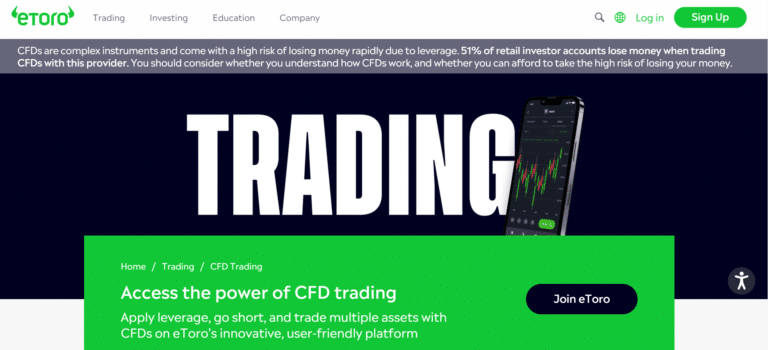
Step 1: How Do You Open a Margin Account for Short Selling?
To short Tesla, you first need a margin account. This type of account allows you to borrow shares to sell, which is essential for short selling. Opening a margin account usually involves filling out an application with a brokerage, agreeing to their terms, and meeting specific financial requirements. Most brokerages require you to have a minimum balance or meet certain income criteria because short-selling is considered high-risk.
Step 2: Funding Your Margin Account
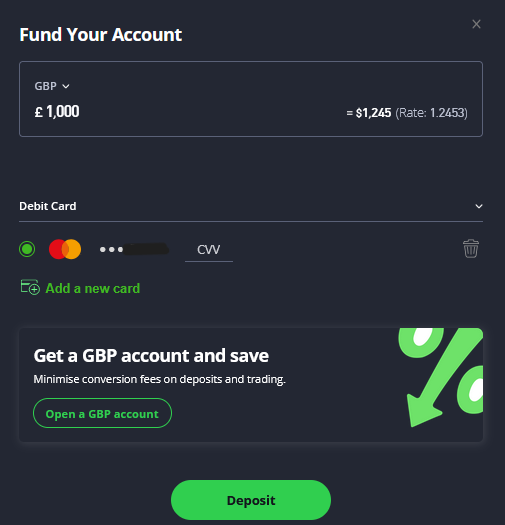
Once your margin account is open, it's time to fund it. This funding meets the brokerage's initial margin requirement, which is a percentage of the total trade value. For UK retail accounts, margin on individual shares is at least 20%, so Tesla is 5:1 leverage at best. Additionally, you'll need to maintain a minimum amount in your account, called the maintenance margin. If the stock moves against your position and your balance falls below this level, you'll face a margin call and will need to add funds or close the position.
For example, I once funded an account with just the minimum required amount. But a sudden upward spike in the stock price quickly led to a margin call, and I had to scramble to add more funds. Since then, I have always kept a cushion in the account to avoid these stressful situations.
Step 3: Borrowing Tesla Shares to Sell
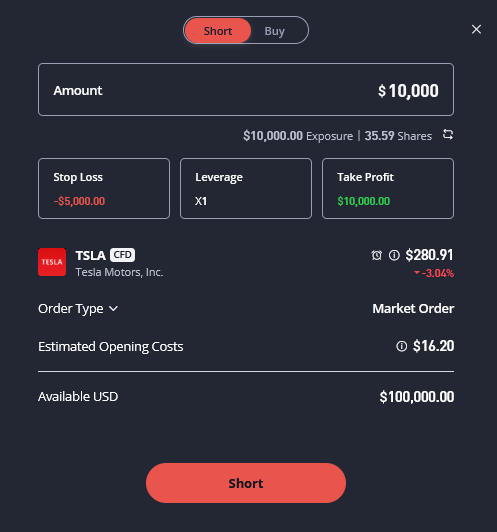
With a funded account, the next step is to borrow shares. Brokerages typically have a pool of shares available for clients to borrow, and they handle the logistics. Once borrowed, these shares can be sold at the current market price. Be aware of the cost: short positions can incur an annualised borrow charge at the interbank borrow rate plus a 0.5% admin fee, applied daily, and the rate varies by stock and can change while your position is open, so it's best to confirm the current figure with your broker before executing a trade.
Step 4: Initiating the Short Sale
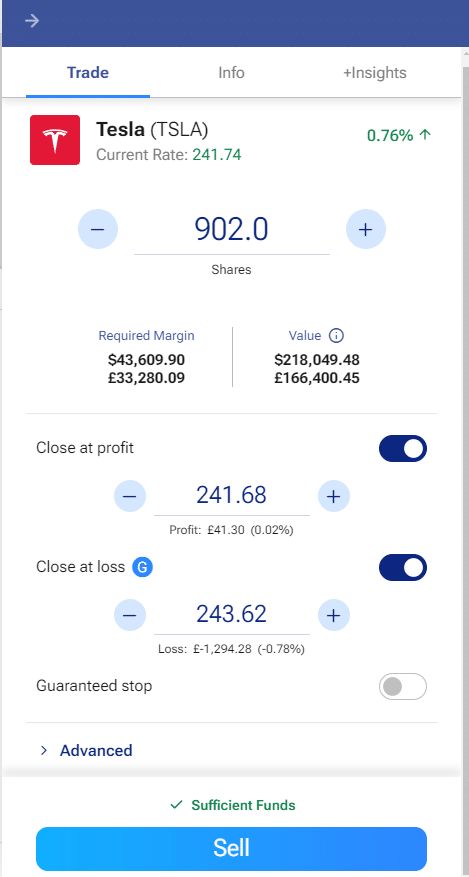
To initiate the short sale, select the Tesla shares in your trading platform, set the number of shares to short, and place a sell order. Once executed, you've officially shorted the stock. At this point, you're aiming for the price to fall so you can repurchase the shares at a lower price later.
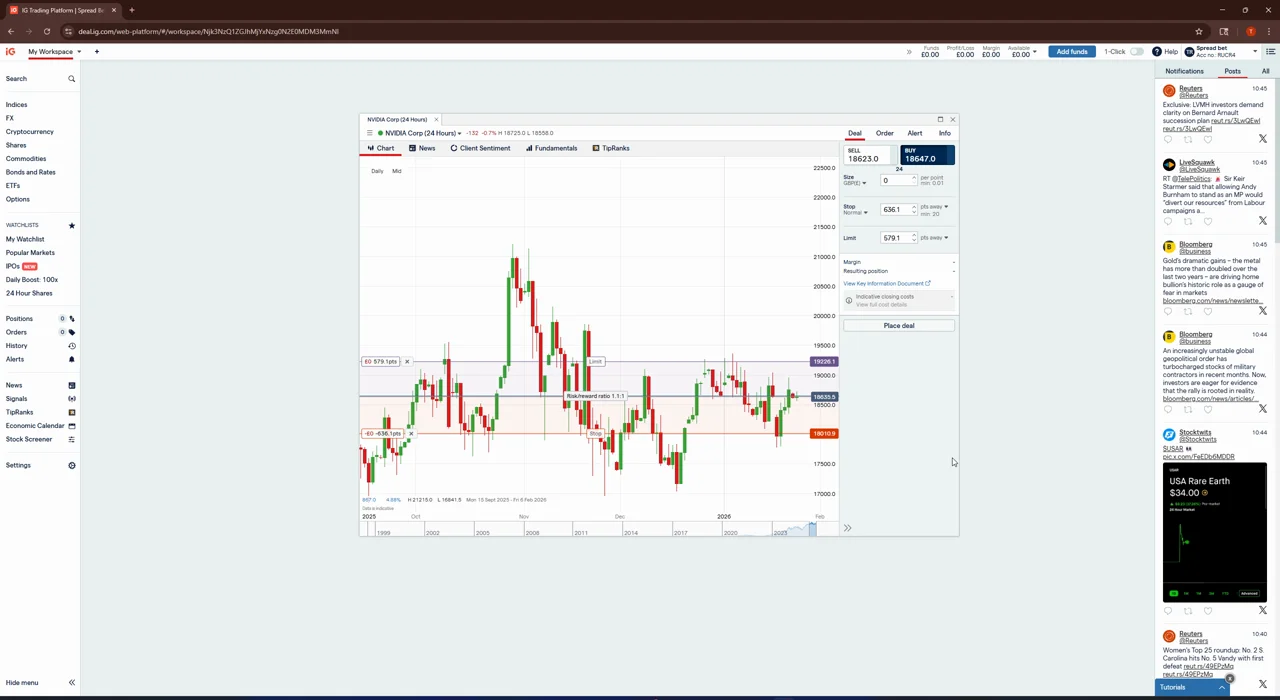
A useful tip: I've found that setting stop-loss orders when I open a position can help mitigate risk by automatically closing the trade if Tesla's price rises unexpectedly.
Step 5: Monitoring and Covering Your Position
The final step is to monitor your position and cover it by buying back the Tesla shares. Keeping an eye on Tesla's price movements and staying updated on market news is vital. When the stock reaches a lower price that meets your profit target, you'll place a "buy to cover" order, repurchasing the shares at the lower price and closing the position.
From experience, it's easy to get caught up in the excitement and hold out for a bigger drop, but I've learned that having a clear exit plan ensures you lock in profits and avoid potential losses. The same habit is tracked week by week in my first month day trading journal.
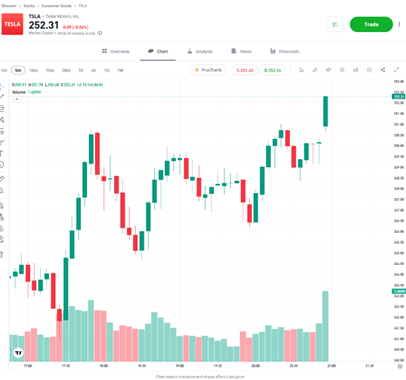
Each step is critical to the short-selling process and managing risk effectively, especially with a volatile stock like Tesla.
| Step | Action | Purpose |
|---|---|---|
| 1. Open a Margin Account | Set up an account for borrowing | Essential to start short selling |
| 2. Fund Account | Deposit funds | Meet margin requirements |
| 3. Borrow Shares | Locate Tesla shares to borrow | Acquire shares to sell short |
| 4. Sell Shares | Initiate the short sale | Sell at current price |
| 5. Buy Back | Repurchase shares at a lower price | Close the short position and make a profit |
What are the Risks of Short Selling Tesla?
Short-selling Tesla carries significant risks, and understanding these risks are crucial before entering a position. Here's a closer look at some of the major risks involved.
What is the Risk of Unlimited Loss?
When you short a stock, your potential losses can be theoretically unlimited. This is because, unlike buying shares, where the maximum loss is the initial investment, a short position can lead to far greater losses if the stock price rises significantly. If Tesla's price shoots up, you'll have to buy back the shares at this new, higher price to close the position. Since there's no cap on how high a stock can go, this creates an unlimited loss scenario.
I remember a time when I shorted a stock, expecting it to decline. Instead, an unexpected merger announcement sent the stock soaring, and I quickly found myself with a growing loss. With Tesla, a sudden positive announcement or product launch could create a similar situation, underscoring why managing risk is essential.
What Company-Specific Risks Does Tesla Present?
Tesla's stock is exceptionally volatile, driven by high trading volumes, strong market sentiment, and frequent media coverage. Tesla's CEO, Elon Musk, has also been known to make statements or announcements that can instantly impact the stock's price. For example, news about new technology, production updates, or even Musk's tweets can lead to sharp price movements, which makes shorting Tesla particularly risky.
I've noticed this firsthand when Musk made unexpected comments on social media about potential developments, causing massive spikes in the stock. Tesla's volatility, combined with these external factors, means that short sellers need to be constantly vigilant and prepared for the stock to move dramatically in either direction.
Understanding these risks is essential when short-selling, especially with a high-profile stock like Tesla. An effective risk management strategy can help mitigate potential losses, but short-selling always carries the potential for significant financial exposure.
What Are the Different Ways to Short Tesla?
If you're interested in shorting Tesla, there are several methods available, each with its unique pros, cons, and risk profiles. Here's an overview of some popular ways to short Tesla.
Can You Short Tesla with Traditional Short Selling?
Traditional short selling involves borrowing Tesla shares from a brokerage, selling them at the current market price, and repurchasing them later when the price has ideally dropped. This is the most direct method of shorting and provides a one-to-one exposure to Tesla's price movement.
- Direct Exposure: You gain direct exposure to Tesla's stock price, making it easier to predict profit and loss.
- Widely Accessible: Most brokerages support traditional short selling, so it's an easy option if you already have a brokerage account.
- Unlimited Risk: Since Tesla's price could rise indefinitely, losses can be theoretically unlimited.
- Borrow Charges: Short positions can incur an annualised borrow charge at the interbank borrow rate plus a 0.5% admin fee, applied daily. The rate varies by stock, can change while the position is open, and adds up the longer you hold.
I've used traditional short selling in the past for stocks I felt were overvalued. While it provides direct exposure, I quickly learned the importance of setting stop-loss orders to limit potential losses, as stocks can sometimes behave unpredictably, especially with high-profile companies like Tesla.
Using CFDs to Short Tesla
- No Need to Borrow Shares: You don't need to locate and borrow shares, making the process simpler.
- Typically Lower Fees: CFDs often have lower upfront costs compared to traditional shorting.
- Leverage Risk: CFDs are usually leveraged, which means you can control a larger position with a small amount of capital, increasing both potential profits and potential losses.
- Not Available in the U.S: CFDs are restricted in some countries, including the United States.
I've found CFDs convenient for short-term trades, especially with volatile stocks. However, leverage can be a double-edged sword, so if you're not prepared for sudden movements, losses can mount quickly.
Using Put Options to Hedge Against Tesla's Stock
A put option gives you the right, but not the obligation, to sell Tesla shares at a specific price (the strike price) before the option expires. If Tesla's stock price falls below the strike price, the option becomes profitable.
- Limited Loss Potential: Unlike traditional shorting, your loss is limited to the cost of the option premium.
- No Borrowing Needed: Since you don't need to borrow shares, there's no interest involved.
- Premium Costs: Buying put options involves paying a premium, which can be costly, especially for a volatile stock like Tesla.
- Expiration Risk: Options have an expiration date, meaning your position is time-bound. If Tesla's price doesn't fall as expected within that timeframe, the option could expire worthless.
Put options are a favourite of mine for limiting risk. I can place a calculated bet against Tesla without worrying about margin calls or sudden losses, making it a more flexible tool for bearish positions.
Are Inverse ETFs a Viable Option for Tesla?
Inverse ETFs are funds designed to move in the opposite direction of a particular index or sector. While they don't directly short Tesla, you can choose ETFs that track indices related to Tesla's sector. If Tesla declines and drags the sector down, the inverse ETF rises in value.
- Easy Access: You can trade ETFs like stocks, so they're simple to buy and sell.
- No Need to Manage Borrowed Shares: Inverse ETFs provide a way to profit from a decline without actively shorting.
- Non-Tesla Specific: Inverse ETFs don't track Tesla exclusively, so they may not reflect its price movements perfectly.
- Subject to Decay: Inverse ETFs often experience decay over time, meaning their performance can degrade, especially if held for extended periods.
I find inverse ETFs useful for indirect short exposure, particularly when I want to bet on a sector rather than a specific stock. However, it's essential to monitor these investments closely, as they're best suited for short-term positions.
| Method | Description | Pros | Cons |
|---|---|---|---|
| Traditional Short | Borrow and sell shares directly | Direct exposure, widely accessible | Unlimited risk, borrow charges accrue daily |
| CFDs | Trade contracts on price movement | No need to borrow, lower fees | Leverage can amplify losses |
| Put Options | Right to sell at a set price | Limited loss potential, no borrowing | Premium costs, expiration risk |
| Inverse ETFs | Opposite performance to index/sector | Easy to access, no need to manage trades | Non-Tesla-specific, subject to decay |
Which Method of Shorting Tesla is Right for You?
When deciding which method to use, consider your risk tolerance, experience, and the costs involved.
- Traditional Short Selling is ideal for those comfortable with direct exposure and willing to manage margin accounts.
- CFDs offer a simpler approach without borrowing, but leverage makes them riskier.
- Put Options are a safer choice for those wanting to limit risk, but they require an understanding of options trading.
- Inverse ETFs provide an indirect, easy-to-access option for those who prefer broader market exposure.
Each method suits different strategies and risk profiles, so choose based on what aligns best with your experience and goals. For instance, I've used put options when I wanted to limit my downside and CFDs when I was looking for a quick trade based on a short-term trend. Matching the right tool to your objectives makes all the difference in effective short selling.
Should You Short Tesla as a Spread Bet or a CFD?
Same direction, different wrappers. The spread bet stakes pounds per point of Tesla's dollar price, pays no commission, and any profit is free from capital gains tax for most UK residents under current rules. The CFD deals in share-sized contracts with a 0.10% commission per side, profits taxable above the CGT allowance, but losses can generally offset other gains, which matters if shorting is the risky sleeve of a wider portfolio. Short-term punt on a fall: the spread bet is simpler. Deliberate hedge against other holdings: the CFD's tax treatment can actually work in your favour. I compare the wrappers properly in spread betting vs CFDs.
If spread betting itself is new to you, my honest guide to spread betting in the UK covers the wrapper from scratch, and for the stock that teaches every shorting lesson at once, see how to short GameStop shares from the UK.
Conclusion: Is Shorting Tesla Right for You?
Shorting Tesla in 2026 can offer profit opportunities, but it comes with significant risks, including unlimited loss potential, margin calls, and high volatility. If you're considering shorting Tesla, ensure you fully understand the strategy and have a solid risk management plan in place. Consulting with a financial advisor can be invaluable, especially if you're new to short-selling or trading high-profile stocks. Ultimately, shorting Tesla requires careful planning, market knowledge, and a readiness for potential losses.
Discuss Shorting Tesla
Looked at shorting TSLA from the UK? Share your platform of choice, borrow fees, and risk-management setup. Our community earns Equity for quality contributions.
Discussion 0 comments
Be the first to start discussing this topic! Log in or create an account to share your thoughts.
Log In Create AccountFAQs
References

69% of retail investor accounts lose money when trading spread bets and CFDs with this provider.
No comments yet. Be the first to start discussing this topic!